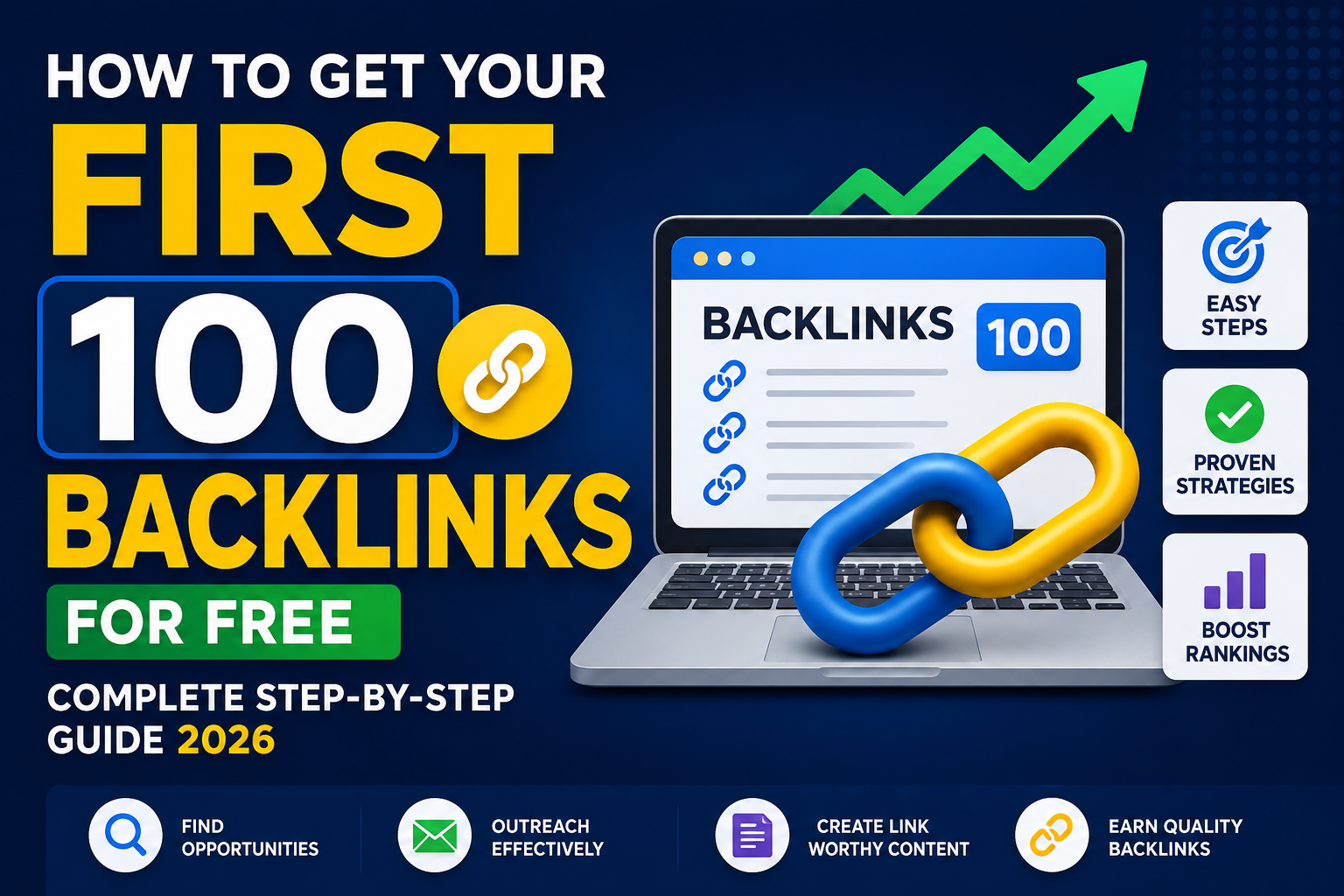

How to Get Your First 100 Backlinks for Free (Complete Step-by-Step Guide 2026)
Every new website faces the same problem: you publish great content, but Google does not seem to notice it. Organic traffic is flat. Rankings are low. And when you check your domain authority or domain rating, the number is barely above zero.
The most common reason? Not enough backlinks.
Backlinks — links from other websites pointing to yours — remain one of the strongest ranking signals Google uses. A site with quality backlinks consistently outranks an equally well-written site without them.
The frustrating part is that most link building guides assume you have a marketing budget. This one does not.
Here is a complete, honest guide to earning your first 100 backlinks — using methods that cost nothing except time and effort.
Why Backlinks Still Matter in 2026
Before diving into tactics, it helps to understand why backlinks matter so much.
When another website links to yours, Google treats it like a vote of confidence. Not all votes are equal — a link from an established, relevant website carries far more weight than a link from a low-quality directory. But the underlying principle has remained stable since Google launched: quality links from real websites improve your rankings.
This is why your DA (Domain Authority, tracked by Moz) and DR (Domain Rating, tracked by Ahrefs) are so closely tied to backlinks. Both metrics estimate your site’s authority based largely on the quantity and quality of sites linking to you.
For a full explanation of how these metrics work and what they mean for your site, read our guide on How to Improve DA and DR in 2026: Complete SEO Guide for Beginners.
The Mindset Shift That Changes Everything
Most people approach backlinks by thinking: “How do I get links?”
The better question is: “Why would another website link to mine?”
Websites link to content that is:
- Genuinely useful to their own readers
- More thorough or clearer than what already exists
- Original — data, research, tools, or perspectives they cannot provide themselves
- Relevant to their niche
When you create content with this filter in mind, links become a natural byproduct rather than something you have to beg for.
Method 1: Guest Posting — The Most Reliable Free Method
Guest posting means writing an article for another website’s blog in exchange for a link back to your site.
It is the single most reliable free backlink method available. Done correctly, one guest post on a relevant site can deliver more SEO value than dozens of low-quality directory links.
How to do it:
- Identify blogs in your niche that accept guest contributions
- Read their existing content carefully to understand their tone and audience
- Pitch a specific, original article idea — not a generic topic
- Write a genuinely useful article that serves their readers
- Include one contextually relevant link back to your own site within the content
Where to start: Finzaro360 is an active guest posting platform covering Finance, Crypto, AI Tools, SEO, and Online Earning. If your expertise falls in any of these areas, you can submit your guest post pitch directly through our Write For Us page.
What makes a good pitch:
- Address the editor by name if possible
- Mention one specific article on their site you found useful
- Propose a specific title and 3-4 bullet points of what you will cover
- Keep the pitch under 200 words
Outreach email template:
Subject: Guest Post Pitch: [Your Specific Title Idea]
Hi [Name],
I recently read your article on [specific topic] and found [specific point] genuinely useful.
I write about [your niche] and would love to contribute an article titled “[Your Proposed Title]” to your blog. It would cover [2-3 bullet points].
I am not offering recycled content — this would be written exclusively for your audience.
Would this be a fit? Happy to send a full draft if you are interested.
[Your name]
Method 2: Broken Link Building
Broken link building means finding dead links on other websites and offering your content as a replacement.
Why it works: Every website has pages that link out to external resources. Sometimes those external pages are deleted or moved, leaving a “404 Not Found” link. Website owners dislike broken links — they hurt user experience and SEO. You are offering them a solution.
How to do it:
- Find resource pages or articles in your niche (search: “your topic + resources” or “your topic + links”)
- Install the free Chrome extension Check My Links to identify broken links on those pages
- If a broken link points to a topic you have covered (or could cover), create the content
- Email the website owner: “I noticed the link to [dead URL] on your [page name] is broken. I just published a piece covering that same topic at [your URL]. You might find it a useful replacement.”
This works because you are doing the site owner a favor, not asking them for one.
Method 3: Skyscraper Technique
Coined by Brian Dean of Backlinko, the Skyscraper Technique means finding content that has already earned many backlinks, creating something significantly better, then reaching out to sites linking to the original.
How to do it:
- Find a well-linked article in your niche (use Ahrefs free version or check Moz’s free Link Explorer)
- Study it carefully — what is it missing? Where is it outdated? What questions does it not answer?
- Create a more comprehensive, more useful, more current version
- Find the sites linking to the original article
- Reach out: “I noticed you linked to [original article]. I just published an updated and more comprehensive version covering [what yours adds]. Worth a look if you want to update that reference.”
The key is that your version must genuinely be better — not just longer. Better means more useful to the reader.
Method 4: Create Genuinely Linkable Assets
Some content formats attract backlinks naturally because other writers and bloggers reference them as sources.
Linkable asset types that consistently earn backlinks:
- Original statistics and data — If you survey your audience or compile data from government/official sources, other writers will cite your article when they reference those numbers
- Comprehensive beginner guides — A thorough, well-structured “complete guide” on a topic becomes a go-to reference that gets cited
- Comparison articles — “X vs Y” content (like our Debt Snowball vs Debt Avalanche guide) gets linked when people write about either option
- Free tools and calculators — Embeddable tools attract massive organic backlinks over time
- Glossaries and definition pages — Journalists and bloggers frequently link to clear, authoritative definitions
When you publish content in any of these formats, do not just wait for links to appear. Actively promote the content to relevant bloggers and communities.
Method 5: HARO — Help a Reporter Out
HARO (now operating under the Connectively platform) connects journalists writing articles with expert sources. When a journalist quotes you, they typically link back to your site.
How it works:
- Sign up for free at the HARO platform
- Three times per day, you receive emails with journalist queries
- Filter for queries relevant to your expertise
- Respond quickly with a brief, quotable insight (2-4 sentences, not an essay)
- Include your name, title, and website URL in your response
Journalists write for major publications. A single placement can deliver a backlink from a very high authority domain.
Key to success: Speed matters. Respond within 1-2 hours of receiving the query. Keep your response focused and directly answering the question — journalists are busy and skim responses quickly.
Method 6: Resource Page Link Building
Many websites maintain “resources” or “useful links” pages pointing to helpful external content. These pages exist specifically to link out.
How to find them:
Search Google for:
your niche + "useful resources"your niche + "recommended links"your niche + "helpful websites"
When you find a resource page that would logically include your content, email the site owner with a brief, polite suggestion. Explain what your page covers and why it would be useful to their readers.
Conversion rates on this outreach are modest but consistent. Every yes is a free backlink from a page designed to give them.
Method 7: Reclaim Unlinked Brand Mentions
Sometimes people mention your website, brand name, or article title — but forget to actually link to you.
How to find these:
- Set up a free Google Alert for your brand name and key article titles
- Use the free version of Ahrefs or Mention.com to search for web mentions of your domain
- When you find a mention without a link, politely ask the author to add one
Email template:
“Hi [name], I noticed you referenced [your article/brand] in your piece on [topic] — thanks for the mention! Would you be able to add a link to [your URL]? It would help readers find the full resource. Either way, I appreciate the reference.”
Most authors are happy to add the link. It takes them 30 seconds and it costs you nothing.
Method 8: Niche Community Participation
Active participation in niche communities builds credibility and occasionally earns backlinks — but only if done authentically.
Platforms to focus on:
- Reddit — Answer questions in relevant subreddits. If your article genuinely helps, you can link to it. Spam gets removed; helpful answers stay.
- Quora — Write detailed answers to questions in your niche. Include a link to your article where it adds real value.
- Relevant Facebook Groups — Share genuinely helpful content, not just self-promotion.
- Niche forums — Industry-specific forums often allow signature links or bio links.
The rule in all of these: give value first. The links are a side effect of being genuinely helpful, not the purpose of participating.
Method 9: Social Proof and Testimonials
If you use a product, service, or tool in your niche, reach out to the company and offer a genuine testimonial. Many companies feature testimonials on their website with a link to the customer’s site.
This works best when:
- You are a legitimate customer with an honest experience to share
- The company is in a related but not competing niche
- The company website has reasonable domain authority
One genuine testimonial can become a permanent backlink on a business website.
Method 10: Podcast Guest Appearances
Thousands of podcasts are constantly looking for guests with relevant expertise. Most podcasts publish show notes that include a link to the guest’s website.
How to find opportunities:
- Search “[your niche] podcast” and look for shows that feature guests
- Use the free directory at Podmatch.com or PodcastGuests.com to connect with podcast hosts
- Email hosts with a brief, specific pitch explaining what you could discuss and why it would interest their listeners
Podcast backlinks are often from domains with solid authority and are permanent — as long as the podcast episode stays live.
Method 11: Internal Linking (Often Overlooked)
Internal links are links between pages on your own website. They are not backlinks in the traditional sense, but they are critical for SEO because:
- They help Google discover and crawl all your pages
- They distribute “link equity” from your high-authority pages to newer ones
- They keep readers on your site longer, reducing bounce rate
Make it a habit: every time you publish a new article, go back to three or four existing articles and add relevant internal links pointing to the new piece. This alone can meaningfully improve rankings for newer content.
For a broader SEO foundation, see our guide on How to Use Google Search Console in 2026: Complete Beginner’s Guide.
Method 12: Competitor Backlink Analysis
If a competitor is ranking ahead of you, look at who is linking to their content. Those same sites are likely open to linking to you if you have comparable or better content.
Free tools for this:
- Ahrefs Backlink Checker (free version, limited results) — Shows the top backlinks to any URL
- Moz Link Explorer (free with account) — Shows backlink data for any domain
- Ubersuggest (free tier) — Backlink data plus keyword insights
Enter your competitor’s URL, export their backlink sources, and work through the list systematically using the methods above (guest post pitch, broken link replacement, resource page submission, etc.).
Method 13: Free Business Directories and Listings
Some directories are low-quality and worth avoiding. But legitimate business directories, especially niche-specific ones, do provide real backlinks.
Directories worth submitting to:
- Google Business Profile — Free listing that also helps local SEO
- Bing Places — Free, often overlooked, legitimate backlink
- Crunchbase — Useful if your site has any business angle
- AllTop — Niche blog aggregator
- Industry-specific directories — Search “[your niche] + directory” to find legitimate ones
Avoid bulk directory submission services that promise hundreds of links for a small fee. These typically generate links from low-quality sites that can actually harm your rankings.
Method 14: Republish on Medium and LinkedIn Articles
Medium and LinkedIn both allow you to republish content from your website (with proper canonical tags set to your original URL to avoid duplicate content issues).
These platforms have extremely high domain authority. A post on Medium or LinkedIn that links back to your original article is a quality backlink — plus additional traffic exposure.
How to do it correctly:
- Publish the article on your site first
- Wait for Google to index the original
- Republish on Medium or LinkedIn with a note at the bottom: “Originally published at [your URL]”
- In Medium, add a canonical link in the settings pointing to your original article
This protects you from duplicate content issues while earning a high-authority backlink.
Method 15: Collaborate with Other Bloggers in Your Niche
Reach out to bloggers at a similar level in your niche — not your direct competitors, but complementary topics. Propose a collaboration:
- A joint article that both sites publish with links to each other
- A round-up post where several bloggers contribute a tip and each gets a link
- Quoting them in your article (many bloggers share content where they are featured, bringing you additional exposure)
These relationships build slowly but compound over time, much like compound interest. For more on why compounding matters in both finance and link building, see our article on Compound Interest Calculator: How It Works & Why It Changes Everything.
Tracking Your Backlink Progress
Once you are actively building backlinks, you need a way to track progress.
Free tools for monitoring backlinks:
- Google Search Console — Go to Links > External Links to see who is linking to you. Free and directly from Google.
- Ahrefs Backlink Checker — Free version shows limited data but is useful for spot checks
- Moz Link Explorer — Free with an account, shows your DA score and inbound links
Check your backlink profile monthly. Look for new links, note which content is attracting links naturally, and flag any suspicious links (which you can disavow via Google Search Console if needed).
Backlink Building vs. DA/DR — What to Expect
One important reality: backlink building takes time to show results.
A new backlink may take several weeks to be discovered by Google’s crawlers. Your DA and DR scores update on different schedules depending on the tool — Ahrefs updates DR roughly every few weeks, while Moz updates DA monthly.
Do not judge a link building campaign on a week of results. A consistent three-to-six month effort is where you start to see meaningful movement in both rankings and authority scores.
For a deeper dive into how DA and DR are calculated and how to improve them strategically, see our guide on How to Increase Domain Authority (DA) and Domain Rating (DR) Fast in 2026.
Quick Reference: 100 Backlinks Roadmap
| Method | Estimated Effort | Backlinks Possible |
|---|---|---|
| Guest posting | High | 10-20 quality links |
| Broken link building | Medium | 5-15 links |
| Skyscraper outreach | High | 5-20 links |
| HARO responses | Medium | 3-10 high-authority links |
| Resource page submissions | Low-Medium | 5-10 links |
| Unlinked mention reclaim | Low | 3-10 links |
| Community participation | Medium | Ongoing, gradual |
| Podcast guest appearances | Medium | 5-15 links |
| Testimonials | Low | 3-8 links |
| Competitor backlink analysis | Medium | Varies |
| Business directory listings | Low | 5-10 links |
| Medium/LinkedIn republishing | Low | 2-5 high-DA links |
| Blogger collaborations | Medium | 5-10 links |
Estimates are general guidance. Results depend on niche, content quality, and outreach consistency.
People Also Ask
Q: How long does it take to get 100 backlinks? With consistent effort across multiple methods, most blogs can realistically reach 100 backlinks within 3-6 months. High-quality backlinks from guest posting and HARO take longer but are more valuable than volume-based approaches.
Q: Do free backlinks actually improve rankings? Yes — quality matters more than cost. A free backlink from a relevant, authoritative website is far more valuable than a paid link from a low-quality directory. The methods in this guide focus on earning quality links, not just volume.
Q: What is a good DA or DR for a new website? Most new websites start at DA 1 or DR 1. Reaching DA/DR 20-30 within the first year through consistent link building is a realistic and meaningful milestone. Scores above 50 are generally considered strong.
Q: Is buying backlinks worth it? Buying backlinks violates Google’s guidelines and risks a manual penalty. The methods in this guide focus entirely on earning links legitimately, which is both safer and more sustainable.
Q: What types of content earn the most backlinks naturally? Original data, comprehensive guides, comparison articles, free tools, and definitions consistently attract the most organic backlinks. These are the formats other writers find most useful to reference.
Q: How do I know if a backlink is hurting my site? Signs of problematic backlinks include links from unrelated foreign language spam sites, links from sites with no real content, or sudden drops in rankings. You can disavow suspicious links through Google Search Console.
Q: Is internal linking important for SEO? Yes. While internal links are not traditional backlinks, they help Google discover your content, distribute page authority across your site, and improve user navigation — all of which support better rankings.
Q: What is anchor text and does it matter? Anchor text is the visible, clickable text in a hyperlink. Over-optimized anchor text (always using exact match keywords) can look unnatural. Natural, varied anchor text — including brand names, partial keywords, and generic phrases — is the best approach.
Summary
| Strategy | Cost | Difficulty | Quality |
|---|---|---|---|
| Guest posting | Free | Medium-High | Very High |
| HARO | Free | Medium | Very High |
| Broken link building | Free | Medium | High |
| Skyscraper technique | Free | High | High |
| Unlinked mention reclaim | Free | Low | Medium-High |
| Resource page building | Free | Low-Medium | Medium |
| Podcast appearances | Free | Medium | High |
| Community participation | Free | Low-Medium | Variable |
⚠️ SEO Disclaimer: SEO results vary based on website age, niche competition, content quality, and many other factors outside any individual’s control. The strategies described in this article are legitimate, Google-guideline-compliant methods used by professional SEO practitioners. However, no specific ranking improvements or traffic increases can be guaranteed. Finzaro360.com does not provide SEO services and is not responsible for individual results. Always consult current Google Search documentation for the most up-to-date guidelines.
Conclusion
Getting your first 100 backlinks does not require a budget. It requires consistency, patience, and a genuine commitment to creating content worth linking to.
Start with one or two methods. Guest posting and HARO are the highest-value starting points if you want quality over quantity. Broken link building and resource page outreach work well for volume.
Most importantly: produce content that earns links because it deserves them — not content you have to beg for links to promote.
100 backlinks is a meaningful milestone. Beyond it, the same methods scale. Keep building, keep creating, and your domain authority will follow.
What to Read Next on Finzaro360
- How to Improve DA and DR in 2026: Complete SEO Guide
- How to Increase Domain Authority (DA) and Domain Rating (DR) Fast in 2026
- How to Use Google Search Console in 2026: Complete Beginner’s Guide
- WordPress vs Wix vs Squarespace 2026: Which Is Best for Beginners?
- Best Guest Posting Platform in 2026 – Why Finzaro360 Leads the Market
Publish a Guest Post on Finzaro360
Want a quality backlink from a growing finance, crypto, and digital marketing blog? We accept expert guest contributions and provide dofollow links within the content. Visit our Write For Us page to see topics we accept and how to submit.
Published on Finzaro360.com | Category: SEO & Blogging