
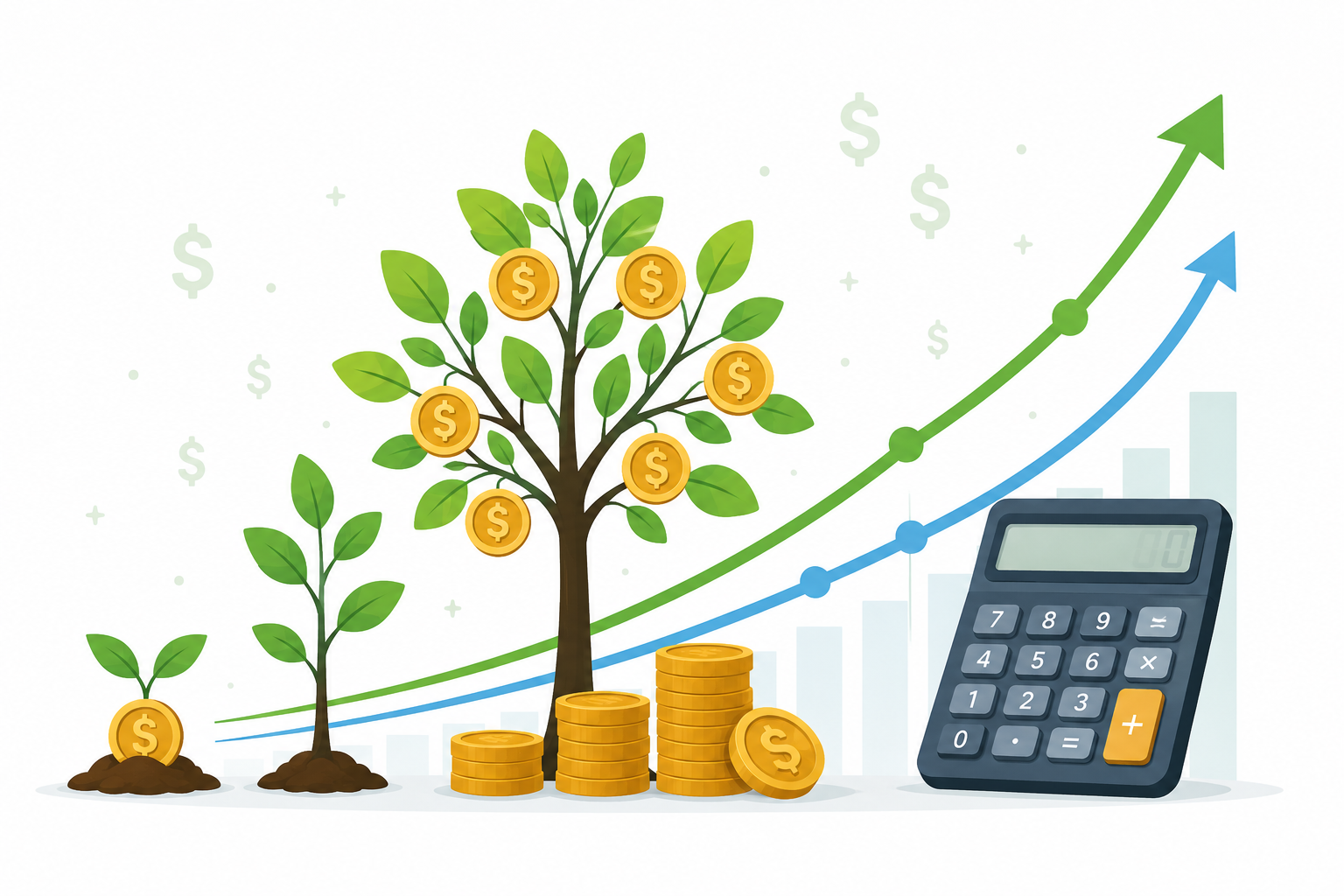

Compound Interest Calculator: How It Works & Why It Changes Everything About Your Money
If there is one financial concept that separates people who build wealth from people who always feel behind, it is compound interest.
Warren Buffett called it his biggest advantage. Albert Einstein — though this quote is likely misattributed — was said to have called compound interest the “eighth wonder of the world.” Whether or not Einstein actually said it, the idea holds true: compound interest is one of the most powerful forces in personal finance.
This guide will explain exactly what compound interest is, how to calculate it yourself, how to use a compound interest calculator, and most importantly — how you can use it to build real wealth over time.
No complicated math degree required.
What Is Compound Interest? (Simple Explanation)
Compound interest is interest earned on both your original money AND the interest you have already earned.
Here is the simplest way to understand it:
- Simple interest: You earn interest only on your original deposit.
- Compound interest: You earn interest on your original deposit PLUS all the interest that has already been added.
Think of it like a snowball rolling down a hill. At first it is small. But as it rolls, it picks up more snow. The bigger it gets, the faster it grows. Eventually the snowball is enormous — not because you kept adding snow by hand, but because the growth became self-generating.
That is exactly how compound interest works with money.
Simple Interest vs Compound Interest: A Clear Comparison
Let us use a real example so this becomes concrete.
Scenario: You invest $1,000 at 10% annual interest for 5 years.
| Year | Simple Interest Balance | Compound Interest Balance |
|---|---|---|
| Year 1 | $1,100 | $1,100 |
| Year 2 | $1,200 | $1,210 |
| Year 3 | $1,300 | $1,331 |
| Year 4 | $1,400 | $1,464 |
| Year 5 | $1,500 | $1,611 |
After 5 years, simple interest gives you $1,500. Compound interest gives you $1,611. That is a $111 difference.
Now extend that to 30 years:
- Simple interest: $4,000
- Compound interest: $17,449
Same starting amount. Same interest rate. The difference is $13,449 — created purely by compound growth.
This is why starting to save and invest early matters so much. Time is the fuel that makes compound interest explode.
The Compound Interest Formula
If you want to calculate compound interest yourself — without a calculator — here is the formula:
A = P (1 + r/n)^(nt)
Where:
- A = Final amount (what you end up with)
- P = Principal (your starting amount)
- r = Annual interest rate (in decimal form — so 8% = 0.08)
- n = Number of times interest compounds per year
- t = Time in years
Example Calculation
Let us say you invest $5,000 at 7% annual interest, compounded monthly, for 10 years.
- P = $5,000
- r = 0.07
- n = 12 (monthly compounding)
- t = 10
A = 5000 × (1 + 0.07/12)^(12×10) A = 5000 × (1.005833)^120 A = 5000 × 2.0097 A = $10,048.50
So $5,000 grows to over $10,000 in 10 years — without you adding a single extra dollar.
How Compounding Frequency Affects Your Money
Compound interest can compound at different frequencies:
- Annually — once per year
- Semi-annually — twice per year
- Quarterly — 4 times per year
- Monthly — 12 times per year
- Daily — 365 times per year
More frequent compounding means slightly faster growth. Here is the difference on $10,000 at 6% for 20 years:
| Compounding Frequency | Final Balance |
|---|---|
| Annually | $32,071 |
| Semi-annually | $32,620 |
| Quarterly | $32,907 |
| Monthly | $33,102 |
| Daily | $33,198 |
As you can see, daily vs annual compounding makes a difference — but the frequency matters less than the interest rate and the time you stay invested.
How to Use a Compound Interest Calculator
A compound interest calculator does all the math for you. You just enter a few numbers and it shows you exactly how your money grows over time.
Here is what most calculators ask for:
- Starting amount (Principal) — How much you are investing today
- Annual interest rate — The expected yearly return
- Compounding frequency — Monthly, quarterly, annually
- Time period — How many years you will leave the money invested
- Monthly contributions — Optional: how much you add each month
Recommended Free Compound Interest Calculators
These are legitimate, well-known tools you can use right now:
- Investor.gov Compound Interest Calculator (U.S. Securities and Exchange Commission) — Free, trustworthy, no sign-up needed. Visit: investor.gov
- NerdWallet Compound Interest Calculator — Clean interface, shows yearly breakdown
- Bankrate Compound Interest Calculator — Includes monthly contribution options
Best Investment Apps 2026 when mentioning where to find accounts that offer compound growth.
The Real Power: Starting Early vs Starting Late
This is where compound interest becomes truly life-changing.
Let us compare two people — no invented numbers, just the math of compounding:
Person A starts investing at age 25. They invest $200 per month at an assumed 7% annual return and stop at age 35. They never add another dollar after that.
Person B starts at age 35 and invests the same $200 per month at 7% all the way until age 65.
- Person A invests for 10 years (total out of pocket: $24,000)
- Person B invests for 30 years (total out of pocket: $72,000)
By age 65, Person A — who invested less total money — typically ends up with more because compound interest had more time to work.
The lesson: Time in the market matters more than timing the market or even the amount you invest.
The best time to start is as early as possible. The second best time is today.
Where Can You Earn Compound Interest?
Here are real places where compound interest works for you:
1. High-Yield Savings Accounts
Many online banks offer savings accounts with higher interest rates than traditional banks. These compound daily or monthly.
Look for accounts with no fees and FDIC insurance (in the US) or equivalent government protection in your country.
2. Index Funds and ETFs
When you invest in index funds or ETFs through a brokerage account, your dividends can be reinvested automatically. This is compound growth in action.
3. Retirement Accounts
Accounts like a 401(k) or IRA in the US, or equivalent pension accounts in other countries, allow your investments to compound tax-deferred or tax-free. This accelerates growth significantly.
4. Certificates of Deposit (CDs)
Fixed-term deposits that pay a guaranteed interest rate. Lower risk, predictable compounding.
5. Dividend-Paying Stocks
When dividends are reinvested, each reinvestment buys more shares, which then pay more dividends — a compounding loop.
The Dark Side: Compound Interest Works Against You Too
Compound interest is a double-edged sword.
When you carry credit card debt, the credit card company earns compound interest — from you.
Example: A $3,000 credit card balance at 20% annual interest, with only minimum payments made, can take years to pay off and cost you several times the original balance in interest alone.
This is why eliminating high-interest debt is one of the most important financial moves you can make. Every dollar of debt you pay off is a guaranteed return equal to that debt’s interest rate.
Internal Link Suggestion: Connect this section to your article on How to Get Out of Debt Fast in 2026 and Debt Snowball vs Debt Avalanche.
Compound Interest Quick Reference Table
| Starting Amount | Rate | Years | Final Amount (Monthly Compounding) |
|---|---|---|---|
| $1,000 | 6% | 10 | ~$1,819 |
| $1,000 | 6% | 20 | ~$3,310 |
| $1,000 | 6% | 30 | ~$6,023 |
| $5,000 | 7% | 10 | ~$10,048 |
| $5,000 | 7% | 20 | ~$20,190 |
| $5,000 | 7% | 30 | ~$40,567 |
| $10,000 | 8% | 20 | ~$49,268 |
| $10,000 | 8% | 30 | ~$109,357 |
Note: These figures use standard compound interest formula with monthly compounding. They are for educational illustration and do not account for taxes, fees, or market fluctuations.
Practical Steps to Start Using Compound Interest Today
You do not need a lot of money to get started. Here is what actually matters:
Step 1: Start with whatever you have. Even $50 or $100 per month compounds over time. Do not wait until you have the “perfect” amount.
Step 2: Open an account that earns interest or investment returns. A high-yield savings account is the safest starting point. For longer-term goals, consider a brokerage account with index funds.
Step 3: Set contributions to automatic. The biggest enemy of compound interest is inconsistency. Automate your contributions so the process happens without relying on willpower.
Step 4: Reinvest your earnings. Make sure dividends and interest are set to reinvest automatically, not withdrawn.
Step 5: Leave it alone. Compound interest rewards patience. The biggest mistake people make is withdrawing early or panic-selling during market downturns.
Internal Link Suggestion: Link to Build Wealth From Scratch: Saving, Investing & Smart Money Habits and How Saving Money Today Can Help You Achieve Financial Freedom Faster.
The Rule of 72: A Simple Shortcut
Want to quickly estimate how long it will take to double your money?
Divide 72 by your annual interest rate.
- At 6% interest → 72 ÷ 6 = 12 years to double
- At 8% interest → 72 ÷ 8 = 9 years to double
- At 10% interest → 72 ÷ 10 = 7.2 years to double
- At 12% interest → 72 ÷ 12 = 6 years to double
This is called the Rule of 72, and it is one of the most useful shortcuts in personal finance.
People Also Ask
Q: What is compound interest in simple terms? Compound interest is interest earned on both your original money and the interest it has already earned. Over time, this creates exponential growth — your money earns interest on interest, which causes it to grow faster and faster.
Q: How often does compound interest compound? It depends on the account or investment. Savings accounts typically compound daily or monthly. Investments like index funds grow through reinvested returns, which effectively compound continuously.
Q: Is compound interest good or bad? Compound interest is good when it is working for you (savings, investments). It is bad when it is working against you (credit card debt, loans). The key is to earn it, not pay it.
Q: What is the best account for compound interest? High-yield savings accounts, index funds, and retirement accounts (like a Roth IRA) are popular options depending on your time horizon and risk tolerance.
Q: How much money do I need to start earning compound interest? You can start with any amount. Many savings accounts have no minimum balance. Many investment apps allow you to start with $1 or $5. What matters more than the starting amount is starting early and staying consistent.
Q: What is the Rule of 72? The Rule of 72 is a simple formula: divide 72 by your annual interest rate to estimate how many years it will take to double your money. For example, at 6% interest, your money doubles in approximately 12 years.
Q: Does compound interest make you rich? Compound interest alone does not make anyone rich overnight. But over decades, consistent investing with compound growth has historically created significant wealth for ordinary people who started early and stayed patient.
Summary
| Concept | Key Point |
|---|---|
| What it is | Interest on interest — exponential growth |
| Formula | A = P(1 + r/n)^(nt) |
| Best frequency | More frequent = slightly faster growth |
| When to start | As early as possible |
| Where to use it | Savings accounts, index funds, retirement accounts |
| Danger zone | Credit card debt — it compounds against you |
| Quick estimate | Use the Rule of 72 |
⚠️ Financial Disclaimer: This article is for educational and informational purposes only. The examples and figures shown are based on mathematical formulas and are not guarantees of investment returns. Actual investment returns vary and are not guaranteed. Past performance does not predict future results. Please consult a qualified financial advisor before making any investment or financial decision. Finzaro360.com does not provide personalized financial advice.
Conclusion
Compound interest is not a get-rich-quick trick. It is a get-rich-slowly-but-surely strategy that has worked for generations of wealth builders.
The formula is simple: start early, stay consistent, reinvest your earnings, and leave the money alone.
The compound interest calculator tools linked in this article will show you exactly what your money can become. Use them. Plug in your numbers. Let the math motivate you.
The best financial decision you can make today is to put compound interest to work — on your side.
Ready to take the next step?
- Read: How Saving Money Today Can Help You Achieve Financial Freedom Faster
- Read: Best Investment Apps 2026 — Where to Start Investing
- Read: Build Wealth From Scratch: Saving, Investing & Smart Money Habits
- Read: The 50/30/20 Budget Rule Explained for Beginners
Published on Finzaro360.com | Category: Finance | Tags: compound interest, personal finance, wealth building, savings, investment basics