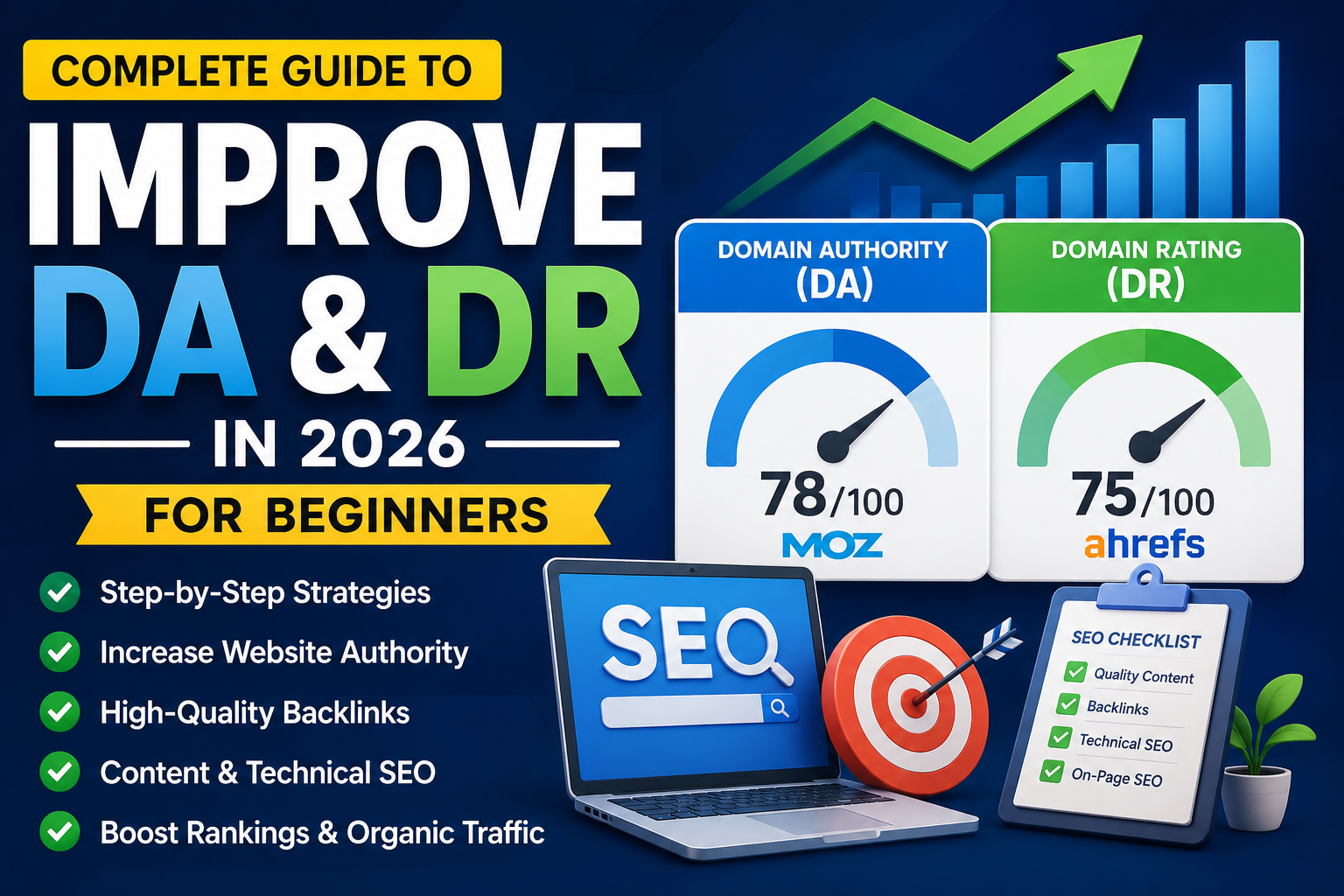
How to Improve DA and DR in 2026: Complete SEO Guide for Beginners
How to Improve DA and DR in 2026: Complete SEO Guide for Beginners
If you’re new to SEO and keep hearing terms like “DA,” “DR,” and “domain authority” thrown around, you might feel like everyone else knows something you don’t. I felt the same way when I started. But here’s the truth — improving your DA and DR isn’t complicated. It just requires understanding what these metrics actually mean and following a clear, consistent strategy. This guide covers everything you need to know, from scratch.
Understanding DA and DR: What’s the Difference?
Many beginners use DA and DR interchangeably, but they’re actually from two different tools and measure slightly different things.
Domain Authority (DA) is a metric created by Moz. It scores your website from 1 to 100 based on your backlink profile and overall SEO health. Higher DA generally means a better chance of ranking on Google.
Domain Rating (DR) is Ahrefs’ equivalent metric. DR focuses specifically on the strength and quality of your website’s incoming backlinks — how many referring domains link to you and how authoritative those domains are.
Both scores matter because many website owners, SEO agencies, and guest posting platforms use these numbers to judge whether a site is worth linking to or partnering with. The higher your DA and DR, the more opportunities open up for you.
Why Your DA and DR Are Low (And That’s Okay)
Every single website starts at DA 1 / DR 0. Even the biggest sites in the world started there. Your score is low right now because:
- Your site is new and hasn’t earned enough backlinks yet
- You may not have enough indexed content
- You may have technical issues that limit crawlability
- You haven’t been actively building links
All of these are completely fixable. Let’s go through how.
Phase 1: Fix Your Foundation (Technical SEO)
Before you do anything else, make sure your website is technically healthy. You can build thousands of backlinks, but if Google can’t properly crawl your site, your DA and DR won’t reflect your real effort.
Must-Do Technical Fixes for Beginners
- Install an SSL certificate — Your site must be on HTTPS, not HTTP
- Submit a sitemap — Go to Google Search Console and submit your XML sitemap
- Fix crawl errors — Check Google Search Console for 404 errors and broken pages
- Improve page speed — Use Google PageSpeed Insights to identify and fix speed issues
- Make it mobile-friendly — Most Google traffic is mobile; your site needs to work perfectly on phones
These are free to fix using tools like Google Search Console, PageSpeed Insights, and Screaming Frog’s free version. Don’t skip this phase — it’s the foundation everything else is built on.
Phase 2: Build Quality Content
Google rewards websites that consistently publish helpful, well-written content. Content is what attracts backlinks naturally, keeps visitors on your site longer, and builds your topical authority over time.
Content Tips for Beginners
- Write articles that are at least 1,200-1,500 words for competitive topics
- Use your target keyword in the title, first paragraph, and at least one H2 heading
- Answer the question fully — don’t just scratch the surface
- Add real examples, data, or personal experience to make content trustworthy
- Update old articles every 6 months to keep them fresh
If you need inspiration on what good niche content looks like, browse through Finzaro360’s AI tools for productivity section — it’s a great example of how to cover a topic comprehensively for a specific audience.
Phase 3: Start Building Backlinks
This is the phase that directly moves your DA and DR numbers. Backlinks are the most important factor in both metrics, so this is where you need to put consistent effort.
Method 1: Guest Posting
Guest posting is the most reliable, white-hat way to earn quality backlinks as a beginner. You write an article for another website, and in return, you get a contextual do-follow link back to your site.
The key is to target websites that are relevant to your niche. A backlink from a finance website to a finance blog is worth much more than a backlink from a random tech site. That’s why submitting through Finzaro360’s Guest Post program is a smart move for anyone in finance, crypto, AI, or SEO niches — the relevance factor is already built in.
Method 2: Resource Page Outreach
Many websites maintain “useful resources” pages in their niche. Find these pages using Google searches like “your topic + useful links” or “your topic + resources.” Then email the site owner and suggest your content as an addition. This takes effort but regularly earns quality, editorial backlinks.
Method 3: Broken Link Building
Find broken outbound links on websites in your niche (use the free Check My Links Chrome extension). Then create or suggest content that replaces the broken link. Email the webmaster letting them know about the broken link and offer your content as a replacement. Most will be grateful and update the link.
Phase 4: Smart Internal Linking
Internal linking is often ignored by beginners but it’s incredibly powerful. When you link from one page on your site to another, you’re passing authority and helping Google understand your site’s structure.
For every new article you publish, go back to 2-3 older articles and add internal links pointing to the new one. This helps Google discover the new page faster and boosts its chances of ranking.
For example, if you have articles about both SEO and online earning, linking from your SEO content to your online earning guides creates a content ecosystem that Google rewards with better visibility for both pages.
Phase 5: Track Your Progress
Check your DA using Moz’s free DA checker. Check your DR using Ahrefs’ free website authority checker. Do this once a month — not every day, because these metrics update slowly. Also track your backlinks using Google Search Console (free) to see who’s linking to you and which new backlinks have been picked up.
Realistic Expectations for Beginners
Here’s an honest timeline so you know what to expect:
- Month 1-2: Fix technical issues, publish 4-6 articles, earn first 5-10 backlinks
- Month 3-4: DA/DR may start appearing (5-10 range) as Moz/Ahrefs index your backlinks
- Month 6: With consistent guest posting, you can realistically reach DA 15-20, DR 10-15
- Month 12: A dedicated beginner can reach DA 25-35, DR 20-30 with 2-4 backlinks per month
Common Beginner Mistakes to Avoid
- Buying cheap backlinks — These will hurt your site, not help it
- Ignoring relevance — A backlink from a cooking blog to an SEO website has almost zero value
- Obsessing over metrics daily — DA and DR update slowly; check monthly, not daily
- Skipping technical SEO — No backlinks will help a broken, slow website
- Giving up too early — Most beginners quit at month 2-3, right before results start showing
Conclusion
Improving your DA and DR as a beginner is absolutely achievable. Start with technical SEO, build quality content, earn backlinks through guest posting and outreach, and use internal linking to maximize every backlink you earn. Stay consistent for 12 months and you’ll be amazed at how far your site has come.
Your first step? Get your first quality backlink from a niche-relevant site. Submit a guest post through the Finzaro360 Guest Post page today and start moving those numbers.
🔗 Backlink Strategy for This Article
Best Backlink Sources
- Beginner SEO blogs and tutorials (DA 20-40)
- WordPress and blogging resource websites
- Digital marketing newsletters and publications
- Finance and crypto niche blogs accepting contributors
Guest Posting Ideas
- “My DA Went From 0 to 20 in 8 Months — Here’s How”
- “5 Backlink Mistakes Beginners Make (And How to Avoid Them)”
- “The Beginner’s First 90 Days of SEO: A Real Story”
Outreach Strategy
- Target smaller blogs (DA 15-30) for higher acceptance rates
- Personalize every pitch email — no copy-paste templates
- Offer to write 1,500+ words with original research or data
- Follow up exactly once, 7 days after initial pitch
Social Sharing Platforms
- LinkedIn — great for SEO beginner content
- Facebook Groups for bloggers and SEO beginners
- Reddit: r/SEO, r/juststart, r/blogging
- Telegram SEO channels and communities
