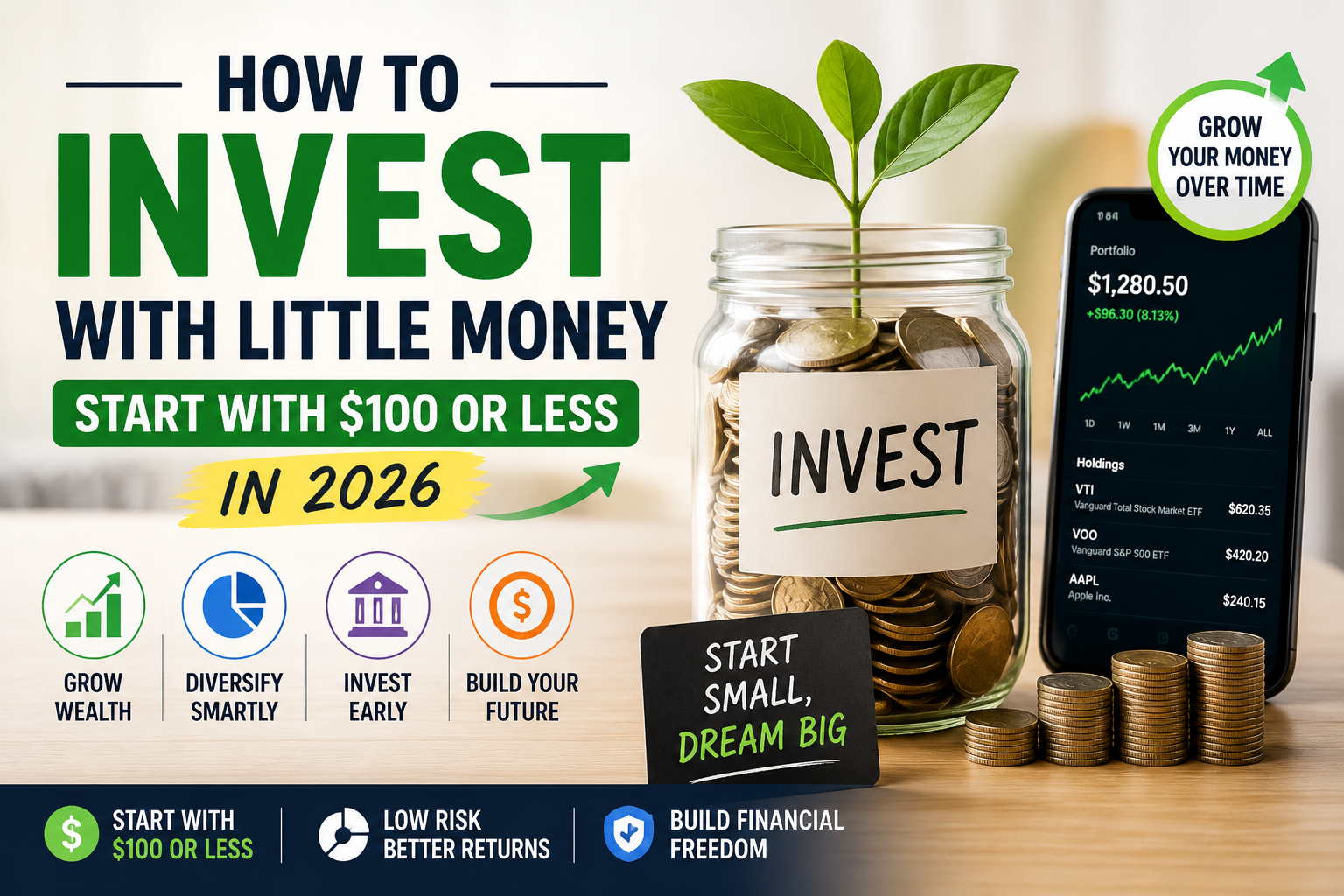

How to Invest With Little Money: Start With $100 or Less in 2026
One of the most common reasons people give for not investing is that they do not have enough money to start.
“I will invest when I have more saved.” “I need at least a few thousand dollars before it is worth it.” “Investing is for people who are already wealthy.”
These are understandable thoughts — but they are not accurate. And they cost people years of compound growth.
The reality in 2026 is that the barriers to investing have never been lower. You can start with $1, $10, or $100 and access the same investment vehicles that wealthy investors use. The amount you start with matters far less than the habit of starting at all.
This guide will show you exactly how to invest with little money, which options make the most sense at different starting amounts, and how to build a consistent investing habit regardless of your income level.
Why Starting Small Still Works
Before the tactics, it helps to understand why small investments are worth making.
The answer is compounding. When investment returns are reinvested, they generate their own returns. Over time, this creates exponential growth — and the earlier you start, the more powerful the effect.
Example: $50 invested per month from age 25 to age 65, at a hypothetical 7% average annual return, grows to a significant sum — far more than the $24,000 actually contributed — purely through compound growth over time.
The amount invested each month matters. But the time invested matters more. Starting with $50 today beats starting with $500 five years from now.
For a full explanation of how compounding works, see: Compound Interest Calculator: How It Works & Why It Changes Everything
Step 1: Build a Small Emergency Fund First
Before investing any money, you need a small financial cushion.
If you invest every spare dollar and then face an unexpected expense — a medical bill, car repair, job loss — you may be forced to sell your investments at a bad time, potentially at a loss.
A starter emergency fund of $500–$1,000 in a savings account gives you a buffer that prevents this. It does not need to be fully funded before you start investing, but having some cushion is essential.
For a complete guide on building your emergency fund: How to Build an Emergency Fund in 2026
Step 2: Eliminate High-Interest Debt First
If you are carrying credit card debt at 18–25% interest, paying that off before investing is almost always the mathematically better decision.
Here is why: if your debt costs 20% per year in interest, paying it off gives you a guaranteed 20% return — better than almost any investment available.
Once high-interest debt is eliminated, redirect those payments into investing.
For debt payoff strategies: Debt Snowball vs Debt Avalanche: Which Method Works Best?
Where to Invest With Little Money — Your Options
Option 1: Index Fund ETFs (Best Starting Point for Most People)
Index ETFs — funds that track broad market indexes like the S&P 500 — can be purchased for the price of one share, and many brokerages now offer fractional shares, meaning you can invest any dollar amount.
Why they suit small investors:
- No minimum investment on many platforms
- Instant diversification across hundreds of companies
- Very low fees (expense ratios often 0.03%–0.20%)
- No expertise required
For a full explanation of how index funds work and which platforms offer them: Index Funds for Beginners: The Complete Guide
Option 2: Micro-Investing Apps
Micro-investing apps are specifically designed for people starting with very small amounts. They have simplified interfaces, low or no minimums, and often include educational tools.
Well-known options (verify availability in your country):
- Acorns — Rounds up your everyday purchases to the nearest dollar and invests the difference automatically. Genuinely accessible for complete beginners.
- Stash — Allows investing from $1 with themed portfolios and educational content.
- Robinhood — Commission-free trading with fractional shares. Wide range of ETFs and stocks available.
- Public — Commission-free, fractional shares, community features for beginners.
Note: Always check fees, regulatory status, and availability in your country before using any investment app.
For a comprehensive review of current platforms: Best Investment Apps 2026
Option 3: High-Yield Savings Accounts
Not all “investing” needs to go into the stock market. For money you may need within 1–3 years, a high-yield savings account is a sensible option.
Online banks typically offer significantly higher interest rates than traditional banks. While these rates do not always beat inflation over the long term, they are far better than letting money sit in a standard account earning near-zero interest.
A high-yield savings account is not a replacement for investing — but it is a better home for your emergency fund and short-term savings than a standard account.
Option 4: Retirement Accounts (Tax-Advantaged Investing)
If you are in the US and have access to an employer-sponsored 401(k) — especially one with an employer match — this is often the single highest-priority investment available to you.
Why: An employer match is a 50% or 100% instant return on your contribution before any market growth occurs. Contribute at least enough to capture the full employer match before investing elsewhere.
After employer match: consider a Roth IRA ($7,000 annual limit in 2026 for under 50s). Contributions grow tax-free, and qualified withdrawals in retirement are tax-free.
Equivalent accounts exist in other countries — always maximize tax-advantaged accounts before taxable investing where possible.
Option 5: Dollar Cost Averaging Into Index Funds
Dollar Cost Averaging (DCA) means investing a fixed amount at regular intervals — weekly or monthly — regardless of what the market is doing.
When markets are down, your fixed amount buys more shares. When markets are up, it buys fewer. Over time, this averages out your purchase price and removes the pressure of trying to “time” the market.
DCA is particularly well-suited to investors with small, regular amounts — like contributing $50 or $100 every month automatically.
For a full breakdown of this strategy: DCA Strategy — Dollar Cost Averaging Complete Guide
How to Invest Based on Your Starting Amount
Starting With $10–$50
- Open a micro-investing app (Acorns, Stash, or equivalent)
- Set up automatic round-ups or a fixed weekly deposit
- Choose a diversified ETF portfolio matching your risk tolerance
- Focus on building the habit rather than the amount
Starting With $50–$100
- Open a brokerage account with no minimum (Fidelity, Charles Schwab, or equivalent)
- Purchase fractional shares of a broad market index ETF (like VTI or VOO)
- Set up a monthly automatic contribution
- If you have employer 401(k) match, prioritize that first
Starting With $100–$500
- Open a Roth IRA (if US-based) or equivalent tax-advantaged account
- Invest in one or two low-cost index ETFs covering US and/or international markets
- Set up automatic monthly contributions
- Let compound growth do the work over time
Starting With $500+
- Maximize employer retirement account match
- Contribute to a Roth IRA or equivalent
- Open a taxable brokerage account for additional investing
- Build a simple 2–3 fund portfolio (total US market, international, bonds)
- Continue automating contributions monthly
The Most Important Rule: Automate Everything
The single biggest predictor of investing success for people starting with little money is not intelligence, financial knowledge, or luck. It is consistency.
And the best way to be consistent is to remove the decision entirely. Set up automatic monthly transfers from your bank account to your investment account on payday. You will never miss money you never see.
Automation turns investing from a monthly decision into a background process that builds wealth while you focus on the rest of your life.
What to Avoid When Starting With Little Money
Day trading. Buying and selling individual stocks frequently requires significant expertise, time, and capital. For investors with small amounts, transaction costs and mistakes quickly erode any gains. Avoid this entirely until you have a solid foundation.
Cryptocurrency as your only investment. Crypto can be part of a diversified portfolio, but its extreme volatility makes it unsuitable as a sole investment — especially for beginners with small amounts. Learn more about crypto risks: Ethereum vs Bitcoin 2026
High-fee investment products. Mutual funds with high expense ratios, insurance-linked investment products, and actively managed funds with 1–2% annual fees are particularly damaging when you are starting small. Low-cost index ETFs are almost always the better option.
Withdrawing investments early. Every time you withdraw and reinvest, you lose compound growth time and potentially trigger tax events. Invest money you genuinely do not need for your stated time horizon.
Waiting until you have “enough.” There is no such amount. Every month you wait is a month of compound growth lost.
Building the Habit: What Consistent Small Investing Looks Like
Here is a practical example of what a disciplined small investor might do:
| Month | Action |
|---|---|
| Month 1 | Open brokerage account, invest $75 in S&P 500 ETF |
| Month 2 | Automatic $75 contribution, balance grows |
| Month 6 | Balance building, continue automatic contributions |
| Month 12 | Review allocation, increase contribution by $10/month |
| Year 2 | Total contributions growing, compound growth beginning |
| Year 5 | Portfolio noticeably larger than total contributions made |
| Year 10+ | Compound growth becoming the dominant force in portfolio growth |
The boring consistency of this approach is exactly what makes it effective.
For a complete wealth-building framework to complement your investing habit: Build Wealth From Scratch: Saving, Investing & Smart Money Habits
How Inflation Connects to Investing Small Amounts
One reason investing — even small amounts — matters so much is inflation.
Money that sits idle in a low-interest account loses purchasing power every year. At 4% inflation, $1,000 in a 0.5% savings account loses roughly 3.5% of its real value annually.
Investing in broad market index funds has historically provided returns that outpace inflation over long periods, making it one of the few practical ways for ordinary people to preserve and grow their real wealth over time.
For a full explanation of inflation’s effect on your money: What Is Inflation and How Does It Steal Your Money?
People Also Ask
Q: Is it worth investing small amounts of money? Yes. The habit of consistent investing matters more than the starting amount. Small amounts invested regularly and left to compound over decades can grow substantially. Starting early with small amounts almost always beats starting later with larger amounts.
Q: What is the best investment for beginners with little money? For most beginners, a low-cost broad market index ETF — such as one tracking the S&P 500 or total stock market — is the most practical starting point. It provides instant diversification, low fees, and requires no stock-picking expertise.
Q: Can I start investing with $100? Yes. Many brokerage platforms have no minimum investment requirement, and fractional shares allow you to invest any dollar amount in virtually any stock or ETF. $100 is a perfectly valid starting point.
Q: What are micro-investing apps? Micro-investing apps are platforms designed for small investors, allowing you to start with $1 or less. Apps like Acorns automatically invest spare change from everyday purchases. They are a useful entry point for building the investing habit.
Q: Should I pay off debt or invest first? If the debt carries high interest (10%+ annually), paying it off first is typically the better financial decision — the guaranteed return from eliminating debt usually exceeds expected investment returns. Build a small emergency fund, eliminate high-interest debt, then invest consistently.
Q: How do I invest automatically? Most brokerage platforms allow you to set up recurring automatic investments on a weekly or monthly schedule. You link your bank account and set the amount and frequency — the platform does the rest.
Q: What is fractional share investing? Fractional share investing allows you to buy a portion of a share rather than a whole one. If a stock costs $3,000 per share, fractional shares let you invest $50 and own 1/60th of that share. Most major brokerages now offer this feature.
Q: Is index fund investing better than saving in a bank account? For money you will not need for 5+ years, index fund investing has historically provided significantly better returns than standard savings accounts after adjusting for inflation. For money needed within 1–3 years, a high-yield savings account is more appropriate due to the short-term volatility of markets.
Summary Table
| Starting Amount | Best Option | Key Action |
|---|---|---|
| $1–$10 | Micro-investing app | Set up round-ups or weekly deposit |
| $10–$100 | Fractional ETF shares | Open brokerage, automate monthly contribution |
| $100–$500 | Index ETF + Roth IRA | Prioritize tax-advantaged account, automate |
| $500+ | Employer 401k match first, then Roth IRA, then taxable | Build simple 2–3 fund portfolio, automate all |
⚠️ Investment Disclaimer: This article is for educational and informational purposes only. All investments carry risk including the potential loss of principal. Past performance of any investment does not guarantee future results. The apps, funds, and platforms mentioned are examples for illustrative purposes — always verify fees, regulatory status, and availability in your country before investing. This article does not constitute personalized financial or investment advice. Please consult a qualified financial advisor before making investment decisions. Finzaro360.com does not provide personalized investment advice.
Conclusion
The belief that investing requires a large amount of money is one of the most expensive misconceptions in personal finance.
You do not need $10,000 to start. You do not need a financial advisor. You do not need to understand the stock market deeply.
You need a brokerage account, a low-cost index ETF, and an automatic monthly contribution — even if that contribution is $25 or $50.
Start with what you have. Build the habit. Increase contributions when you can. Leave it alone for as long as possible.
The people who build significant wealth through investing are not usually the ones who started with the most money. They are the ones who started earliest and stayed consistent longest.
What to Read Next on Finzaro360
- Index Funds for Beginners: The Complete Guide 2026
- Compound Interest Calculator: How It Works & Why It Changes Everything
- DCA Strategy — Dollar Cost Averaging Complete Guide
- Best Investment Apps 2026
- How to Build an Emergency Fund in 2026
- Build Wealth From Scratch: Saving, Investing & Smart Money Habits
Write for Finzaro360
Are you a personal finance writer or investing enthusiast? We publish expert guest posts on Finance, Crypto, AI Tools, and Online Earning. Visit our Write For Us page to submit your pitch and earn a quality dofollow backlink.
Published on Finzaro360.com | Category: Finance