
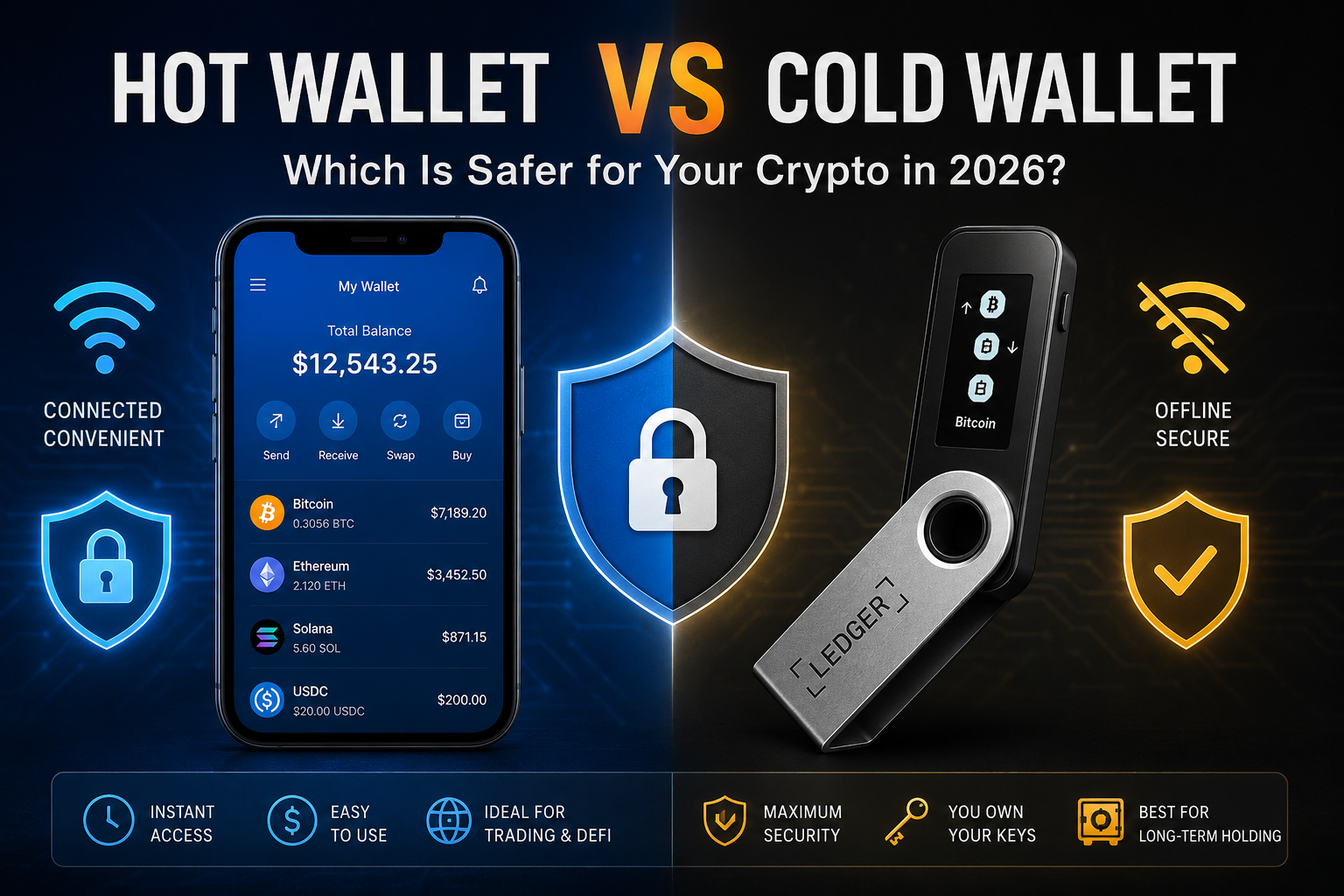

Hot Wallet vs Cold Wallet: Which Is Safer for Your Crypto in 2026?
You have bought your first cryptocurrency. Now comes the question most beginners do not think about until something goes wrong:
Where do you actually keep it?
Leaving crypto on an exchange feels convenient. But exchanges have been hacked, frozen, and shut down over the years — sometimes taking user funds with them. The crypto industry has a saying that captures this risk perfectly: “Not your keys, not your coins.”
This guide explains what crypto wallets actually are, the real difference between hot and cold wallets, which one suits your situation, and how to store your crypto in a way that keeps it genuinely safe.
What Is a Crypto Wallet?
First — a common misconception. A crypto wallet does not actually store your cryptocurrency.
Your crypto lives on the blockchain. What a wallet stores are your private keys — the cryptographic passwords that prove ownership of the crypto associated with your wallet address and authorize transactions.
Think of it this way:
- Your wallet address is like your bank account number — you can share it publicly to receive funds
- Your private key is like your PIN — share it with no one, ever
- Whoever holds the private key controls the crypto
Lose your private key with no backup: your crypto is gone permanently. Someone else gets your private key: your crypto is gone immediately.
This is why how you store your private keys — in a hot wallet or cold wallet — is one of the most important security decisions in crypto.
What Is a Hot Wallet?
A hot wallet is any crypto wallet that is connected to the internet.
“Hot” refers to the live internet connection — which makes it accessible and convenient but also exposed to online threats.
Types of Hot Wallets
Exchange wallets When you buy crypto on Binance, Coinbase, or any exchange and leave it there, it sits in the exchange’s custodial wallet. You do not hold the private keys — the exchange does. This is the most convenient option but also the highest-risk for long-term storage.
To start buying crypto on the world’s most trusted exchange: 👉 Open a Free Binance Account (affiliate link)
Software wallets (non-custodial) Apps on your phone or computer where you hold your own private keys. Examples include MetaMask, Trust Wallet, and Exodus. More secure than exchange wallets because you control the keys — but still internet-connected.
Browser extension wallets MetaMask is the most well-known. Integrates with DeFi platforms and Web3 applications directly from your browser. Convenient for active users but exposed to browser-based threats.
Hot Wallet Pros and Cons
| Pros | Cons |
|---|---|
| Instant access to funds | Connected to internet — hackable |
| Free or very low cost | Vulnerable to malware and phishing |
| Easy to use for beginners | Exchange wallets: you do not own keys |
| Good for active trading | Not ideal for large long-term holdings |
| Connects to DeFi and Web3 | Software wallets: device theft risk |
What Is a Cold Wallet?
A cold wallet stores your private keys completely offline — no internet connection, ever.
“Cold” means disconnected from the internet. This eliminates the largest category of crypto theft: remote, online attacks. A hacker cannot steal private keys that are never online.
Types of Cold Wallets
Hardware wallets Physical devices — similar in size to a USB drive — that generate and store private keys offline. When you want to make a transaction, you connect the device, sign the transaction on the device itself, then disconnect it. The private key never touches the internet.
The most trusted hardware wallets:
- Ledger (Ledger Nano S Plus, Ledger Nano X) — widely used, supports thousands of cryptocurrencies
- Trezor (Trezor Model T, Trezor Safe 3) — open-source firmware, strong security reputation
Both are available on Amazon: 👉 Ledger Nano Hardware Wallet on Amazon (affiliate link)
Paper wallets Your public and private keys printed on paper. Completely offline. Extremely secure against online attacks but vulnerable to physical damage, loss, and theft. Not recommended for most users due to fragility and complexity of use.
Air-gapped computers A dedicated computer that has never been connected to the internet, used solely for crypto key management. Used by very high-value holders. Impractical for most people.
Cold Wallet Pros and Cons
| Pros | Cons |
|---|---|
| Private keys never touch internet | Costs money ($50–$200 for hardware wallet) |
| Extremely resistant to remote hacking | Less convenient for frequent transactions |
| You fully control your keys | Physical device can be lost, damaged, or stolen |
| Best for large or long-term holdings | Setup requires more technical understanding |
| Protection against exchange failures | Seed phrase must be stored carefully |
Hot Wallet vs Cold Wallet — Full Comparison
| Feature | Hot Wallet | Cold Wallet |
|---|---|---|
| Internet connection | Always connected | Never connected |
| Security level | Moderate | Very high |
| Convenience | Very high | Lower |
| Cost | Free (software) | $50–$200 (hardware) |
| Best for | Active trading, small amounts | Long-term storage, large amounts |
| Key custody | You (software) or exchange (custodial) | Always you |
| Hack risk | Moderate to high | Very low |
| Physical theft risk | Low | Moderate (mitigated by PIN + seed phrase) |
| Beginner friendly | Yes | Moderate |
The Seed Phrase — The Most Important Thing in Crypto Security
Whether you use a hot wallet or cold wallet, if it is non-custodial (you hold the keys), you will be given a seed phrase when you set it up.
A seed phrase is a sequence of 12 or 24 random words — generated once, shown once — that can be used to restore your wallet and access your funds if the device is lost, stolen, or damaged.
Seed phrase rules that must never be broken:
- Write it down on paper immediately. Do not type it anywhere.
- Store it in a physically secure location — not with your device.
- Never photograph it. Never store it digitally. Never share it with anyone.
- Consider storing copies in two separate secure locations.
- Anyone who gets your seed phrase has complete access to your crypto — permanently.
There is no customer support to call if you lose your seed phrase. There is no password reset. If it is lost and your device fails, your crypto is gone.
Which Should You Use? A Practical Decision Guide
Use a hot wallet (software, non-custodial) if:
- You are just starting with small amounts
- You actively trade or use DeFi applications
- You want free, easy access without buying hardware
- Your holdings are an amount you could afford to lose if compromised
Use a cold wallet (hardware) if:
- You hold significant amounts of cryptocurrency
- You plan to hold for months or years without regular trading
- You want the highest practical level of security
- The cost of a hardware wallet is small relative to what you are protecting
Keep some on exchange if:
- You are actively trading frequently
- The amount is small and you accept the custodial risk
- You are still learning and not ready for self-custody
The general recommendation from experienced crypto users:
Only keep on an exchange what you are actively trading. Move anything you intend to hold for weeks or months to a non-custodial wallet. Move large holdings or long-term savings to a cold wallet.
The Biggest Security Threat — And It Is Not Hacking
The most common way people lose crypto is not exchange hacks or sophisticated attacks. It is:
- Phishing — fake websites or emails that steal login credentials or seed phrases
- Malware — software that monitors clipboard content and replaces wallet addresses
- Social engineering — scammers posing as support staff who ask for seed phrases
- User error — sending to wrong addresses, losing seed phrases, forgetting passwords
A hardware wallet protects against many of these. But phishing and social engineering work regardless of your wallet type if you are not vigilant.
Protecting your internet connection adds another layer of defense — particularly when using DeFi platforms, accessing exchanges on public networks, or conducting research on crypto projects.
👉 Get NordVPN — Secure Your Crypto Activity Online (affiliate link)
How to Set Up a Non-Custodial Hot Wallet (MetaMask Example)
- Go to metamask.io directly — not through a search ad (phishing risk)
- Install the official browser extension
- Create a new wallet
- Write down your 12-word seed phrase on paper — right now, before anything else
- Store that paper somewhere physically secure
- Set a strong password for the app itself
- Your wallet address is now ready to receive crypto
How to Set Up a Hardware Cold Wallet (Ledger Example)
- Buy directly from ledger.com or Amazon — never second-hand (tampering risk)
- Unbox and connect to your computer via USB
- Follow the setup instructions on the device screen
- The device generates your 24-word seed phrase — write every word down carefully
- Verify your seed phrase on the device as prompted
- Set a PIN code on the device
- Install Ledger Live software to manage your portfolio
- Transfer crypto from exchange to your Ledger wallet address
Your private keys never leave the device. Transactions are signed on the hardware itself.
📚 Recommended Book for This Topic
📘 Cryptoassets: The Innovative Investor’s Guide by Chris Burniske & Jack Tatar
A well-researched framework for understanding cryptocurrency as an asset class — including the importance of security and self-custody. Highly relevant for anyone building a serious crypto portfolio.
👉 Get it on Amazon (affiliate link — we may earn a small commission at no extra cost to you)
People Also Ask
Q: What is the difference between a hot wallet and a cold wallet? A hot wallet is connected to the internet — making it convenient but exposed to online threats. A cold wallet stores private keys completely offline, making it highly resistant to remote hacking. Hot wallets suit active traders; cold wallets suit long-term holders with significant amounts.
Q: Is it safe to keep crypto on Binance? Binance is one of the most secure and reputable exchanges globally. For active trading, keeping crypto on a reputable exchange is reasonable. For long-term storage of significant amounts, moving to a self-custody wallet — especially a cold wallet — is generally recommended by security experts.
Q: What is the best cold wallet for beginners in 2026? The Ledger Nano S Plus and Trezor Safe 3 are both widely recommended for beginners. Both offer strong security, broad cryptocurrency support, and relatively straightforward setup processes.
Q: What happens if I lose my hardware wallet? If you have your seed phrase stored safely, you can restore your wallet and access your funds on any compatible device. The hardware wallet itself does not store your crypto — that lives on the blockchain. What the device stores is the key to access it, which can be restored from your seed phrase.
Q: Can a cold wallet be hacked? Cold wallets are extremely resistant to remote hacking because the private keys never touch the internet. Physical theft of the device is a risk, but hardware wallets require a PIN to operate and wipe themselves after multiple incorrect attempts. The seed phrase is the real target — keep it physically secure.
Q: What is a seed phrase and why is it important? A seed phrase is a sequence of 12 or 24 words generated when you set up a non-custodial wallet. It is the master key to your wallet — anyone with your seed phrase has complete access to your funds. Lose it and lose device access, and your crypto is permanently inaccessible. Store it offline, physically secure, and never share it.
Q: Should beginners use a hot wallet or cold wallet? Most beginners start with a hot wallet (software wallet or exchange) due to the lower cost and simpler setup. As holdings grow, moving to a cold wallet becomes increasingly sensible. A hardware wallet costing $70–$150 is worth it once you hold more than a few hundred dollars in crypto you plan to keep long-term.
Q: What is MetaMask? MetaMask is one of the most popular non-custodial hot wallets — a browser extension that stores your private keys on your device and connects to Ethereum-based DeFi applications and Web3 platforms. It is free and widely used, but as a hot wallet, it is less secure than cold storage for large holdings.
⚠️ Affiliate Disclaimer: This article contains affiliate links to Binance, NordVPN, and Amazon. If you sign up or purchase through these links, Finzaro360.com may earn a small commission at no additional cost to you. We only recommend platforms and products we believe provide genuine value. No guarantees of profit or specific outcomes are made or implied.
⚠️ Cryptocurrency Disclaimer: This article is for educational and informational purposes only. Cryptocurrency storage and security decisions carry real risk. Nothing in this article constitutes financial or security advice specific to your situation. Always conduct your own research. Finzaro360.com is not responsible for any loss of funds resulting from wallet choices or security decisions. Please consult relevant security resources and professionals for guidance specific to your holdings and situation.
Conclusion
The question of hot wallet versus cold wallet comes down to one thing: how much are you willing to risk for convenience?
For small amounts and active trading, a reputable exchange or non-custodial software wallet is a practical starting point. For anything you plan to hold long-term — especially as your portfolio grows — a cold wallet is one of the most straightforward and effective security upgrades you can make.
The cost of a hardware wallet is fixed and modest. The cost of losing significant crypto to a hack or exchange failure is not.
“Not your keys, not your coins” is not just a slogan. It is the core principle of crypto security. Understand it, apply it at the right time, and you are already ahead of most crypto beginners.
What to Read Next on Finzaro360
- What Is Blockchain Technology? Simple Explanation for Beginners
- How to Buy Bitcoin in 2026: Step-by-Step Guide
- How to Avoid Crypto Scams in 2026
- Ethereum vs Bitcoin 2026: Which Is the Better Investment?
- How to Trade Crypto for Beginners
- What Is DeFi? Decentralized Finance Explained
Write for Finzaro360
Are you a crypto security expert or blockchain writer? We publish expert guest posts on Crypto, Finance, AI Tools, and Online Earning. Visit our Write For Us page to submit your pitch and earn a quality dofollow backlink.
Published on Finzaro360.com | Category: Crypto