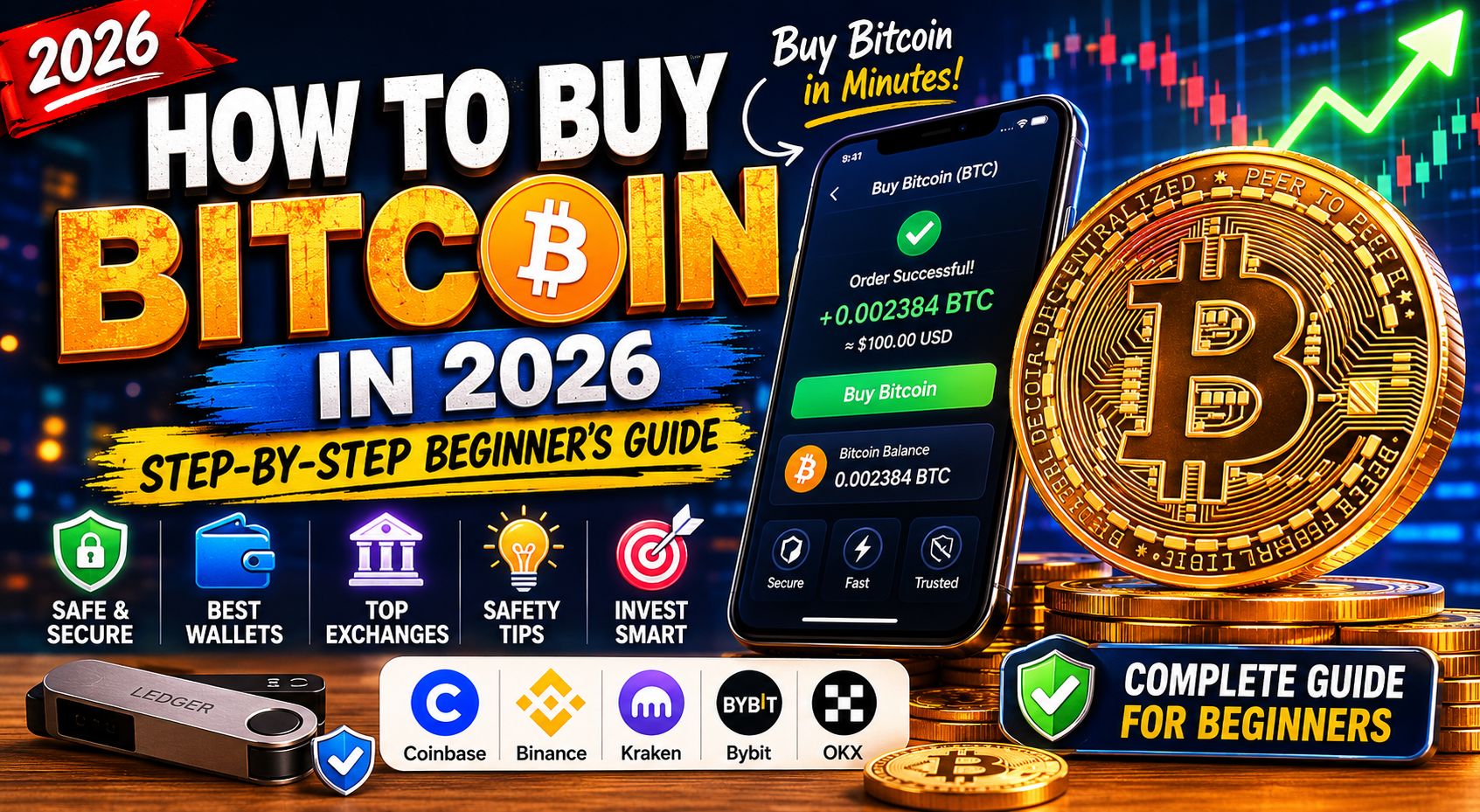

How to Buy Bitcoin in 2026
Bitcoin is no longer a fringe asset. In 2026, it is held by institutions, pension funds, sovereign wealth funds, and over 500 million individual holders worldwide. Buying Bitcoin has never been more accessible — or more important to understand correctly.
This guide walks you through everything: what Bitcoin is, where to buy it safely, how to store it, how much to invest, and critical safety tips every beginner must know.
What Is Bitcoin? (Quick Explainer)
Bitcoin (BTC) is a decentralized digital currency created in 2009 by an anonymous person or group known as Satoshi Nakamoto. It operates on a blockchain — a public, tamper-proof ledger recording every transaction.
Key facts about Bitcoin in 2026:
- Maximum supply: 21 million BTC — no more will ever be created
- Current circulating supply: ~19.8 million BTC
- Divisible to 8 decimal places (0.00000001 BTC = 1 “satoshi”)
- You do NOT need to buy a whole Bitcoin — you can buy $10 worth
- No bank, government, or company controls it
Step 1: Choose a Trustworthy Crypto Exchange
A crypto exchange is an online platform where you buy, sell, and hold Bitcoin. Choosing the right exchange is the most important first decision.
Best Crypto Exchanges for Beginners in 2026:
| Exchange | Best For | Trading Fee | Available In |
|---|---|---|---|
| Coinbase | Absolute beginners | 1.49% | US, UK, EU, 100+ countries |
| Binance | Low fees, all features | 0.1% | Global (excl. US some states) |
| Kraken | Security-focused users | 0.16% | US, EU, global |
| Bybit | Intermediate traders | 0.1% | Global (excl. US) |
| OKX | Advanced features | 0.08% | Global |
Recommendation for absolute beginners: Start with Coinbase (easiest interface) or Binance (lowest fees). Both are regulated, secure, and support dozens of countries.
Tip: We have a complete guide to buying Bitcoin on Binance specifically for Pakistan and South Asian users.
Step 2: Create and Verify Your Account
- Go to your chosen exchange’s official website (always double-check the URL — fake sites are common)
- Click “Sign Up” and enter your email and password
- Enable Two-Factor Authentication (2FA) immediately — this is non-negotiable for security
- Complete KYC verification (Know Your Customer):
- Upload a government-issued ID (passport, national ID, or driver’s license)
- Take a selfie for facial verification
- Verification usually takes 15 minutes to 24 hours
Why is KYC required? Regulated exchanges are legally required to verify identities to prevent money laundering and fraud. This also protects you — verified accounts have better recovery options if hacked.
Step 3: Fund Your Account
Once verified, deposit money to buy Bitcoin. Most exchanges accept:
- Bank Transfer (ACH/SEPA/SWIFT) – Slowest (1–5 days) but lowest fees. Best for large amounts.
- Debit/Credit Card – Instant but higher fees (1.5–4%). Good for small first purchases.
- PayPal or Apple Pay – Available on Coinbase and some others. Instant, moderate fees.
- P2P (Peer-to-Peer) – Buy directly from another person using bank transfer, mobile money, or cash. Binance P2P is popular in countries with payment restrictions.
Step 4: Place Your Bitcoin Order
Once funded, buying Bitcoin takes less than 60 seconds:
- Navigate to the Buy/Sell section
- Select Bitcoin (BTC) from the list of cryptocurrencies
- Enter the dollar amount you want to spend (e.g., $50)
- Review the order: you’ll see the BTC amount, exchange rate, and fees
- Click “Buy Bitcoin” to confirm
Your Bitcoin will appear in your exchange wallet within seconds.
Market Order vs Limit Order:
- Market Order – Buys instantly at the current price. Easiest for beginners.
- Limit Order – You set a price; order executes only when Bitcoin hits that price. Saves money in volatile markets.
Step 5: Decide Where to Store Your Bitcoin
This is where most beginners make a critical mistake. Leaving your Bitcoin on the exchange permanently is risky.
Storage Options:
Option 1: Exchange Wallet (Custodial) — Easiest but Risky
Your Bitcoin stays on the exchange. Convenient for trading but you don’t technically “own” the private keys. If the exchange is hacked or goes bankrupt, your Bitcoin could be at risk.
“Not your keys, not your coins.” — oldest saying in crypto.
Option 2: Software Wallet (Non-Custodial) — Good for Small Amounts
Download a free wallet app and move your Bitcoin there. You control the private keys.
- Trust Wallet – Most popular mobile wallet, free
- Exodus – Beautiful UI, multi-currency support
- Electrum – Lightweight, Bitcoin-only, highly secure
Option 3: Hardware Wallet (Cold Storage) — Best for Large Amounts
A physical device (like a USB drive) that stores your Bitcoin completely offline. Even if your computer is hacked, your Bitcoin is safe.
- Ledger Nano X – Best hardware wallet in 2026. Supports 5,500+ coins. ~$149.
- Trezor Model T – Open-source, trusted since 2014. ~$219.
Read our detailed Ledger Nano X review to see if it’s the right choice for you.
Rule of thumb: If your crypto holdings exceed $1,000, move them to a hardware wallet.
How Much Should You Invest in Bitcoin?
There is no universal answer, but here are widely accepted guidelines:
- Only invest what you can afford to lose completely. Bitcoin is volatile — it has dropped 80%+ multiple times in its history.
- Most financial advisors suggest keeping crypto to 1–10% of your total investment portfolio
- Never invest emergency funds, rent money, or borrowed money in Bitcoin
Dollar-Cost Averaging (DCA) Strategy — Best for Beginners
Instead of investing $1,000 all at once, invest $100 every week or month regardless of price. This strategy reduces the risk of buying at a peak and smooths out your average purchase price over time.
We’ve covered the complete DCA strategy for Bitcoin in 2026 — including how to automate it on major exchanges.
Bitcoin Safety: 10 Rules Every Beginner Must Follow
- Enable 2FA on every account — use an authenticator app (Google Authenticator, Authy), not SMS
- Never share your seed phrase with anyone — this 12–24 word phrase gives complete access to your wallet
- Write down your seed phrase on paper — never store it digitally or in screenshots
- Use a unique strong password for every exchange account
- Verify URLs before logging in — phishing sites look identical to real exchanges
- Never click crypto links in emails or DMs — always navigate directly to the exchange
- Ignore anyone who guarantees Bitcoin returns — it’s always a scam
- Be skeptical of giveaway promotions — “Send 1 BTC, get 2 back” is always fraud
- Use a dedicated email for crypto accounts — not your main personal email
- Research before buying any altcoin — Bitcoin is the most established; new coins are much riskier
Bitcoin Taxes: What You Need to Know in 2026
In most countries, Bitcoin is treated as property for tax purposes. This means:
- Selling Bitcoin for profit is a taxable capital gains event
- Trading BTC for another cryptocurrency is also taxable in many jurisdictions
- Simply holding (HODLing) Bitcoin does NOT trigger taxes
- Keep records of every buy, sell, and trade — the purchase date, amount, and price
Free crypto tax tools: Koinly, CoinTracker, and TaxBit all integrate with major exchanges to automatically calculate your tax liability.
Bitcoin vs Other Cryptocurrencies: Should You Diversify?
Bitcoin is the safest and most established cryptocurrency. For beginners, it’s the right starting point. Once comfortable, you may consider:
- Ethereum (ETH) – Second largest, smart contracts and DeFi ecosystem
- Solana (SOL) – Fast transactions, growing NFT and DeFi ecosystem
- BNB – Binance’s native token, discounts on trading fees
Never put all funds in a single altcoin. Bitcoin has the strongest track record, deepest liquidity, and widest institutional adoption.
Use our free Crypto Liquidation Calculator to calculate your risk levels before entering any position, and our Position Size Calculator to manage how much to invest per trade.
Frequently Asked Questions
Can I buy less than 1 Bitcoin?
Yes — Bitcoin is divisible to 8 decimal places. You can buy as little as $1 worth of Bitcoin on most exchanges.
Is Bitcoin legal?
In most countries, yes. Bitcoin is legal in the US, UK, EU, Australia, Canada, and most of Southeast Asia and South Asia. A few countries restrict or ban it — check your local regulations.
Can I lose all my money in Bitcoin?
Theoretically yes — any investment can go to zero. Bitcoin has recovered from every major crash historically, but past performance never guarantees future results. Never invest more than you can afford to lose.
What is the best time to buy Bitcoin?
Nobody can consistently predict the “best” time. The DCA strategy (buying regularly regardless of price) is proven to be more effective for most investors than trying to time the market.
How do I cash out my Bitcoin?
Send your Bitcoin back to an exchange, sell it for your local currency (USD, EUR, PKR, etc.), and withdraw to your bank account. Most exchanges process withdrawals in 1–5 business days.
Final Verdict: Is Bitcoin Worth Buying in 2026?
Bitcoin has proven itself as a legitimate store of value over 15+ years. Institutional adoption, ETF approvals, and continued scarcity make it a compelling long-term asset for many investors in 2026.
However, never invest borrowed money, emergency funds, or more than you can afford to lose. Approach Bitcoin as a long-term, high-risk, high-reward component of a diversified financial plan.
Start small, use DCA, secure your holdings properly, and be patient. The most successful Bitcoin investors are the ones who hold long-term and ignore short-term price noise.
Ready to manage your crypto smartly? Use our free tools: Liquidation Calculator, Position Size Calculator, and Bitcoin Profit Calculator.
Published by Finzaro360 | Learn. Earn. Grow Online.