
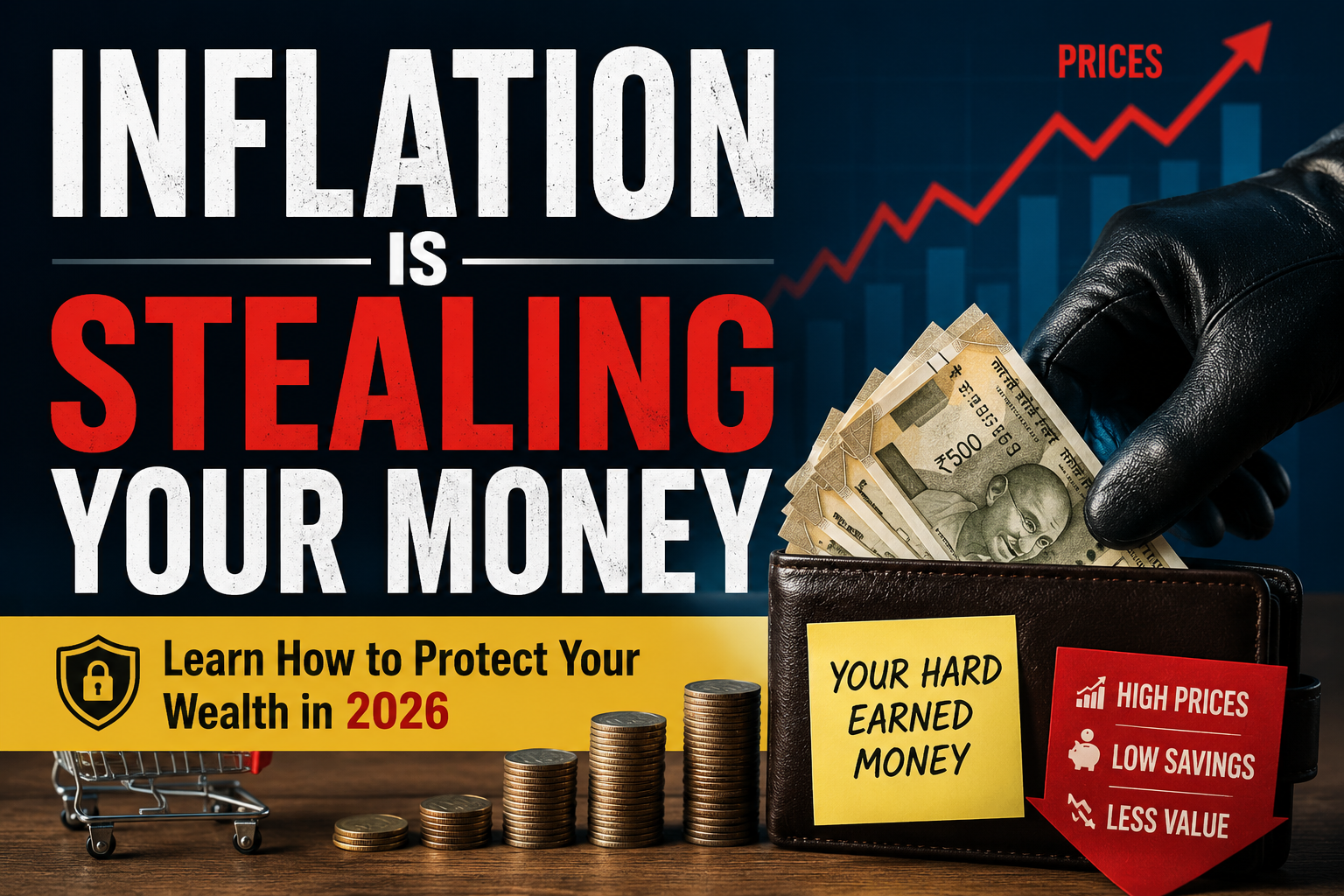

What Is Inflation and How Does It Steal Your Money?
Have you ever noticed that the same grocery bill that cost you $100 a few years ago now costs $120 or more — even though you bought exactly the same things?
That is inflation at work.
Inflation is not just an economic term politicians argue about on television. It is a real force that quietly reduces the value of your money every single year. It affects your savings, your salary, your investments, and your long-term financial plans — whether you pay attention to it or not.
This guide explains exactly what inflation is, how it works, what causes it, and most importantly — what you can do to protect your money from it.
What Is Inflation? (Plain English Definition)
Inflation is the rate at which the general price level of goods and services rises over time — which means the purchasing power of your money falls.
Put simply: the same amount of money buys less than it used to.
A simple example:
- In 2015, a cup of coffee cost $2.00
- In 2026, that same coffee costs $3.50
- Your dollar did not disappear — but its buying power shrank
This is inflation. And it happens continuously, year after year, across almost every economy in the world.
How Is Inflation Measured?
Governments and central banks measure inflation using price indexes. The most commonly referenced ones are:
Consumer Price Index (CPI)
The CPI tracks the average price change of a “basket” of goods and services that typical households buy — food, housing, transport, healthcare, clothing, and more.
When the CPI rises 4% in a year, it means that basket of goods costs 4% more than it did the year before. That 4% is the inflation rate.
Producer Price Index (PPI)
The PPI measures price changes from the perspective of producers and manufacturers — before goods reach consumers. Rising PPI often signals that consumer prices will rise soon after.
Core Inflation
Core inflation strips out food and energy prices — two categories known for high volatility — to give a clearer picture of underlying price trends.
Where to check official inflation data:
- USA: Bureau of Labor Statistics — bls.gov
- UK: Office for National Statistics — ons.gov.uk
- Pakistan: Pakistan Bureau of Statistics — pbs.gov.pk
What Causes Inflation?
Inflation does not happen randomly. There are well-understood causes:
1. Demand-Pull Inflation
When the demand for goods and services grows faster than the economy can supply them, prices rise. Think of it as too much money chasing too few goods.
Common triggers: Economic booms, government stimulus spending, low interest rates encouraging borrowing and spending.
2. Cost-Push Inflation
When the cost of producing goods rises — raw materials, energy, labor — businesses pass those costs on to consumers through higher prices.
Common triggers: Rising oil prices, supply chain disruptions, commodity shortages.
3. Built-In (Wage-Price) Inflation
When workers expect prices to rise, they demand higher wages. Higher wages increase business costs, which raises prices further — creating a self-reinforcing cycle.
4. Monetary Inflation
When a government or central bank increases the money supply significantly faster than economic output grows, each unit of currency becomes worth less. More money chasing the same amount of goods means prices rise.
The Inflation Rate — What Is “Normal”?
Most central banks in developed economies target an inflation rate of around 2% per year. This is considered healthy — low enough that money retains meaningful value, high enough to discourage people from hoarding cash instead of spending and investing.
| Inflation Level | Classification | Effect |
|---|---|---|
| 0–2% | Low / Target range | Stable, healthy economy |
| 3–5% | Moderate | Noticeable but manageable |
| 6–10% | High | Erodes savings meaningfully |
| 10%+ | Very High | Significant economic stress |
| Hyperinflation | Extreme | Currency can become nearly worthless |
How Inflation Steals Your Money — The Real Impact
This is where inflation becomes personal. Let us look at exactly how it affects your financial life.
1. Your Savings Lose Value Over Time
If you keep $10,000 in a savings account earning 1% interest per year, but inflation is running at 4% per year, you are effectively losing 3% of your purchasing power annually.
After 10 years at 4% inflation, that $10,000 has the purchasing power of roughly $6,756 in today’s money. The number in your account has not changed — but what it can buy has shrunk significantly.
This is why simply saving money in a low-interest account is not enough to build wealth. You need returns that beat inflation.
2. Fixed Salaries Become Worth Less
If your salary stays the same while inflation rises, your real income — what your salary can actually buy — decreases. A salary of $50,000 with 5% inflation is effectively a pay cut of $2,500 in real purchasing power.
This is why negotiating salary increases that at least match inflation is so important. For strategies on earning more, see our guide on Passive Income Ideas 2026: 17 Proven Ways to Earn Money While You Sleep.
3. Debt Can Become Cheaper (In Some Cases)
Inflation has one counterintuitive effect that works in borrowers’ favor: if you have fixed-rate debt, inflation gradually makes that debt cheaper to repay in real terms.
If you borrowed $10,000 at a fixed interest rate and inflation rises significantly, you are repaying that loan with money that is worth less — which means the real burden of the debt shrinks over time.
This is why governments with large fixed debts sometimes benefit from moderate inflation.
4. Retirement Savings Can Fall Short
This is one of the most serious long-term effects of inflation. A retirement fund that looks adequate today may be significantly insufficient 20-30 years from now if inflation has eroded its purchasing power.
Someone retiring with $500,000 today and someone retiring with $500,000 in 25 years — at even moderate 3% annual inflation — have very different financial situations. The second person’s money buys substantially less.
Planning for inflation in your retirement calculations is essential. See our guide on Build Wealth From Scratch: Saving, Investing & Smart Money Habits.
Inflation vs Interest Rates — The Connection
Central banks use interest rates as their primary tool to control inflation.
When inflation is too high: Central banks raise interest rates. Borrowing becomes more expensive. People spend less. Demand falls. Prices stabilize or fall.
When inflation is too low (or there is deflation): Central banks lower interest rates. Borrowing becomes cheaper. People spend and invest more. Demand rises. Prices increase.
This is why you hear so much about central bank interest rate decisions. The US Federal Reserve, the Bank of England, the State Bank of Pakistan — all of them use interest rate policy primarily to manage inflation.
For your personal finances, this matters because rising interest rates affect:
- Mortgage costs
- Credit card interest rates
- Loan repayment amounts
- Savings account yields
- Investment valuations
Understanding this relationship helps you make better financial decisions when interest rate changes are announced.
Real vs Nominal Returns — A Critical Distinction
When evaluating any investment or savings account, always look at the real return — not just the nominal return.
Nominal return = The stated return before accounting for inflation Real return = Nominal return minus the inflation rate
Example:
- Savings account pays 3% annually
- Inflation is running at 4%
- Real return = 3% − 4% = −1%
You are actually losing purchasing power despite earning “interest.”
This distinction is why simply earning any return is not enough. Your investment returns must exceed inflation to grow your real wealth. For a deeper look at how returns compound over time, read our guide on Compound Interest Calculator: How It Works & Why It Changes Everything About Your Money.
How to Protect Your Money From Inflation
Now the practical part. Here is what financially aware people do to stay ahead of inflation:
1. Invest in Assets That Historically Outpace Inflation
Stock market index funds have historically delivered returns that exceed inflation over long periods. This is not guaranteed, but the long-term track record of broad market index funds is one of the strongest tools available against inflation.
See our complete breakdown of where to invest: Best Investment Apps 2026
2. Avoid Keeping Large Cash Balances in Low-Interest Accounts
Cash held in accounts earning below the inflation rate loses real value every year. While an emergency fund in cash is essential, large amounts sitting idle are eroded by inflation over time.
For how much cash to keep accessible, see: How to Build an Emergency Fund in 2026
3. Consider Inflation-Protected Investments
Some investments are specifically designed to keep pace with inflation:
- TIPS (Treasury Inflation-Protected Securities) — US government bonds whose principal adjusts with CPI
- I-Bonds — US savings bonds that pay a rate tied to inflation
- Real estate — Property values and rents historically tend to rise with or ahead of inflation
- Commodities — Gold and other commodities are often used as inflation hedges, though they are volatile
4. Review and Negotiate Your Income Regularly
Your salary is one of your most important financial assets. If it does not grow at least in line with inflation, your real standard of living declines. Regular performance reviews, skill development, and salary negotiations are essential inflation-fighting tools.
5. Reduce High-Interest Debt
High-interest debt — especially credit cards — often carries rates far above inflation. Eliminating that debt is one of the highest guaranteed returns available. See our full strategy guide: How to Get Out of Debt Fast in 2026
6. Use a Budget That Accounts for Rising Costs
A budget built on last year’s prices will not accurately reflect this year’s expenses. Review your budget annually and adjust for real cost increases in your essential categories.
For a complete budgeting framework: How to Make a Monthly Budget in 2026
Inflation and Crypto — What You Need to Know
Some people view cryptocurrency — particularly Bitcoin — as an inflation hedge, arguing that its fixed maximum supply makes it immune to the monetary inflation that devalues fiat currencies.
The reality is more nuanced. Bitcoin and other cryptocurrencies have shown extreme price volatility that makes them unreliable as short-term inflation hedges. Over longer periods, the data is still limited.
Cryptocurrency may form part of a diversified strategy, but treating it as a guaranteed inflation hedge involves significant risk. For a balanced overview: Ethereum vs Bitcoin 2026
Inflation Summary Table
| Concept | Key Point |
|---|---|
| What it is | General rise in price levels; fall in purchasing power |
| How it is measured | CPI, PPI, Core Inflation |
| Target rate (most economies) | Around 2% per year |
| Main causes | Demand-pull, cost-push, monetary expansion |
| Effect on savings | Erodes value if returns are below inflation rate |
| Effect on debt | Fixed-rate debt becomes cheaper in real terms |
| Best protection | Investing in assets that outpace inflation |
| Key formula | Real Return = Nominal Return − Inflation Rate |
People Also Ask
Q: What is inflation in simple terms? Inflation means prices are rising and the purchasing power of your money is falling. The same amount of money buys fewer goods and services than it did before.
Q: What causes inflation? The main causes are excess demand for goods and services (demand-pull), rising production costs (cost-push), excessive growth in the money supply, and expectations of future price rises built into wages and contracts.
Q: Is inflation good or bad? Moderate inflation (around 2%) is considered healthy for an economy. It encourages spending and investment rather than hoarding cash. High inflation or hyperinflation is harmful as it erodes savings and creates economic instability.
Q: How does inflation affect savings? If the interest rate on your savings is lower than the inflation rate, your money loses purchasing power over time even though the account balance grows. This is why investing — not just saving — is important for long-term wealth preservation.
Q: How can I protect my money from inflation? Invest in assets with returns that historically exceed inflation (stock index funds, real estate), avoid holding large cash balances in low-interest accounts, reduce high-interest debt, and review your income and budget regularly.
Q: What is the difference between inflation and interest rates? Inflation is the rate at which prices rise. Interest rates are set by central banks partly to control inflation. When inflation is high, central banks raise interest rates to reduce borrowing and spending, which slows price growth.
Q: What is hyperinflation? Hyperinflation is an extreme form of inflation where prices rise at an extremely rapid rate — sometimes doubling in days or weeks. Historical examples include Zimbabwe in the 2000s and Germany in the 1920s. It typically destroys the value of a currency entirely.
Q: Does inflation affect everyone equally? No. People with significant savings in cash or fixed-income instruments are hurt more. People with significant debt at fixed rates may benefit in relative terms. Those with assets like real estate or equities are better protected.
⚠️ Financial Disclaimer: This article is for educational and informational purposes only. It does not constitute personalized financial, investment, or economic advice. Inflation rates, investment returns, and economic conditions vary by country and time period. Please consult a qualified financial advisor before making any investment or financial decisions. Finzaro360.com does not provide personalized financial advice.
Conclusion
Inflation is not a distant economic concept — it is working on your money right now, every day.
The good news is that understanding inflation gives you real power to respond to it. You can invest in assets that grow faster than inflation. You can build an emergency fund without letting idle cash sit unprotected. You can negotiate your salary. You can eliminate expensive debt. You can make budgeting decisions that account for real costs rather than outdated numbers.
Inflation is not something that happens to other people. It happens to your savings, your purchasing power, and your long-term financial security. The people who understand it and plan for it are the ones who stay ahead.
Start with what you have. Invest consistently. Let returns compound. And never leave large amounts of money idle in accounts that cannot keep pace with rising prices.
What to Read Next on Finzaro360
- Compound Interest Calculator: How It Works & Why It Changes Everything
- Build Wealth From Scratch: Saving, Investing & Smart Money Habits
- How to Build an Emergency Fund in 2026
- Best Investment Apps 2026
- How to Get Out of Debt Fast in 2026
- Passive Income Ideas 2026
Write for Finzaro360
Are you a finance writer or economic enthusiast? We publish expert guest posts on Finance, Crypto, AI Tools, and Online Earning. Visit our Write For Us page to submit your pitch and earn a quality dofollow backlink.
Published on Finzaro360.com | Category: Finance