

Debt is stressful. Whether it is credit card balances, student loans, car payments, or personal loans — carrying multiple debts at once can feel overwhelming, confusing, and never-ending.
The good news? There are two proven, structured methods that have helped millions of people pay off their debt faster and smarter: the Debt Snowball and the Debt Avalanche.
Both methods work. But they work differently, and the right choice depends on your personality, your financial situation, and what actually keeps you motivated.
This guide will explain both methods clearly, compare them side by side, show you real math on how each one works, and help you decide which one is right for you.
What Is the Debt Snowball Method?
The Debt Snowball method was popularized by personal finance expert Dave Ramsey. The core idea is simple:
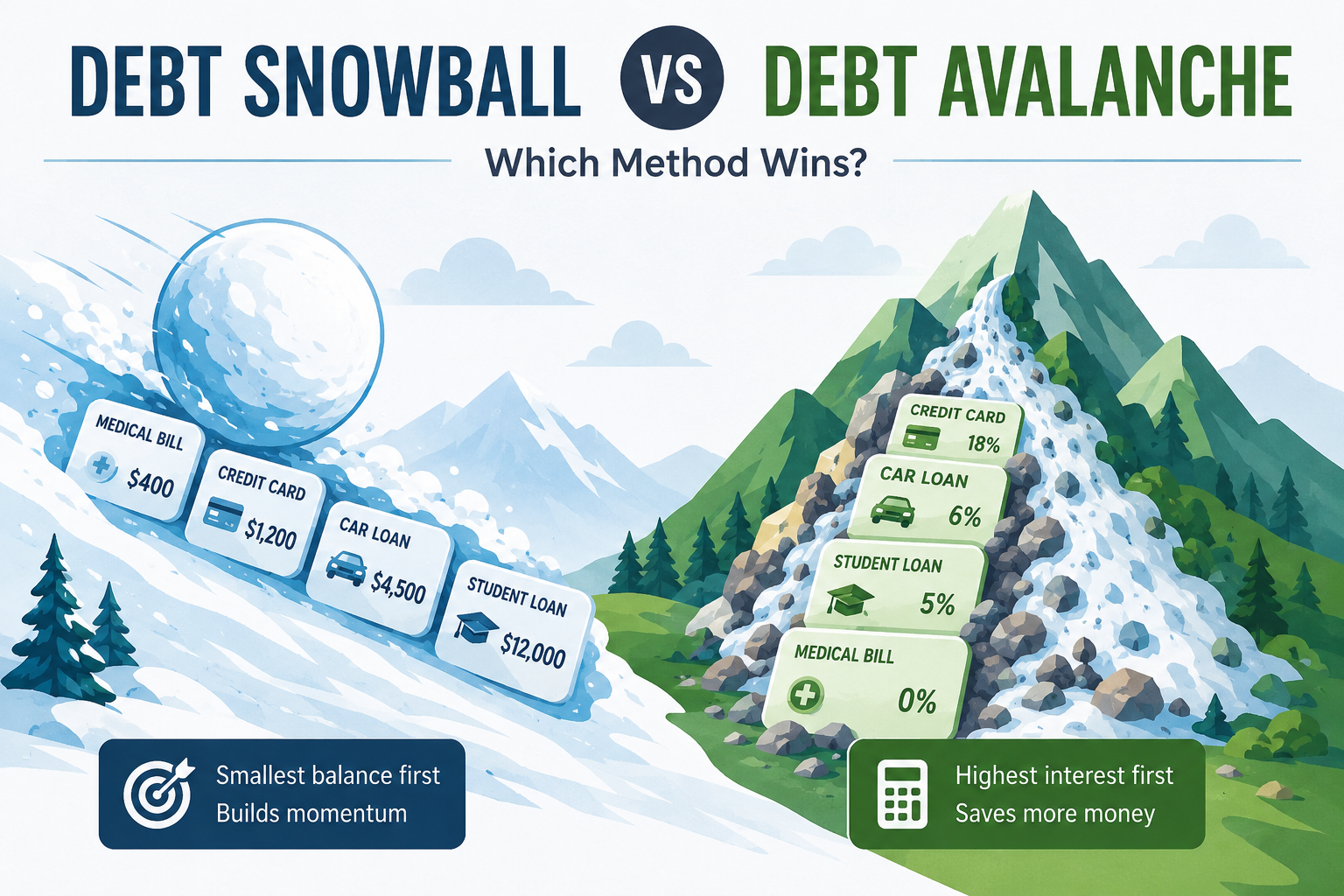
Pay off your smallest debt first, regardless of interest rate.
Here is how it works:
- List all your debts from smallest balance to largest balance.
- Make minimum payments on all debts.
- Put any extra money toward the smallest debt.
- When the smallest debt is paid off, take that payment and add it to the next smallest debt.
- Repeat until all debts are gone.
The “snowball” name comes from the fact that as each small debt disappears, the payment you were making on it rolls into the next debt — just like a snowball rolling downhill and growing bigger.
Debt Snowball Example
Let us say you have four debts and $500 per month total to put toward them:
| Debt | Balance | Minimum Payment | Interest Rate |
|---|---|---|---|
| Medical bill | $400 | $50 | 0% |
| Credit card A | $1,200 | $80 | 18% |
| Car loan | $4,500 | $150 | 6% |
| Student loan | $12,000 | $200 | 5% |
Step 1: Pay minimums on all debts. That is $480 per month. You have $20 extra.
Step 2: Put that $20 extra toward the medical bill (smallest balance). Now you are paying $70/month on it. The medical bill is paid off in about 5-6 months.
Step 3: The $70 you were paying on the medical bill now rolls into Credit Card A. You are now paying $150/month on Credit Card A.
Step 4: Credit Card A gets paid off faster. That payment rolls into the car loan. And so on.
Each time a debt disappears, your available payment on the next debt grows — that is the snowball effect.
Why People Love the Snowball Method
The Snowball method is not mathematically the cheapest way to pay off debt. But it has a powerful psychological advantage: you see wins quickly.
Paying off that first small debt — even if it was only $400 — gives you a real sense of momentum. It proves to yourself that this is working. That motivation keeps people going when the process gets hard.
Research in behavioral economics consistently shows that people are more likely to stick with debt payoff plans when they experience early wins, even at a small financial cost.
What Is the Debt Avalanche Method?
The Debt Avalanche method is the mathematically optimal approach. The idea is:
Pay off your highest interest rate debt first, regardless of balance.
Here is how it works:
- List all your debts from highest interest rate to lowest interest rate.
- Make minimum payments on all debts.
- Put any extra money toward the highest interest rate debt.
- When the highest interest debt is paid off, roll that payment into the next highest interest rate debt.
- Repeat until all debts are eliminated.
Debt Avalanche Example
Using the same four debts from before, but now ordered by interest rate:
| Debt | Balance | Minimum Payment | Interest Rate |
|---|---|---|---|
| Credit card A | $1,200 | $80 | 18% |
| Car loan | $4,500 | $150 | 6% |
| Student loan | $12,000 | $200 | 5% |
| Medical bill | $400 | $50 | 0% |
Step 1: Pay minimums on all. $480/month. Extra $20 goes to Credit Card A (18% — highest rate).
Step 2: Credit Card A is attacked aggressively. Once paid off, that $100 total rolls into the car loan.
Step 3: Car loan is eliminated. Then student loan. Medical bill is saved for last since it has 0% interest — you are not losing money by waiting.
Why People Love the Avalanche Method
The Avalanche method saves you more money in total interest paid over the life of your debt repayment journey. By targeting the most expensive debt first, you reduce the amount of interest that keeps piling up.
If you are disciplined, data-driven, and motivated by numbers rather than emotional wins, the Avalanche method will save you the most money.
Debt Snowball vs Debt Avalanche: Direct Comparison
| Feature | Debt Snowball | Debt Avalanche |
|---|---|---|
| Payoff order | Smallest balance first | Highest interest rate first |
| Total interest paid | More (costs more overall) | Less (saves more money) |
| Speed of first win | Faster — quick early victories | Slower — first debt may be large |
| Motivation factor | Very high | Moderate |
| Best for | People who need momentum | People driven by data and savings |
| Mathematical efficiency | Lower | Higher |
| Psychological effectiveness | Higher | Lower for some people |
| Recommended by | Dave Ramsey | Most financial economists |
Which Method Saves More Money?
The honest answer: the Debt Avalanche almost always saves more in total interest paid.
Here is why: high-interest debt (especially credit card debt at 18-25%) grows fast. Every month you carry a high-interest balance, it is costing you money. The sooner you eliminate those high-rate debts, the less total interest you pay.
However — and this is important — the Snowball method’s value is not about math. It is about human behavior. The research on this is clear: a plan you actually stick to beats a mathematically perfect plan you abandon in month four.
One study published in the Journal of Consumer Research (Avery and Kooreman, 2012) found that consumers who focused on paying off individual accounts — rather than spreading payments — were more likely to become debt-free. This aligns with the Snowball approach.
Neither method is “wrong.” The right method is the one you will actually follow through with.
A Hybrid Approach: The Best of Both Methods
Here is something many financial guides do not tell you: you do not have to choose one method exclusively.
Many people use a hybrid approach:
- If your smallest debt also has a high interest rate — attack it first (both methods agree).
- If you have one or two tiny debts you can knock out in 1-2 months, clear those first for a psychological boost, then switch to Avalanche order.
- Use Snowball when motivation is low. Use Avalanche when you feel disciplined and focused.
The goal is not to follow a method perfectly. The goal is to become debt-free.
Internal Link Suggestion: Link to your article on How to Get Out of Debt Fast in 2026: 7 Proven Steps to Financial Freedom here.
Tools to Help You Choose and Track Your Progress
You do not have to do all the math manually. These free tools can help:
- Undebt.it — Free online tool that shows your payoff timeline for both Snowball and Avalanche side by side. Highly recommended.
- Vertex42 Debt Reduction Spreadsheet — Free Excel template for tracking payoff plans.
- NerdWallet Debt Payoff Calculator — Free, clean interface, shows total interest under different methods.
- YNAB (You Need A Budget) — Paid budgeting app ($14.99/month or $99/year) that includes debt payoff tracking. Strong reviews from users focused on getting debt-free.
Internal Link Suggestion: Link to your article on Best Budgeting Apps 2026 when mentioning YNAB.
Step-by-Step: How to Start Either Method Today
Regardless of which method you choose, the starting steps are the same.
Step 1: List every single debt. Write down the creditor name, total balance, minimum payment, and interest rate for every debt you have. Do not leave anything out.
Step 2: Know your monthly cash flow. How much money comes in each month? How much goes out on essentials (rent, food, utilities)? The difference is what you have available for debt payments.
Step 3: Commit to a minimum extra payment. Even $20 or $50 extra per month makes a difference when directed consistently at one debt at a time.
Step 4: Choose your method. If you need early wins and motivation: Snowball. If you want to minimize total interest and can stay the course: Avalanche.
Step 5: Automate where possible. Set up automatic payments at least for the minimums. Then manually send extra to your target debt each month.
Step 6: Celebrate payoffs. When a debt disappears, acknowledge it. This keeps motivation alive for the long journey.
Internal Link Suggestion: Link to Build Wealth From Scratch: Saving, Investing & Smart Money Habits and The 50/30/20 Budget Rule Explained as related next steps.
Common Mistakes to Avoid
Mistake 1: Taking on new debt while paying off old debt. You cannot fill a bucket with water if there is still a hole in it. Cut up or freeze credit cards if necessary while you are in payoff mode.
Mistake 2: Only paying minimums. Minimum payments are designed to keep you in debt as long as possible. Always pay at least a little extra on your target debt.
Mistake 3: No emergency fund. Without a small emergency fund (even $500-$1,000), one unexpected expense sends you right back to credit card debt. Build a small buffer before aggressively attacking debt.
Mistake 4: Giving up after a setback. Life happens. If you have a bad month, do not abandon the plan — just pick it back up the next month.
Mistake 5: Forgetting about interest rates entirely. Even if you are doing Snowball, keep an eye on interest rates. If a debt is charging you 25%, it deserves urgent attention.
Debt Payoff Reality Check
Here are some things to keep in mind as you plan your debt payoff journey:
- These methods work. Millions of people have used them to become debt-free.
- It takes time. There is no instant solution. Patience is required.
- Extra income accelerates everything. A side hustle, selling unused items, or cutting subscriptions can give you more to put toward debt.
- The psychological benefit of being debt-free is enormous. Reduced stress, better sleep, more financial freedom — these are real outcomes.
People Also Ask
Q: What is the debt snowball method? The debt snowball method is a debt payoff strategy where you pay off your smallest debt first while making minimum payments on all others. Once the smallest debt is cleared, you roll that payment into the next smallest. This creates momentum and early psychological wins.
Q: What is the debt avalanche method? The debt avalanche method is a debt payoff strategy where you target the debt with the highest interest rate first, regardless of balance. This approach saves the most money in total interest paid over time.
Q: Which is better — debt snowball or debt avalanche? The debt avalanche is mathematically superior and saves more money. But the debt snowball is psychologically more effective for many people because it creates early wins. The “better” method is the one you will actually stick to.
Q: Does the debt snowball method really work? Yes. The debt snowball has helped millions of people pay off debt, largely because early wins keep people motivated. However, it typically costs more in total interest compared to the avalanche method.
Q: Can I combine debt snowball and debt avalanche? Yes. A hybrid approach — knocking out a small debt first for momentum, then switching to interest-rate order — is a practical strategy many financial planners recommend.
Q: How long does it take to pay off debt using these methods? It depends entirely on your total debt, interest rates, and how much extra money you can put toward payments each month. Use a free debt payoff calculator (like Undebt.it or NerdWallet) to get a personalized timeline.
Q: Should I save money or pay off debt first? Most financial experts recommend building a small emergency fund ($500–$1,000) first, then focusing on high-interest debt. Once high-interest debt is eliminated, balance between saving and paying off lower-interest debt.
Q: What if I can only afford minimum payments right now? Start with minimums and look for any opportunity to free up even a small amount — cancel subscriptions, reduce discretionary spending, or explore ways to increase income. Even $20 extra per month toward one debt makes a meaningful difference over time.
Summary Comparison Table
| Debt Snowball | Debt Avalanche | |
|---|---|---|
| Core principle | Smallest balance first | Highest rate first |
| Cost | Higher total interest | Lower total interest |
| Motivation | Strong (quick wins) | Depends on discipline |
| Best for | Emotionally-driven people | Data-driven people |
| Flexibility | Easy to follow | Requires patience |
| Tools | Undebt.it, NerdWallet | Undebt.it, NerdWallet |
| Can combine with other? | Yes | Yes |
⚠️ Financial Disclaimer: This article is for general educational and informational purposes only. It does not constitute personalized financial, legal, or credit counseling advice. Everyone’s debt situation is unique. Please consider consulting a qualified financial advisor or credit counselor if you are struggling with significant debt. Finzaro360.com does not guarantee specific outcomes from following either debt repayment method.
Conclusion
Both the Debt Snowball and the Debt Avalanche are legitimate, proven strategies for paying off debt. Neither is wrong. Both lead to the same destination: financial freedom.
The Snowball wins on motivation. The Avalanche wins on math.
Your job is to be honest with yourself: Are you someone who needs those early wins to stay motivated? Go Snowball. Are you someone who can stay disciplined even when progress feels slow, knowing you are saving money? Go Avalanche.
Either way — start today. List your debts, calculate your extra monthly payment, choose a method, and begin. Every payment you make is one step closer to the day when you owe nothing to anyone.
That day is worth working toward.
What to Read Next on Finzaro360:
- How to Get Out of Debt Fast in 2026: 7 Proven Steps to Financial Freedom
- The 50/30/20 Budget Rule Explained for Beginners
- Build Wealth From Scratch: Saving, Investing & Smart Money Habits
- Compound Interest Calculator: How It Works & Why It Changes Everything
- Best Budgeting Apps 2026
Published on Finzaro360.com | Category: Finance | Tags: debt snowball, debt avalanche, debt payoff, personal finance, financial freedom