
Introduction
Topical authority strategy 2026 is one of the most powerful SEO approaches for websites that want long-term Google rankings and sustainable organic traffic growth. Instead of publishing random articles, modern SEO focuses on building complete content clusters around a specific niche or subject. In this guide, you will learn how topical authority works, why content clusters matter in 2026, and how to create a structured SEO strategy that helps your website build trust, authority, and better rankings over time. now
You published an article. You did your keyword research. You optimized your title, your meta description, your headings. You followed every on-page SEO rule you have ever read about.
And yet — Google still will not rank you.
If this sounds familiar, the problem likely has nothing to do with your individual article. The problem is that Google does not yet trust your website as an authority on the topic you are writing about.
In 2026, Google does not just evaluate individual pages in isolation. It evaluates your entire website. It asks a fundamental question: does this website demonstrate genuine depth, breadth, and expertise in its subject area? Or is it just publishing isolated articles on random topics with no coherent strategy?
This concept is called topical authority — and building it is one of the most important and most misunderstood strategies in modern SEO.
This guide will explain exactly what topical authority is, why it matters more than ever in 2026, and how to build it systematically using a content cluster strategy — step by step, practically, without unnecessary complexity.
Table of Contents
- What is Topical Authority?
- Why Topical Authority Matters More Than Ever in 2026
- What is a Content Cluster?
- Pillar Pages vs Cluster Articles — Understanding the Difference
- How to Build Topical Authority — Complete Step-by-Step Process
- How to Find Content Gaps in Your Niche
- Internal Linking and Topical Authority
- Keyword Research for Content Clusters
- How Many Articles Do You Need?
- Common Mistakes That Destroy Topical Authority
- How Long Does It Take to Build Topical Authority?
- Key Takeaways
- FAQ
- Internal Linking Suggestions
- Conclusion
- Disclaimer
What is Topical Authority?
Topical authority refers to the degree to which Google — and other search engines — recognize your website as a trusted, comprehensive source on a specific subject.
When your website demonstrates genuine depth across a topic — covering it from multiple angles, addressing different user questions, going beyond surface-level information — Google begins to treat your domain as an authority in that space. The practical result is that your content ranks more easily, your new articles get indexed faster, and you become competitive even on keywords where you might not yet have strong backlinks.
Here is a concrete way to think about it:
Imagine two websites both writing about personal finance.
Website A has published forty articles covering personal finance from every meaningful angle — how to save money, how to budget, how to invest, how to use digital banking apps, how to protect savings against inflation, how mutual funds work, and how to choose the right bank account. Every major subtopic within personal finance is addressed with depth and accuracy.
Website B has published six articles — three general saving tips pieces, one banking overview, one investment introduction, and one article about a trending finance topic. The content is scattered with no coherent structure.
Google will recognize Website A as a personal finance authority. When Website A publishes a new article, Google will rank it faster and higher — even for competitive terms — because it has already established that this domain genuinely covers the subject in depth.
That is the compounding power of topical authority.
Why Topical Authority Matters More Than Ever in 2026
Several major developments in Google’s algorithm over recent years have made topical authority not just useful but essential for sustainable SEO success.
The Helpful Content System Google’s Helpful Content updates have consistently rewarded websites that provide genuinely comprehensive, human-first content — and penalized sites that publish thin, repetitive, or poorly structured material. A site with deep topical coverage naturally satisfies these signals.
E-E-A-T: Experience, Expertise, Authoritativeness, Trustworthiness Google has increased the weight it places on E-E-A-T signals, particularly for websites covering topics that affect health, money, or life decisions. Building topical authority is one of the most direct ways to demonstrate expertise and authoritativeness at a domain level.
AI-Powered Search Features Google’s AI-driven search features — including AI Overviews — tend to pull information from websites that cover topics comprehensively. Websites with scattered, shallow content are frequently overlooked in favor of sites with genuine topical depth.
The Decline of Keyword-Only SEO Writing individual articles optimized for isolated keywords — without any broader content strategy — has become significantly less effective. Google now understands context, intent, and subject matter at a level where topical coherence is rewarded across an entire domain.
The websites that build sustainable, long-term organic traffic in 2026 are the ones with a systematic, depth-first content strategy.
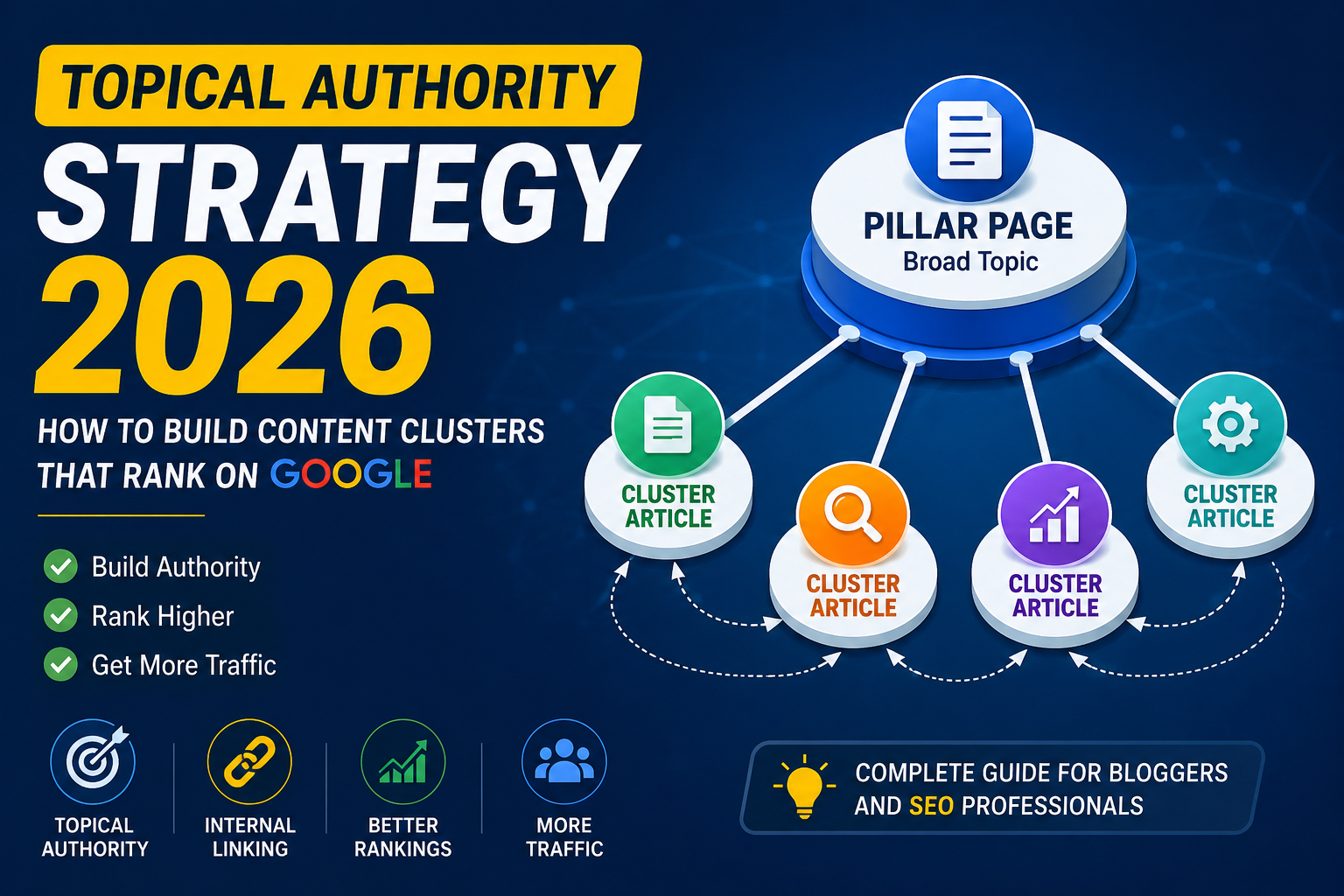
What is a Content Cluster?
A content cluster is an organized group of articles that collectively cover a broad topic in depth, structured in a way that helps both users and search engines understand the relationship between the content.
A standard content cluster has three components:
The Pillar Page This is a comprehensive, long-form article that covers a broad topic at a high level. It serves as the central hub of your content cluster and links out to all related cluster articles.
Example: “The Complete Guide to Personal Finance in Pakistan”
Cluster Articles These are individual articles that dive deeply into specific subtopics within the broader subject covered by the pillar page. Each cluster article covers one angle in far greater detail than the pillar page could accommodate.
Examples for a personal finance cluster:
- SadaPay vs NayaPay vs EasyPaisa — Complete Comparison
- How to Save Money in Pakistan — 10 Proven Strategies
- Mutual Funds in Pakistan — Beginner’s Guide
- How to Protect Your Savings from Inflation
- HBL vs Meezan Bank vs UBL — Which is Best?
Internal Links Every cluster article links back to the pillar page, and the pillar page links out to every cluster article. Related cluster articles also link to each other where contextually appropriate.
This interconnected structure accomplishes several things: it tells Google that all these articles are related to one core topic, it distributes link equity throughout the cluster, it keeps users navigating within your content, and it accelerates your topical authority build.
Pillar Pages vs Cluster Articles — Understanding the Difference
Many website owners confuse pillar pages with standard long-form articles. They are different in purpose and structure.
| Feature | Pillar Page | Cluster Article |
|---|---|---|
| Length | 3,000 to 8,000+ words | 1,500 to 3,000+ words |
| Topic coverage | Broad overview of the main topic | Deep dive into one specific subtopic |
| Internal links | Links to all cluster articles | Links back to pillar and to related clusters |
| Keyword target | Broad, higher-volume head keyword | Specific, long-tail keyword |
| Primary purpose | Central hub of the content cluster | Depth and detail on one angle |
| Tone | Comprehensive but accessible | Detailed and specific |
A pillar page is not simply a very long article. It is a strategic hub designed to introduce users to a topic, give them a solid foundational understanding, and then guide them to deeper resources through its cluster articles. The pillar page breadth is intentional — it covers the what and the why, while cluster articles cover the how in detail.
How to Build Topical Authority — Complete Step-by-Step Process
Here is the full practical process for building topical authority through content clusters.
Step 1: Define Your Core Niche Areas
Before you can build topical authority, you need to clearly decide which topics you want to be authoritative on. Be specific and realistic.
For a website covering multiple niches — such as SEO, personal finance, cryptocurrency, AI tools, and online earning — the most effective approach is to build authority one niche at a time rather than trying to tackle everything simultaneously.
Pick the one or two niches where you can publish the most valuable content most consistently, and begin your content cluster strategy there first.
Step 2: Map Every Subtopic Within Your Chosen Niche
Once you have chosen a niche, map out every meaningful subtopic within it. This is sometimes called a topic map or a content gap analysis.
Open a blank document and work through this question systematically:
“If someone wanted to know everything about [your chosen topic], what are all the different things they would need to understand?”
For personal finance as an example, subtopics might include:
- Saving money
- Budgeting
- Banking and digital wallets
- Investing (mutual funds, stocks, real estate)
- Protecting savings against inflation
- Understanding different bank accounts
- Sending and receiving money internationally
- Understanding taxes
- Financial planning for freelancers
List every angle you can think of. This becomes your content roadmap.
Step 3: Identify Your Pillar Page Topic
From your topic map, identify the broadest, most central topic that can serve as your pillar page. This should be something that:
- Has meaningful search volume
- Serves as a natural hub for all other subtopics
- Can be written comprehensively enough to justify linking out to multiple cluster articles
Using the personal finance example, a suitable pillar page might be: “The Complete Guide to Personal Finance in Pakistan” or “How to Manage Your Money in Pakistan — A Practical Guide.”
Step 4: Identify and Prioritize Your Cluster Articles
From the remaining subtopics in your map, these become your cluster articles. Prioritize them based on:
- Search demand — how often are people searching for this subtopic?
- User intent — what is the searcher actually trying to accomplish?
- Content gap — is this subtopic already well-covered on your site?
- Strategic value — does covering this topic attract the right audience?
Build a publishing schedule and commit to covering each subtopic with a dedicated, high-quality article.
Step 5: Write and Publish the Pillar Page First
Begin with the pillar page. This establishes the foundation of your cluster and gives you a central page to link back to from every cluster article you subsequently publish.
The pillar page should:
- Comprehensively introduce the main topic
- Address the most important questions users have at a high level
- Include a table of contents for easy navigation
- Link to all existing cluster articles — and be updated as new ones are published
- Be written at a level that is accessible to beginners while still being genuinely valuable
Step 6: Publish Cluster Articles Systematically
Now publish your cluster articles one by one. Each article should:
- Cover its specific subtopic in genuine depth
- Include a natural link back to the pillar page
- Include links to other relevant cluster articles
- Be long enough to fully satisfy the user’s search intent for that subtopic
- Be optimized for its specific long-tail or secondary keyword
As you publish each new cluster article, go back to your pillar page and add a link to it.
Step 7: Build Internal Links Across the Entire Cluster
Beyond the standard pillar-to-cluster and cluster-to-pillar links, look for opportunities to link between cluster articles themselves where the connection is natural and genuinely useful for readers.
For example, an article about mutual funds in Pakistan might naturally link to an article about saving money and to an article about protecting savings from inflation — because these topics are genuinely related and readers moving between them are following a logical learning path.
Step 8: Monitor, Update, and Expand
Building topical authority is not a one-time project. It is an ongoing process.
Monitor your cluster articles for:
- Ranking improvements as the cluster grows
- New subtopics emerging in your niche that need to be addressed
- Articles that need to be updated as information changes
- Opportunities to add more internal links as new content is published
Treat your content clusters as living structures that grow and strengthen over time.
How to Find Content Gaps in Your Niche
A content gap is any subtopic within your niche that your website has not yet addressed — or has addressed poorly. Filling content gaps is essential to building complete topical coverage.
Method 1: Google Autocomplete and People Also Ask Type your main topic keyword into Google and look at the autocomplete suggestions. Then search it and examine the “People Also Ask” section. These are real questions that real users are searching for — and they represent content opportunities.
Method 2: Competitor Analysis Look at the websites currently ranking for your main topic keywords. What articles do they have that you do not? What subtopics are they covering that are absent from your site? You do not need to copy them — you need to be more comprehensive than them.
Method 3: SEO Tools Tools like Ahrefs, SEMrush, and Moz have content gap analysis features that show you keywords your competitors rank for but you do not. At the time of writing, these features are available in their respective paid plans — verify current features and pricing directly from each tool’s official website.
Method 4: Your Own Audience Look at the questions your readers send you, the comments on your articles, and the topics that come up repeatedly in your niche community. These represent real demand from real users.
Internal Linking and Topical Authority
Internal linking is the mechanical backbone of your content cluster strategy. Without deliberate and consistent internal linking, your cluster articles exist in isolation — and Google cannot understand their topical relationship to each other or to your pillar page.
Here are the principles that guide effective internal linking within a content cluster:
Link with descriptive anchor text Use anchor text that describes what the linked article is about — not generic phrases like “click here” or “read more.” Descriptive anchor text helps Google understand the relationship between the pages.
Prioritize contextual relevance Only link between articles when the connection genuinely makes sense for the reader. Forced or irrelevant internal links add noise without adding value.
Link new articles to older ones When you publish a new cluster article, go back through your existing articles and find places to naturally add a link to the new piece. This distributes authority to newer content.
Keep your pillar page updated Every time a new cluster article is published, add it to the pillar page’s list of related resources or link to it within the body content where appropriate.
Track your internal link structure Use a simple spreadsheet or a tool like Screaming Frog to track which pages are linking to which — and identify articles that have too few internal links pointing to them.
Keyword Research for Content Clusters
Keyword research for a content cluster strategy is different from standard keyword research. The goal is not to find isolated high-volume keywords — it is to map the full range of search intent across your topic.
Head Keyword — for the Pillar Page Choose a broad keyword with meaningful search volume that represents the overall topic. This becomes the primary target for your pillar page.
Long-Tail Keywords — for Cluster Articles Each cluster article targets a specific long-tail keyword that represents a more focused search intent within the broader topic. These tend to be lower competition and higher intent than head keywords.
Semantic Keywords and Related Terms Within each article, naturally incorporate semantic keywords — related terms and phrases that Google associates with your main topic. This strengthens topical relevance without keyword stuffing.
User Intent Mapping For each keyword, understand what the user actually wants to accomplish. Are they looking for information? Trying to compare options? Ready to take an action? Write content that fully satisfies that intent.
How Many Articles Do You Need?
There is no single correct answer, but here are practical guidelines:
A minimum viable content cluster typically includes:
- One well-developed pillar page
- Five to ten cluster articles covering the most important subtopics
A strong, competitive content cluster might include:
- One pillar page
- Fifteen to thirty or more cluster articles covering the topic comprehensively
The goal is complete topical coverage — not hitting a specific number. Ask yourself: “Is there any meaningful question a user could have about this topic that my website does not answer?” Keep publishing until the answer is no.
For a new website, start with one complete cluster before expanding into additional topic areas. Depth in one niche builds authority faster than shallow coverage across many niches.
Common Mistakes That Destroy Topical Authority
Publishing content on too many unrelated topics A website that covers SEO, personal finance, travel tips, cooking recipes, and sports news simultaneously does not build topical authority in any of them. Focus is essential.
Skipping the pillar page Publishing cluster articles without a central pillar page creates isolated content without the hub-and-spoke structure that communicates topical depth to Google.
Neglecting internal links Publishing cluster articles and not linking them to the pillar page and to each other defeats the entire strategic purpose of the content cluster model.
Thin cluster articles Writing short, superficial cluster articles just to fill in the topic map without providing genuine depth does not build authority — it dilutes it.
Abandoning the cluster after initial publication Topical authority builds over time as your cluster grows. Stopping after five articles leaves significant gaps that competitors will fill.
Targeting keywords with no coherent topical connection Each cluster article should clearly belong to the same topical family as the pillar page. Articles that are tangentially related or entirely off-topic break the cluster’s coherence.
How Long Does It Take to Build Topical Authority?
Building genuine topical authority takes time. There are no meaningful shortcuts.
Realistic general expectations based on consistent effort:
- Two to three months: Google begins to recognize your website’s topical focus as cluster articles accumulate
- Three to six months: Initial ranking improvements appear for lower-competition cluster article keywords
- Six to twelve months: The pillar page begins to rank more competitively; new articles rank faster
- Twelve months and beyond: Compounding authority effects — new content ranks more quickly and you become genuinely competitive for higher-difficulty terms
These timelines assume consistent publishing, genuine content quality, and at least basic link building activity. Results vary based on niche competition, content depth, and domain age. No specific outcomes are guaranteed.
Key Takeaways
- Topical authority means Google recognizes your website as a comprehensive, trusted source on a specific subject
- Content clusters — pillar pages connected to supporting cluster articles through internal links — are the primary mechanism for building topical authority
- Topical authority matters more in 2026 than ever before due to Google’s Helpful Content updates and E-E-A-T emphasis
- Building topical authority requires depth first — covering one niche completely before expanding to others
- Internal linking is the structural backbone that makes content clusters work
- Content gap analysis helps you identify what subtopics you still need to cover
- Topical authority builds over months and compounds over time — consistency is the key variable
FAQ
Q: Can a new website build topical authority? Yes. In fact, a focused content cluster strategy is one of the most effective approaches for new websites — it compensates for low domain authority by demonstrating deep topical expertise from the start. New sites with strong topical coverage often outrank older sites with scattered content.
Q: Does topical authority replace the need for backlinks? No. Topical authority and backlinks are complementary strategies, not alternatives. Strong topical authority helps you rank with fewer backlinks than a scattered site would need — but backlinks still contribute meaningfully to overall rankings and domain authority.
Q: How many content clusters can one website have? As many as are appropriate for your niche and publishing capacity. However, the most effective approach is to build one cluster to completion before starting the next — rather than building several clusters simultaneously at shallow depth.
Q: Does social media content help build topical authority? Social media signals themselves do not directly build topical authority on your website. However, social media drives traffic, earns engagement, and creates link building opportunities — all of which indirectly support your topical authority strategy.
Q: Should I cover every possible subtopic, even ones with very low search volume? Not necessarily. Focus on subtopics with meaningful search demand and clear user intent. Covering extremely obscure subtopics with no search volume adds content volume but not necessarily topical authority signal.
Internal Linking Suggestions
| Suggested Article | Recommended Anchor Text | Why It Is Relevant |
|---|---|---|
| What is Domain Authority & How to Increase It in 2026 | how domain authority works | Topical authority and domain authority are directly connected strategies |
| Internal Linking Strategy 2026 | internal linking for SEO | Internal links are the structural backbone of content clusters |
| Keyword Research Kaise Karein — Free Tools Guide | keyword research for content clusters | Keyword strategy is the foundation of effective cluster planning |
| On-Page SEO Complete Checklist 2026 | on-page SEO optimization | Each cluster article needs strong on-page optimization to perform |
| Free Backlinks Kaise Banayein 2026 | building backlinks for authority | Backlinks work alongside topical authority for complete SEO strength |
External Source Suggestions
- Google Search Central — How Google Evaluates Content Quality: developers.google.com/search/docs/fundamentals/creating-helpful-content
- Moz — Topical Authority in SEO: moz.com/blog
- Ahrefs Blog — Content Clusters and Pillar Pages: ahrefs.com/blog
- Google’s E-E-A-T Guidelines: developers.google.com/search/docs/fundamentals/creating-helpful-content
Conclusion
Topical authority is not a tactic. It is a long-term content strategy — and in 2026, it is one of the most important foundations for sustainable organic growth.
The websites that consistently rank well, consistently attract backlinks, and consistently grow their organic traffic are not the ones chasing individual keywords in isolation. They are the ones that have committed to covering their subject areas with genuine depth, structure, and consistency.
The content cluster model gives you a practical, step-by-step framework to build that depth systematically. Start with one pillar page, build out your cluster articles one by one, connect them with deliberate internal linking, fill your content gaps continuously — and give the strategy the time it needs to compound.
Authority does not happen in a month. But with the right strategy and the right consistency, it happens with certainty.
Explore our related guides on domain authority, internal linking strategy, and keyword research — all available on Finzaro360 — to build a complete SEO foundation for your website.
Disclaimer
This article is published for educational and informational purposes only. SEO strategies including topical authority and content clustering vary in effectiveness depending on niche competition, content quality, domain age, and many other variables. No specific rankings or traffic outcomes are guaranteed. Algorithm features and tool capabilities referenced in this article may change over time — always verify from official sources.