
Introduction
link building guide pakistan
If you want your website to rank on Google, there are very few strategies more important than link building.
Backlinks — links from other websites pointing to yours — remain one of Google’s most significant ranking signals in 2026. A website with strong, high-quality backlinks consistently outranks websites with weak or no link profiles, even when the content quality is comparable.
But link building is also one of the most misunderstood areas of SEO. There are legitimate strategies that build genuine, lasting authority — and there are manipulative shortcuts that might produce short-term results but carry serious long-term risks.
Understanding the difference between white hat link building (legitimate, sustainable) and black hat link building (manipulative, risky) is not just an academic exercise. It is a practical decision that determines whether your website grows safely over years or risks penalties that can wipe out your rankings overnight.
This guide covers everything: what link building is, why it matters, the full spectrum from white hat to black hat techniques, and a practical roadmap for building backlinks that actually help your website grow — with specific context for bloggers and website owners in Pakistan.
Table of Contents
- What is Link Building?
- Why Backlinks Still Matter in 2026
- How Google Evaluates Backlinks
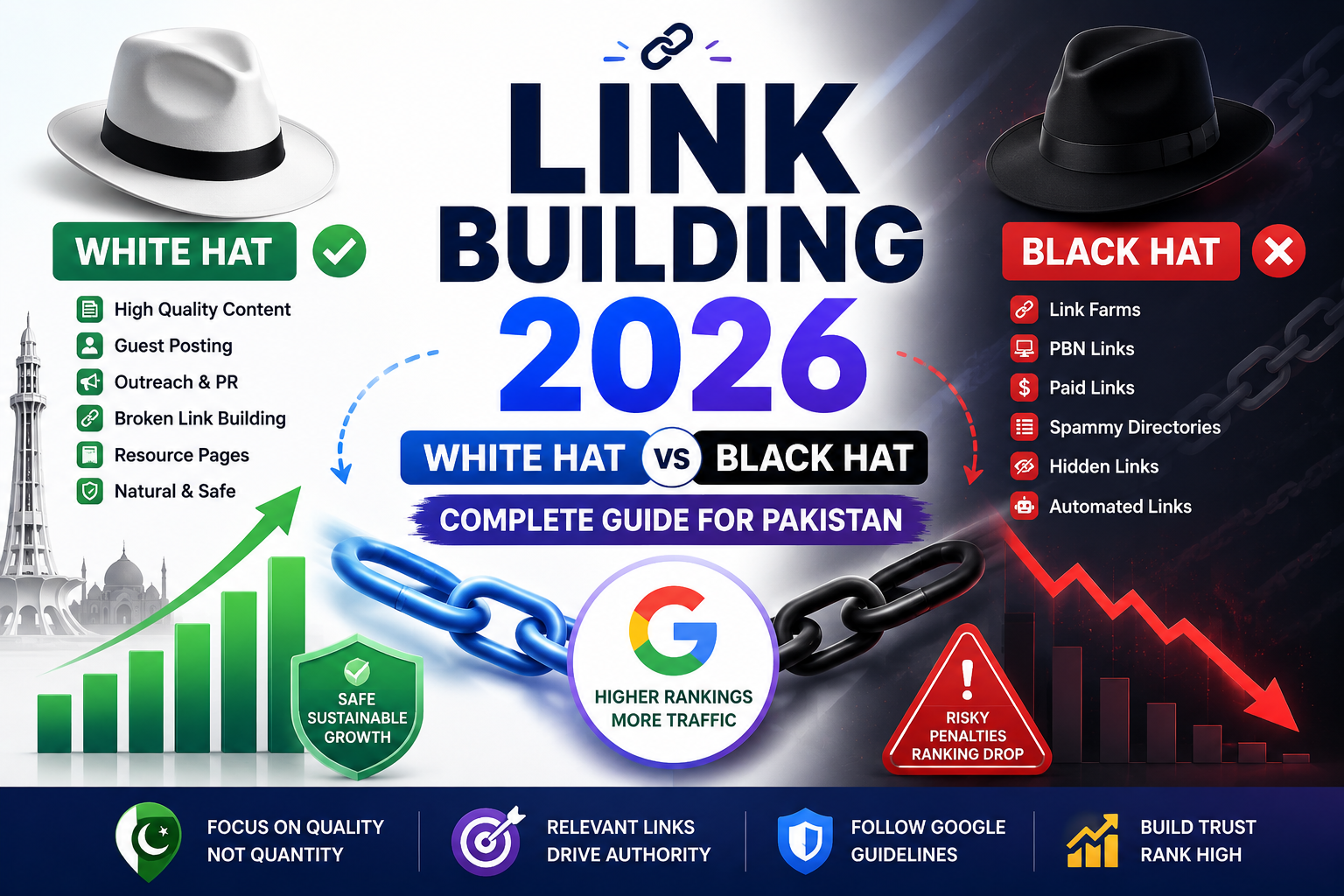
- White Hat vs Grey Hat vs Black Hat — The Full Spectrum
- White Hat Link Building Techniques
- Grey Hat Link Building Techniques
- Black Hat Link Building Techniques
- The Risks of Black Hat Link Building
- Link Building in Pakistan — Practical Context
- How to Evaluate a Backlink Opportunity
- How to Get Started With Link Building
- Common Link Building Mistakes
- Key Takeaways
- FAQ
- Internal Linking Suggestions
- Conclusion
- Disclaimer
What is Link Building?
Link building is the process of acquiring hyperlinks from other websites that point to your own website. These inbound links are commonly called backlinks.
When another website links to your content, it is essentially passing a vote of confidence — telling search engines that your content is valuable enough to reference. Google’s algorithm was originally built around this concept: pages with more high-quality links pointing to them are considered more authoritative and are ranked higher in search results.
Over the decades, Google has refined how it evaluates links enormously. It no longer counts all links equally. The quality, relevance, diversity, and naturalness of your backlink profile all factor into how much ranking benefit you receive from any given link.
Link building, as a discipline, is about earning or acquiring the kinds of links that send strong positive signals to Google — while avoiding the kinds that trigger penalties or distrust.
Why Backlinks Still Matter in 2026
Despite years of speculation that Google would eventually move away from links as a ranking signal, backlinks remain one of the most important factors in search rankings in 2026.
Google has confirmed through its documentation and through statements from its representatives that links are among the top signals it uses to evaluate page quality and authority. The reason is straightforward: a link from one website to another represents a human editorial decision — someone decided that your content was worth referencing. That signal of genuine endorsement is difficult to replicate through any purely technical means.
What has changed is how Google evaluates those links. In 2026, a single high-quality, relevant backlink from an established authority site in your niche delivers more benefit than hundreds of low-quality, irrelevant, or obviously manipulated links. The emphasis has shifted decisively from quantity to quality.
For new and growing websites, building a strong backlink profile is often the primary difference between content that ranks well and content that remains invisible in search results regardless of its quality.
How Google Evaluates Backlinks
Not all backlinks are created equal. Google evaluates each link across several dimensions:
Relevance A backlink from a website that covers the same or closely related topics as yours carries significantly more value than a link from an unrelated website. A finance blog receiving a link from another finance website sends a strong relevance signal. The same finance blog receiving a link from a cooking website sends almost no signal.
Authority of the Linking Domain Links from established, authoritative websites — major publications, industry leaders, government sites — carry more weight than links from new or low-authority sites. One link from a high-authority domain can be worth dozens of links from minor sites.
Placement Within Content Links embedded naturally within the body content of an article — contextual links — carry more weight than links in footers, sidebars, or author bios. Contextual placement suggests genuine editorial endorsement.
Anchor Text The clickable text of the link provides Google with additional context about what the destination page covers. Descriptive, keyword-relevant anchor text reinforces the topical relevance of the link.
Link Velocity How quickly you acquire backlinks matters. A sudden, unnatural spike in backlinks — particularly from low-quality sources — can trigger algorithmic suspicion. Natural link growth tends to be gradual and consistent.
Dofollow vs Nofollow Dofollow links pass link equity to your site. Nofollow links instruct Google not to pass equity, though they may still have indirect benefits. Most editorial backlinks are dofollow by default.
White Hat vs Grey Hat vs Black Hat — The Full Spectrum
Link building strategies exist on a spectrum from completely legitimate to clearly manipulative. Understanding where different techniques fall helps you make informed decisions about your strategy.
| Category | Definition | Risk Level |
|---|---|---|
| White Hat | Fully compliant with Google guidelines | Low — sustainable long-term |
| Grey Hat | Not explicitly banned but potentially manipulative | Medium — risk varies by implementation |
| Black Hat | Clearly violates Google’s guidelines | High — risk of manual penalties |
The distinction is not always perfectly clear — some techniques exist in genuinely ambiguous territory. The guiding principle is whether the link represents a genuine editorial endorsement or whether it was acquired primarily to manipulate search rankings.
White Hat Link Building Techniques
These are the strategies that are fully aligned with Google’s guidelines and build lasting, defensible authority.
Guest Posting on Relevant Websites
Guest posting involves writing original articles for other websites in your niche in exchange for a byline and a backlink to your own site.
When done properly — pitching to genuinely relevant, quality websites, writing original and valuable content, and earning links naturally within that content — guest posting is one of the most effective white hat link building strategies available.
The key qualifications:
- The host website should be genuinely relevant to your niche
- The content should provide real value to the host site’s audience
- The link should be natural and contextually relevant within the article
- The host site should have real editorial standards and genuine traffic
Guest posting becomes grey hat when it is done purely for links with no regard for content quality, or at industrial scale across hundreds of low-quality sites.
Creating Linkable Assets
A linkable asset is any piece of content so useful, original, or comprehensive that other websites naturally want to reference it.
Examples of effective linkable assets:
- Original research or surveys with data that others want to cite
- Comprehensive guides that become go-to references in a niche
- Free tools and calculators that bloggers embed or link to
- Infographics that visualize complex information clearly
- Curated resource lists that become standard references
This is sometimes called earning links rather than building them — creating content so valuable that links come to you organically.
Broken Link Building
Broken link building involves finding links on other websites that point to pages that no longer exist (returning 404 errors), and then reaching out to the website owner to suggest your content as a replacement.
This is a genuinely useful technique for website owners — you are helping them fix a problem while earning a link. It is white hat because the link you earn is a legitimate editorial replacement for content that already existed.
Digital PR and Brand Mentions
Getting your website mentioned in news articles, industry roundups, podcast show notes, and editorial publications earns some of the highest-quality backlinks available.
This typically requires either genuinely newsworthy content, expert commentary, or active outreach to journalists and editors. It is time-intensive but produces highly authoritative backlinks.
Resource Page Link Building
Many websites maintain resource pages — curated lists of useful tools, guides, and references for their audience. Reaching out to suggest your relevant content for inclusion on these pages is a straightforward and legitimate link building approach.
Skyscraper Technique
The skyscraper technique involves identifying highly-linked content in your niche, creating a significantly better version of that content, and then reaching out to websites that link to the original to let them know your improved version exists.
This works because you are offering website owners a genuinely better resource to link to. The quality of your content does the persuasion work.
HARO and Expert Quotes
Help a Reporter Out (HARO) and similar journalist query platforms connect reporters seeking expert sources with website owners who can provide commentary. Providing quality expert quotes earns editorial backlinks from media publications.
At the time of writing, several HARO alternatives exist following changes to the original platform. Verify current options by searching for journalist query platforms relevant to your niche.
Grey Hat Link Building Techniques
Grey hat techniques are not explicitly banned by Google but involve some degree of manipulation or risk. They exist in genuinely ambiguous territory.
Link Exchanges
Mutually agreeing to link to each other’s websites — sometimes called link swaps — can be legitimate when done between genuinely relevant sites at reasonable scale. However, excessive reciprocal linking primarily for SEO purposes violates Google’s link scheme guidelines.
Occasional, natural link exchanges between complementary sites are unlikely to cause issues. Systematic, large-scale link exchange programs are risky.
Sponsored Posts with Followed Links
Paying for placement of an article containing a backlink on another website is technically a link scheme according to Google’s guidelines — unless the paid link is marked with the nofollow or sponsored attribute. Many websites accept paid guest posts with dofollow links without proper disclosure.
This is a common practice in the Pakistani blogging community and across the global SEO industry. The risk level depends on scale, link quality, and how obvious the arrangement appears to Google’s algorithms.
Private Blog Networks (PBNs)
PBNs are networks of websites created primarily to sell backlinks to other sites. They are considered grey to black hat depending on how transparent the arrangement is and how obviously the sites were created purely for link purposes.
Using PBNs carries significant risk of Google penalties. Many SEO professionals avoid them entirely.
Black Hat Link Building Techniques
These techniques clearly violate Google’s Webmaster Guidelines and carry a real risk of manual penalties, algorithmic demotions, or complete deindexation.
Buying Links From Link Farms
Link farms are websites or networks created purely to sell links, with no genuine editorial content or real audience. Purchasing links from these sources violates Google’s policies and provides little to no real benefit — Google’s algorithms have become increasingly effective at identifying and devaluing such links.
Automated Link Building
Using software to automatically create thousands of links across blog comment sections, forums, profile pages, and web directories. These links are low quality, obviously manipulative, and can trigger spam detection.
Hidden Links
Adding links to a page that are invisible to human visitors — through CSS tricks, white text on white backgrounds, or other concealment methods. This is a clear violation of Google’s guidelines and a classic spam technique.
Cloaking
Showing different content to search engine crawlers than to human visitors — often to hide manipulative link structures from Google. A serious black hat technique with significant penalty risk.
Negative SEO Attacks
Building spammy, toxic links to a competitor’s website to damage their rankings. While this is directed at others rather than yourself, it is a fundamentally manipulative technique and is considered black hat.
The Risks of Black Hat Link Building
The consequences of black hat link building are serious and potentially permanent.
Algorithmic Demotions Google’s Penguin algorithm (now part of Google’s core algorithm and running in real time) is specifically designed to identify and devalue manipulative link patterns. Sites with unnatural link profiles may experience significant ranking drops without any manual action.
Manual Penalties Google’s search quality team issues manual actions — direct penalties — against websites with clear link scheme violations. A manual penalty can remove your site from search results entirely for specific queries or site-wide.
Recovery Is Difficult Recovering from a Google penalty typically requires identifying and removing or disavowing all problematic links, submitting a reconsideration request, and waiting — sometimes for months — for Google to reassess your site. There is no guarantee of full recovery.
Wasted Investment Black hat links typically cost money — and the traffic and rankings they generate are temporary. When the penalty comes, the entire investment is lost.
Reputation Damage Being known in your niche as a site that uses manipulative tactics damages your credibility with legitimate link partners, advertisers, and readers.
The risk-reward calculation for black hat link building in 2026 is deeply unfavorable. The risks are significant, the rewards are temporary, and sustainable alternatives exist.
Link Building in Pakistan — Practical Context
For website owners and bloggers in Pakistan, link building presents both specific challenges and specific opportunities.
The opportunity: Pakistani bloggers operate in a market with relatively lower competition for many English and Urdu language keywords compared to Western markets. Building a strong backlink profile even at modest scale can produce competitive results.
Guest post communities: Active communities of Pakistani bloggers and website owners exist across Facebook groups, WhatsApp groups, and LinkedIn. These communities frequently facilitate legitimate guest post exchanges and link partnerships. Engaging in these communities is one of the most practical starting points for link building in Pakistan.
English-language outreach: Many Pakistani bloggers underestimate the accessibility of international guest posting opportunities. High-quality English content written by Pakistani bloggers can absolutely secure placements on international authority websites — and those international links carry significant value.
Local directory citations: For locally-focused businesses and blogs, getting listed in legitimate Pakistani business directories and industry platforms builds both links and local visibility.
University and educational websites: .edu.pk links from Pakistani educational institutions carry authority. These can sometimes be earned through scholarship pages, resource contributions, or academic partnerships.
Avoiding fake metrics services: The Pakistani freelancing community has a large presence of individuals and services offering fake DA increases, low-quality PBN links, and bulk backlink packages. These services carry the risks described above. Evaluate any link building service carefully before investing.
How to Evaluate a Backlink Opportunity
Before accepting a link from or building a link on any website, evaluate it across these criteria:
Relevance Is this website genuinely related to your niche? An off-topic site provides minimal benefit regardless of its authority.
Traffic Does the website receive real organic traffic? A tool like Ahrefs or SEMrush can show estimated traffic. A site with zero organic traffic likely has limited editorial value.
Domain Authority or Domain Rating While not the only factor, a reasonable DA or DR score indicates that the site has some established authority. At the time of writing, a guest post on a site with DA 20 and above is generally worth pursuing for niche blogs.
Content Quality Does the website publish genuine, well-written content? Sites with thin, low-quality, or obviously AI-spun content are unlikely to provide valuable links.
Spam Score Check the site’s spam score in Moz. A high spam score suggests a problematic backlink profile that Google may have already discounted.
Editorial Standards Does the site have clear editorial guidelines? Does it review and approve content? Sites with no standards that accept any submitted content indiscriminately provide less valuable links.
How to Get Started With Link Building
If you are starting from scratch, here is a practical roadmap:
Step 1: Publish link-worthy content first Before any outreach, make sure you have published comprehensive, genuinely valuable content. No one links to thin or mediocre content. Your best pillar articles and guides are your primary link-earning assets.
Step 2: Start with your network Reach out to bloggers and website owners you already know — in your niche, in your community, in Pakistani blogging groups. These warm connections are the easiest starting point.
Step 3: Begin guest post outreach Identify five to ten websites in your niche that accept guest posts. Research their content, understand their audience, and pitch relevant article ideas that add genuine value to their readers.
Step 4: Create at least one linkable asset Build one genuinely useful tool, comprehensive guide, or original research piece that gives websites a reason to link to you without requiring outreach.
Step 5: Build consistently, not in bursts Aim for one to three quality links per month rather than trying to build fifty links in a single week. Consistent, gradual link growth looks natural. Sudden spikes look suspicious.
Step 6: Track your backlink profile Use Google Search Console’s Links report and a tool like Ahrefs or Moz to monitor your growing backlink profile. Know what you have, where it is coming from, and what anchor text is being used.
Common Link Building Mistakes
Prioritizing quantity over quality Fifty links from irrelevant, low-quality directories provide less benefit and more risk than five links from relevant, established websites.
Using the same anchor text repeatedly Building dozens of links with identical keyword-rich anchor text looks manipulative. Vary your anchor text naturally.
Buying cheap link packages Services offering hundreds of links for small amounts of money almost universally use low-quality or manipulative methods. These links rarely help and frequently cause harm.
Ignoring relevance Links from completely unrelated websites provide minimal SEO benefit regardless of the linking site’s authority.
Not monitoring for toxic links Occasionally, your website may attract spammy links from low-quality sites that linked to you without your knowledge. Monitor and disavow these regularly.
Giving up too early Link building is slow at first. Most outreach gets ignored. Persistence and genuine value creation are the keys to long-term success.
Key Takeaways
- Backlinks remain one of Google’s most important ranking signals in 2026
- White hat link building — guest posting, linkable assets, broken link building, digital PR — is sustainable and safe
- Black hat techniques — link farms, PBNs, automated links, hidden links — carry serious penalty risk and should be avoided
- Quality and relevance of backlinks matter far more than quantity
- For Pakistani bloggers, community engagement and English-language guest posting are the most accessible starting points
- Evaluate every backlink opportunity across relevance, traffic, authority, and content quality
- Build links consistently and gradually — sudden spikes in link acquisition look unnatural
FAQ
Q: How many backlinks do I need to rank on Google? There is no specific number. What matters is that your backlink profile is stronger and more relevant than your direct competitors for your target keywords. In lower-competition niches, even a small number of quality links can be sufficient. Always benchmark against the sites currently ranking for your target terms.
Q: Is guest posting still effective in 2026? Yes, when done properly. Guest posting on genuinely relevant, quality websites that have real audiences and editorial standards remains one of the most effective white hat link building strategies. The key distinction is quality and relevance — not volume.
Q: Should I disavow all low-quality links? Not necessarily all of them. Google’s algorithm already discounts many low-quality links automatically. The disavow tool is most useful when you have a clear pattern of manipulative links that you believe are actively harming your rankings. Use it selectively and carefully.
Q: How do I find websites that accept guest posts? Search Google for phrases like “[your niche] write for us,” “[your niche] guest post guidelines,” or “[your niche] submit article.” You can also look at the backlink profiles of competitors using Ahrefs or SEMrush to see where they have earned guest post placements.
Q: Can I build links to a brand new website? Yes, but focus on content first. A new website without substantial content is difficult to pitch for guest posts or link placements. Publish at least ten to fifteen quality articles before beginning serious link building outreach.
Internal Linking Suggestions
| Suggested Article | Recommended Anchor Text | Why It Is Relevant |
|---|---|---|
| Free Backlinks Kaise Banayein 2026 | how to build free backlinks in 2026 | Directly complementary — covers specific free backlink methods in detail |
| What is Domain Authority & How to Increase It in 2026 | how backlinks affect domain authority | Link building is the primary driver of domain authority improvement |
| Guest Posting in 2026: Benefits, Risks & Best Practices | guest posting strategy 2026 | Guest posting is the most important white hat link building technique |
| Topical Authority Kaise Build Karein — Content Cluster Strategy 2026 | building topical authority | Topical authority and link building are complementary SEO strategies |
| On-Page SEO Complete Checklist 2026 | on-page SEO checklist | On-page optimization and link building work together for complete SEO |
External Source Suggestions
- Google Search Central — Link Scheme Guidelines: developers.google.com/search/docs/essentials/spam-policies#link-spam
- Google Disavow Tool: search.google.com/search-console/disavow-links
- Moz — Link Building Guide: moz.com/learn/seo/link-building
- Ahrefs — Backlink Checker: ahrefs.com/backlink-checker
Conclusion
Link building remains one of the most important and most misunderstood aspects of SEO. Done right — with genuine value creation, relevant outreach, and consistent effort — it builds the kind of authority that compounds over time and produces lasting rankings.
Done wrong — with shortcuts, low-quality purchases, and manipulative schemes — it creates the illusion of progress until Google catches up and erases it.
For bloggers and website owners in Pakistan, the opportunity is real. With consistent white hat link building, quality content, and engagement with the blogging community, it is absolutely possible to build a website with genuine authority and competitive rankings — in any niche.
The path is not quick. But it is clear, it is sustainable, and it produces results that last.
Explore our related guides on domain authority, guest posting, and free backlink strategies — all available on Finzaro360.
Disclaimer
This article is published for educational and informational purposes only. SEO strategies and Google’s guidelines evolve over time — always refer to Google’s official Search Central documentation for the most current guidance. Link building results vary significantly based on niche, competition, content quality, and consistency of effort. No specific rankings or traffic outcomes are guaranteed.