
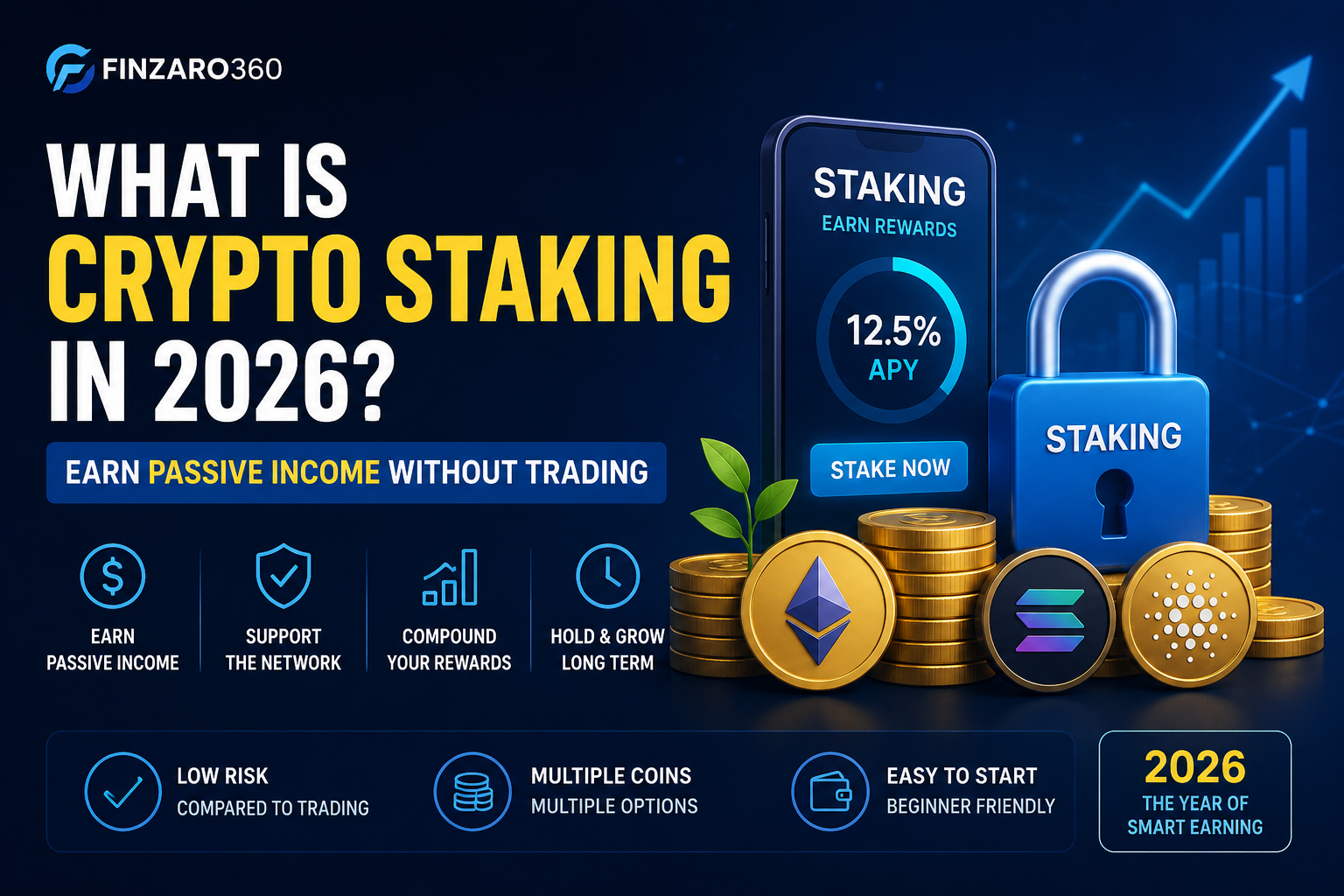

What Is Crypto Staking in 2026? Earn Passive Income Without Trading | Finzaro360
Most people think there are only two ways to make money in crypto — buy low and sell high, or lose sleep watching charts at 3am. But there’s a third way that most beginners completely miss: staking. And it’s one of the most underrated passive income strategies in the crypto world right now.
In this guide, we’ll break down exactly what crypto staking is, how it works in plain language, which coins you can stake, and how to start — even if you’ve never staked anything before.
What Is Crypto Staking — In Simple Words
Staking is basically locking up your cryptocurrency for a period of time to help support a blockchain network — and getting paid for doing it. Think of it like a fixed deposit account at a bank. You lock in your money, the bank uses it, and you earn interest. Staking works on a similar principle, except instead of a bank, it’s a decentralized blockchain network doing the work.
When you stake crypto, you’re participating in what’s called a Proof of Stake (PoS) system. The network uses your staked coins to validate transactions and secure the blockchain. In return, it rewards you with more of the same cryptocurrency — usually as a percentage of what you’ve staked, paid out daily, weekly, or monthly depending on the platform.
How Does Staking Actually Work?
Here’s the simple version: blockchains need validators to confirm that transactions are legitimate. In a Proof of Stake system, validators are chosen based partly on how much crypto they’ve staked. The more you stake, the higher your chances of being selected to validate — and earn rewards.
You don’t need to run your own validator node. Most platforms let you delegate your coins to an existing validator and still earn a share of the rewards. This is called delegated staking, and it’s what most regular users do.
What Cryptocurrencies Can You Stake?
Not every crypto supports staking — Bitcoin, for example, runs on Proof of Work (mining), not Proof of Stake, so you can’t stake BTC. But many of the top coins do support it:
- Ethereum (ETH) — One of the most popular staking options. You can stake ETH directly or through liquid staking platforms.
- Solana (SOL) — High rewards, fast network, beginner-friendly staking options.
- Cardano (ADA) — Known for flexible staking with no lockup period.
- Polygon (MATIC) — Good for beginners, widely supported on exchanges.
- BNB (Binance Coin) — Stakeable directly on Binance with flexible and locked options.
- USDT / USDC (Stablecoins) — You can stake stablecoins too, earning yield without exposure to price volatility.
For a solid foundation on Ethereum before you stake, read our guide: What Is Ethereum in 2026? Complete Beginner’s Guide to ETH.
Where Can You Stake Crypto? (3 Main Options)
Option 1 — Centralized Exchanges (Easiest for Beginners)
Platforms like Binance offer built-in staking directly in your account. You just go to the “Earn” section, choose a coin, pick flexible or locked staking, and done. No technical knowledge required.
If you don’t have a Binance account yet, create one here: Register on Binance — it’s free and takes under 5 minutes. Pakistan mein Binance account kaise banayein, iske liye hamara guide parhen: Binance Account Kaise Banayein Pakistan 2026.
Option 2 — DeFi Staking Platforms (More Control, More Risk)
Platforms like Lido, Rocket Pool, or native blockchain wallets let you stake without a centralized exchange. You keep custody of your coins, which is safer from an exchange-risk perspective, but it requires more technical know-how.
Option 3 — Hardware Wallets (Most Secure)
If you’re staking larger amounts, consider using a hardware wallet like the Ledger Nano X for maximum security. Read our honest review: Ledger Nano X Review 2026.
How Much Can You Actually Earn From Staking?
Returns vary widely depending on the coin and platform. Here are rough APY (Annual Percentage Yield) ranges as of 2026:
| Coin | Approximate APY | Lock Period |
|---|---|---|
| Ethereum (ETH) | 3–5% | Flexible (via liquid staking) |
| Solana (SOL) | 6–8% | Flexible |
| BNB | 4–8% | Flexible or 30/60/90 days |
| Cardano (ADA) | 3–5% | No lockup |
| USDT (Stablecoin) | 5–12% | Varies by platform |
These are not guaranteed returns — they fluctuate with network activity and market conditions. Always check the current APY on your chosen platform before committing.
Use our Bitcoin Profit Calculator to estimate potential returns on your crypto investments.
Risks of Crypto Staking — Read This Before You Start
Staking is not risk-free. Here are the main risks you should understand:
Price Volatility: Even if you earn 8% APY in staking rewards, if the coin’s price drops 40%, your overall position is still down. This is why stablecoin staking is popular for risk-averse investors.
Lockup Periods: Some staking options lock your coins for 30, 60, or 90 days. During that time, you can’t sell even if the market crashes.
Smart Contract Risk: DeFi staking platforms run on smart contracts. If there’s a bug or exploit, funds can be lost. Stick to well-audited, reputable platforms.
Exchange Risk: If you stake on a centralized exchange and that exchange collapses (like FTX did in 2022), your staked assets could be at risk. Only use trusted, regulated platforms.
To protect yourself from common crypto threats, read: How to Avoid Crypto Scams in 2026: 15 Red Flags Every Investor Must Know.
How to Start Staking on Binance — Step by Step
- Create your Binance account — Register here if you haven’t already.
- Complete KYC verification — Upload your CNIC (for Pakistan) to unlock staking features.
- Deposit or buy crypto — Purchase ETH, BNB, SOL, or any stakeable coin on Binance.
- Go to “Earn” section — Click on Simple Earn or On-chain Yields.
- Choose your coin and staking option — Select flexible (withdraw anytime) or locked (higher APY, fixed duration).
- Confirm and start earning — Rewards are credited automatically to your account.
Staking vs Trading — Which Is Better for Beginners?
Trading requires skill, time, emotional discipline, and an understanding of technical analysis. Most beginners lose money trading, especially in volatile markets. Staking, by contrast, is passive — you don’t need to watch charts or make daily decisions. For someone just entering crypto, staking is almost always the smarter starting point.
That said, staking isn’t a replacement for understanding what you’re investing in. Before staking any coin, make sure you understand the project behind it. Start with our Cryptocurrency Kya Hai? Shuru Karne Ka Poora Guide.
Secure Your Crypto With a VPN
When accessing your exchange accounts or DeFi wallets, always use a secure connection. A VPN encrypts your internet traffic and protects your login credentials from hackers — especially on public WiFi. We recommend NordVPN for its speed, reliability, and strong no-logs policy.
Want to Learn More About Earning Online?
- Passive Income Ideas 2026: 17 Proven Ways to Earn Money While You Sleep
- How to Invest With Little Money: Start With $100 or Less
- Ethereum vs Bitcoin 2026: Which Is the Better Investment?
Write for Us
Have experience with crypto, DeFi, or staking? Share your knowledge with our audience. Submit a guest post to Finzaro360 and get featured in front of thousands of readers interested in finance and crypto.
Final Thoughts
Crypto staking is one of the cleanest passive income strategies available in 2026 — provided you understand what you’re doing and don’t take on more risk than you can handle. It won’t make you rich overnight, but a consistent 5–10% annual return on assets you were planning to hold anyway is genuinely valuable over time.
Start small. Choose a reputable platform. Pick a coin you believe in long-term. And let your crypto work while you sleep.
📌 Affiliate Disclosure: This post contains affiliate links including Binance referral links. Finzaro360 may earn a commission at no extra cost to you. We only recommend platforms we trust.
Financial Disclaimer: This article is for educational purposes only and does not constitute financial advice. Cryptocurrency investments carry significant risk. Always do your own research (DYOR) before investing. Never invest more than you can afford to lose. Results vary based on market conditions and individual decisions.