
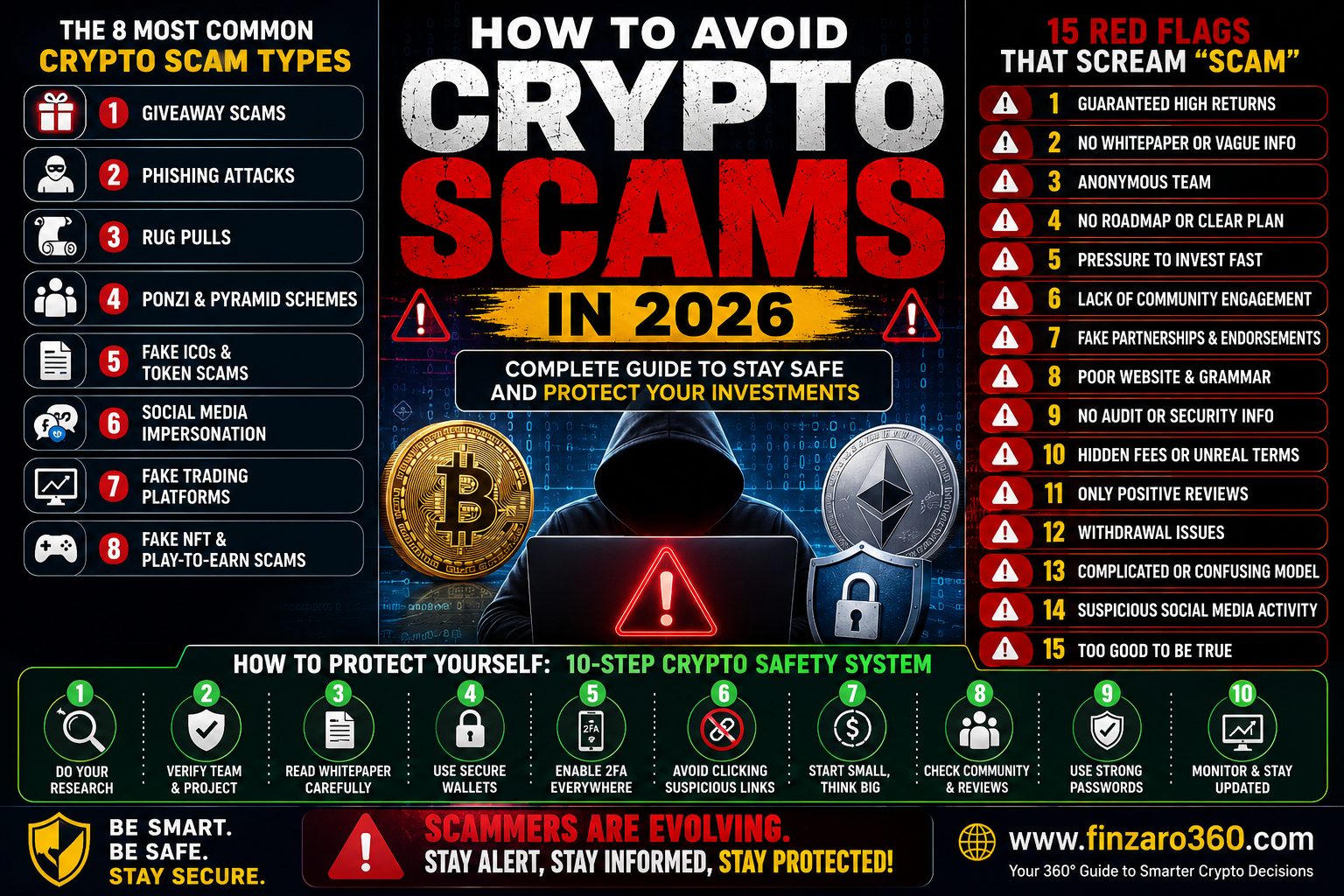

How to Avoid Crypto Scams in 2026: 15 Red Flags Every Investor Must Know
Crypto scams stole over $14 billion from investors in 2024 alone — and that number is rising every year. In 2026, scammers are smarter, more sophisticated, and increasingly using AI to impersonate real people, create fake platforms, and manipulate investors.
Whether you are a complete beginner just learning how to buy Bitcoin or an experienced trader, this guide will teach you exactly how to spot and avoid every major type of crypto scam operating in 2026.
Why Crypto Scams Are So Effective
Crypto is the perfect environment for scammers because:
- Transactions are irreversible — once sent, crypto cannot be recovered
- No central authority can reverse fraudulent transactions
- Many investors are new and unfamiliar with how it works
- The “get rich quick” nature of crypto makes people lower their guard
- Scammers now use AI-generated voices, videos, and websites that look completely real
The 8 Most Common Crypto Scam Types in 2026
1. Rug Pull Scams
Developers create a new cryptocurrency or NFT project, hype it heavily on social media, attract thousands of investors — then suddenly disappear with all the funds. The coin becomes worthless overnight.
How to spot it: Anonymous team, no code audit, unrealistic promises, sudden massive promotion from paid influencers.
2. Phishing Websites
Scammers create fake websites that look identical to Binance, Coinbase, MetaMask, or other legitimate platforms. When you enter your login details or seed phrase, they steal everything.
How to spot it: Slightly different URL (e.g., “binannce.com” instead of “binance.com”), no HTTPS, unsolicited links in emails or DMs.
3. Fake Celebrity Endorsements
In 2026, AI-generated deepfake videos of Elon Musk, Michael Saylor, and other crypto figures promoting fake investment platforms are extremely convincing. These videos circulate on YouTube, TikTok, and X.
How to spot it: Any “guaranteed returns” claim, any “send crypto to get more back” offer, voice or lip movement that looks slightly off.
4. Ponzi and High-Yield Investment Programs (HYIPs)
Platforms promise 1–5% daily returns (365–1,825% per year) with no risk. Early investors are paid using funds from new investors — until the whole scheme collapses.
How to spot it: Guaranteed daily/weekly returns, pressure to recruit new members, no clear business model, no verifiable company address.
5. Fake Exchange or Wallet Apps
Scammers create fake crypto exchange apps and list them on third-party app stores or even sometimes on legitimate app stores before being removed. These apps steal your credentials the moment you log in.
How to spot it: Always download apps directly from the official website. Check reviews carefully, look at the developer name, and verify the download count.
6. Romance Scams (Pig Butchering)
Scammers build weeks or months of genuine-seeming romantic relationships online before introducing a “profitable” crypto investment opportunity. The victim invests increasing amounts until they try to withdraw — at which point the platform locks their account and the scammer disappears.
How to spot it: Anyone you met online who introduces investment opportunities, especially crypto. No legitimate romantic partner will ever direct you to a specific investment platform.
7. Pump-and-Dump Schemes
Coordinated groups buy large amounts of a low-market-cap coin, then aggressively promote it to drive up the price. Once retail investors pile in and the price peaks, organizers sell all their holdings simultaneously, crashing the price.
How to spot it: Coins suddenly trending with no fundamental news, Telegram or Discord groups promoting “the next 100x coin,” anonymous promoters, very low liquidity.
8. AI-Powered Impersonation Scams
Scammers use AI voice cloning to impersonate exchange customer support, pretend to be friends or family in distress, or clone the voices of crypto influencers in fake podcasts and videos.
How to spot it: Unusual urgency, requests for money or seed phrase, voice or video that “feels slightly off,” unexpected contact from someone you know asking for crypto.
15 Red Flags That Scream “SCAM”
- 🚩 “Guaranteed” returns — No investment can guarantee profits. Anyone promising 10% per day is lying.
- 🚩 “Send crypto to receive more back” — This is always a scam, no exceptions.
- 🚩 Pressure to invest immediately — “This offer expires in 2 hours” is a manipulation tactic.
- 🚩 Anonymous or unverifiable team — Real projects have publicly known founders with verifiable identities.
- 🚩 No whitepaper or technical documentation — Legitimate projects explain how they work in detail.
- 🚩 Requests for your seed phrase or private key — Never share this with anyone, ever. There is no legitimate reason anyone needs this.
- 🚩 Unsolicited investment advice via DM — Strangers on Telegram, WhatsApp, or Instagram offering “insider tips.”
- 🚩 Celebrity endorsements you didn’t search for — Real celebrities don’t cold-message investors.
- 🚩 URLs with slight misspellings — Binancce.com, Coiinbase.com, MetaMaask.io.
- 🚩 Withdrawal fees before you can withdraw — Legitimate platforms never require an upfront fee to release your funds.
- 🚩 Platform not registered or regulated — Always verify regulation with your country’s financial authority.
- 🚩 Unusually high referral commissions — 50%+ referral bonuses are a classic HYIP/Ponzi signal.
- 🚩 No working customer support — Test support before depositing any significant amount.
- 🚩 Social proof from fake accounts — Check if glowing reviews come from accounts with no history or followers.
- 🚩 Tokens only purchasable on their own platform — Real cryptocurrencies trade on multiple independent exchanges.
How to Protect Yourself: 10-Step Crypto Safety System
Step 1: Use Only Regulated, Established Exchanges
Stick to platforms with proven track records: Binance, Coinbase, Kraken, Bybit, OKX. Avoid unknown exchanges regardless of how professional they look.
Step 2: Enable 2FA on Everything
Use an authenticator app (Google Authenticator or Authy) — never SMS-based 2FA, as SIM-swapping is a real threat in 2026. Enable 2FA on your exchange account, email, and any linked apps.
Step 3: Use a Hardware Wallet for Large Holdings
If your crypto holdings exceed $500–$1,000, move them to a hardware wallet. A hardware wallet stores your private keys offline — completely immune to online hacking. We reviewed the Ledger Nano X in detail — currently the most trusted hardware wallet in 2026.
Step 4: Verify Every URL Manually
Never click crypto links from emails, DMs, or search ads. Always type the exchange URL directly. Bookmark the real URLs of every platform you use and only access them through bookmarks.
Step 5: Never Share Your Seed Phrase
Your 12–24 word seed phrase is the master key to your crypto wallet. Write it on paper. Store it somewhere physically secure. Never photograph it, type it into any website, or share it with anyone — including people claiming to be customer support.
Step 6: Research Before Investing in Any New Project
Before buying any cryptocurrency beyond Bitcoin or Ethereum:
- Read the whitepaper
- Research the founding team on LinkedIn
- Check if the code has been audited by a reputable third party
- Look for organic community discussion (not just paid promotions)
- Check CoinGecko and CoinMarketCap listings and age
Step 7: Use the “Too Good to Be True” Test
If an investment promises returns that seem impossible in traditional finance, they are impossible in crypto too. No legitimate investment consistently returns 1% daily. Apply extreme skepticism to any opportunity that sounds extraordinary.
Step 8: Separate Your Crypto Email
Use a dedicated email address exclusively for crypto accounts. This limits your exposure if your primary email is compromised, and reduces phishing attempts that cross-target multiple accounts.
Step 9: Keep Software and Wallets Updated
Always run the latest version of your hardware wallet firmware, software wallets, and devices. Security patches often close vulnerabilities that scammers actively exploit.
Step 10: Tell Someone You Trust
If a stranger online is pressuring you to invest in something exciting and asking you to keep it secret — that is the single biggest scam red flag. Legitimate investments don’t require secrecy.
What to Do If You’ve Been Scammed
Act immediately:
- Stop all further transactions — don’t send any more funds hoping to recover losses
- Document everything — screenshots of conversations, wallet addresses, transaction IDs
- Report to your exchange — they may be able to flag receiving addresses
- Report to authorities — FBI IC3 (US), Action Fraud (UK), your local cybercrime unit
- Report the platform/wallet address on Chainabuse.com — helps warn other investors
- Be wary of “recovery services” — the majority of crypto recovery services are themselves scams targeting scam victims
Hard truth: Recovering stolen crypto is extremely rare. Prevention is everything.
Legitimate Ways to Earn from Crypto in 2026
The best way to avoid scams is to stick to proven, legitimate methods of growing your crypto portfolio. These include buying established coins through regulated exchanges, staking, and long-term holding strategies.
To manage your risk properly when trading, use our free Crypto Liquidation Calculator to know exactly when your position could be liquidated — this alone can save you from massive avoidable losses.
If you’re looking for other legitimate ways to build wealth alongside crypto, our guide on 17 passive income ideas in 2026 covers proven methods used by thousands of real investors globally.
Final Thoughts
The crypto space in 2026 is full of genuine opportunity — but also genuine danger. The most successful long-term crypto investors are not the smartest. They are the most cautious. They do their research, they use proper security, and they never let greed override logic.
Save this article. Share it with anyone you know who is new to crypto. The 15 red flags in this guide could save someone you care about from losing everything.
⚠️ Disclaimer
The information provided in this article is for educational and informational purposes only and does not constitute financial, investment, or legal advice. Cryptocurrency investments are highly volatile and speculative. Past performance is not indicative of future results. You could lose some or all of your invested capital. Always conduct your own due diligence and consult a qualified financial advisor before making any investment decisions. Finzaro360 is not responsible for any financial losses incurred from following information in this article. Read our full Disclaimer and Privacy Policy.
Published by Finzaro360 | Learn. Earn. Grow Online.