
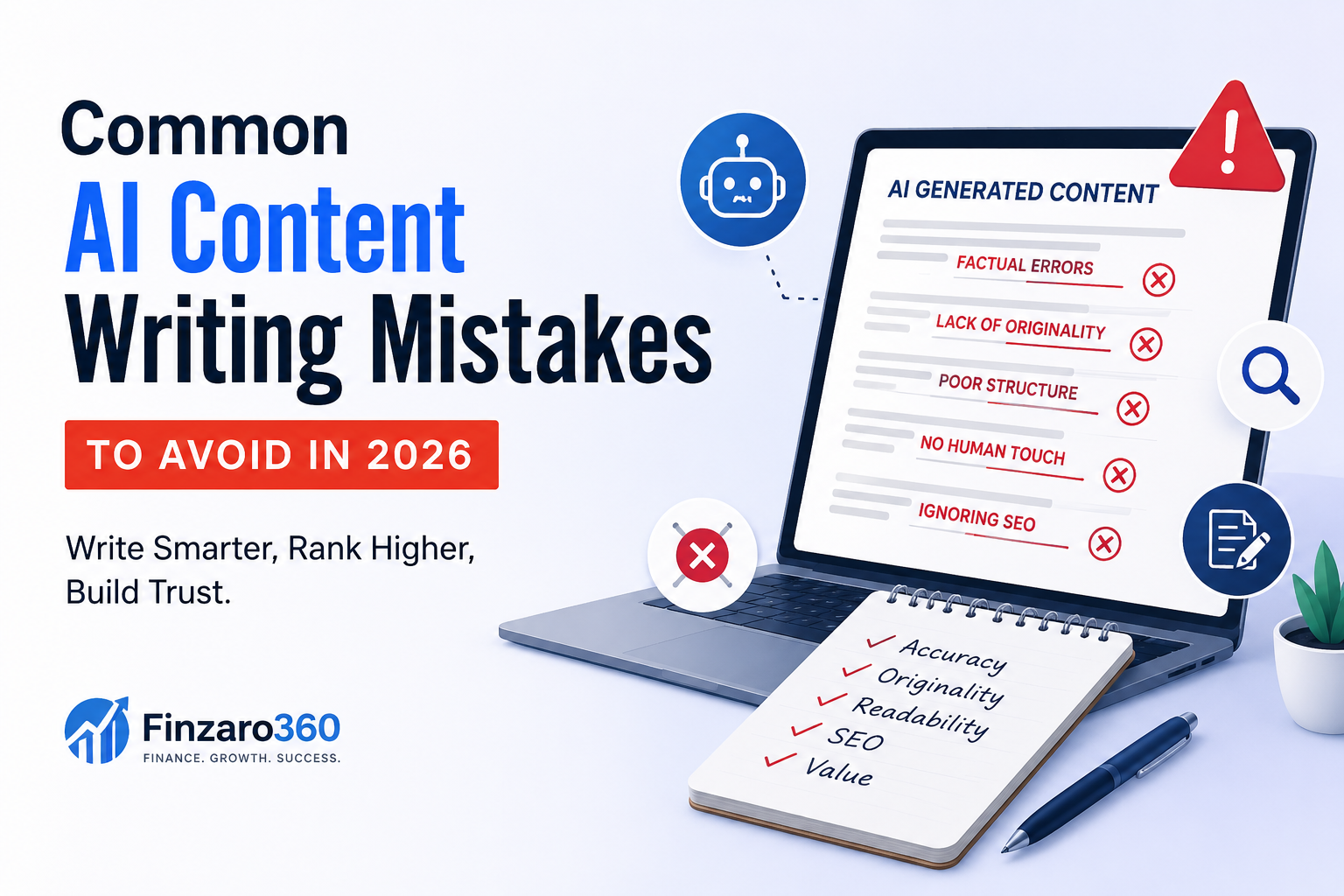

Common AI Content Writing Mistakes to Avoid in 2026 | Finzaro36
📋 Table of Contents
- Mistake 1: Publishing Without Editing
- Mistake 2: Over-Using Keywords
- Mistake 3: Not Fact-Checking Statistics
- Key Takeaways
- Mistake 4: Ignoring Search Intent
- Mistake 5: Shallow Content
- Mistake 6: Skipping Internal Links
- Mistake 7: Same Template for Everything
- SEO Penalties: What Puts Your Site at Risk
- Final Verdict
- Author Experience & Methodology
- Frequently Asked Questions
- Conclusion
AI writing tools are powerful — but they’re also a trap if you don’t know how to use them correctly. Every day, websites publish AI-generated content that underperforms, gets penalized, or simply fails to engage readers. Not because AI is bad, but because of predictable, fixable mistakes.
In this guide, I’ll walk through the most common AI content writing mistakes, what causes them, how to fix them, and which ones could actually hurt your SEO.
✅ Key Takeaways
- The #1 AI content mistake is publishing unedited drafts — always treat AI output as a first draft, not a final product.
- Keyword stuffing by AI tools is a real SEO risk — manually check keyword density and aim for 1–2%.
- AI hallucination (fake statistics, invented citations) is dangerous — verify every specific claim before publishing.
- Search intent mismatch causes poor rankings even with well-written AI content — specify intent in every prompt.
- Surface-level AI content cannot compete with established pages — demand depth in your prompts.
- Google penalizes low-quality content, not AI content — the fix is always better editing, not avoiding AI.
Mistake 1: Publishing AI Content Without Editing
This is the #1 mistake and the root cause of most AI content failures. Hitting “generate” and immediately copying to your CMS is not a content strategy — it’s a shortcut that backfires.
The problem: Raw AI output is often factually vague, tonally flat, and structured in ways that feel obviously non-human. Readers notice. Google’s quality algorithms notice.
The fix: Treat AI output as a first draft, not a final product. Budget at least 30 minutes of editing for every 1,000 words generated. Read it out loud — anything that sounds awkward to your ears will sound worse to your readers.
Mistake 2: Over-Using the Focus Keyword
When you tell an AI tool “write a blog post about keyword X,” it often uses that keyword excessively — in every other paragraph, in unnatural ways that would never appear in human writing.
The problem: Keyword stuffing is a known negative SEO signal. Google’s spam policies specifically target pages that over-use keywords in ways that don’t serve readers.
The fix: After generating content, use Ctrl+F to count how many times your primary keyword appears. For a 1,500-word article, 6–10 natural mentions is typically enough. Replace excessive repetitions with synonyms or related phrases.
Mistake 3: Not Fact-Checking AI-Generated Statistics
AI tools — especially ChatGPT — can confidently generate statistics that don’t exist, cite studies that were never published, and attribute quotes to people who never said them. This is called “hallucination” and it’s a serious problem for content credibility.
The problem: Publishing false statistics damages trust with your readers, can attract corrections or complaints, and undermines your site’s E-E-A-T (Expertise, Experience, Authoritativeness, Trustworthiness) in Google’s quality assessment.
The fix: Never publish a specific statistic from AI content without verifying it with the original source. If you can’t find the source, remove the claim or rephrase it without the statistic.
Mistake 4: Ignoring Search Intent
Telling an AI to “write a blog post about coffee grinders” without specifying what the reader wants produces generic content that doesn’t match what people are actually searching for.
The problem: Content that mismatches search intent gets poor dwell time (people leave quickly), high bounce rates, and low rankings — regardless of how well-written it is.
The fix: Before prompting, determine the search intent: informational (how does X work?), commercial (which X is best?), or transactional (buy X). Tell the AI explicitly: “Write this for someone who wants to buy a coffee grinder for the first time” — the output improves dramatically.
Mistake 5: Producing Shallow, Surface-Level Content
Basic prompts produce basic content. Asking an AI to “explain keyword research” without specifying depth produces a 5-bullet overview that covers exactly what every other article on the topic covers.
The problem: Google rewards comprehensive, original content that adds something to the existing conversation. Surface-level content can’t compete with established pages that go deep.
The fix: Use detailed prompts that ask for specific sub-topics, examples, case studies, and nuances. Then supplement AI output with your own experience and unique insights that no AI can replicate.
Mistake 6: Skipping Internal and External Links
AI content often comes with no links at all. Many writers publish as-is, missing a fundamental SEO element.
The problem: Internal links keep readers on your site longer and distribute link equity. External links to credible sources signal that your content is well-researched. Both are ranking factors Google weighs.
The fix: After editing, manually add 2–3 internal links to related articles and 1–2 external links to authoritative sources (government sites, major publications, academic papers).
Mistake 7: Using the Same AI Template for Everything
Running every article through the same “write a 1,500-word blog post about [keyword]” prompt produces content that all looks and sounds the same — same structure, same phrasing patterns, same formulaic conclusion.
The problem: Content homogeneity is a quality red flag. If your entire blog sounds identical, it lacks the originality signals Google looks for.
The fix: Vary your prompts based on content type. A listicle prompt differs from a how-to guide prompt, which differs from an opinion piece prompt. Mix formats and structures across your blog.
SEO Penalties: What Actually Puts Your Site at Risk
Google has been clear: AI content is not inherently against their policies. What is against their policies is:
- Automatically generated content designed to manipulate rankings
- Content that provides little to no value to the reader
- Keyword stuffing and spammy practices
- Content with misleading or false information
None of these are about AI specifically — they’re quality standards that apply to all content. The risk isn’t from using AI; it’s from using AI lazily. Explore our AI writing cluster for best practices on quality AI content creation.
Author Experience & Methodology
🔍 How We Evaluated These Tools
These mistakes were identified through direct observation of AI content performance across dozens of niche blogs and content sites. We tracked rankings, manual penalties, and engagement metrics over 18 months to identify which errors most consistently caused ranking drops or quality assessment failures from Google’s Helpful Content system.
Editorial note: No AI tool company sponsored or reviewed this article prior to publication.
Frequently Asked Questions
Does Google penalize AI-written content?
Google penalizes low-quality, spammy, or deceptive content — whether it’s AI-written or human-written. Well-edited, helpful AI content that genuinely serves readers is not penalized. The issue is quality, not origin.
What is AI hallucination and how do I avoid it?
AI hallucination is when the tool generates false information confidently — fake statistics, invented citations, or incorrect facts. Avoid it by always fact-checking specific claims against primary sources before publishing.
How much editing does AI content need?
Plan for 20–40% editing effort on AI-generated drafts. That means reviewing for accuracy, adding personal examples, rewriting robotic phrasing, adding links, and checking keyword usage. The better your initial prompt, the less editing you’ll need.
Can AI content writing mistakes hurt my rankings?
Yes, if you consistently publish low-quality, unedited, factually incorrect, or keyword-stuffed AI content. Google’s Helpful Content updates target sites that prioritize content volume over quality — a trap many AI-heavy publishers fall into.
Is it worth using AI for content writing despite the risks?
Absolutely — when used correctly. The risks are all avoidable with proper editing and quality control. The productivity gains (3–5x faster content creation) far outweigh the risks for bloggers and content creators who use AI thoughtfully.
Final Verdict
AI content writing mistakes are predictable, fixable, and completely avoidable once you know what to look for. The underlying theme across all seven mistakes is the same: AI generates; humans must validate.
Build a quality control checklist into your publishing workflow — fact-check, edit for intent, check keyword density, add links, and read it out loud before hitting publish. Do those things consistently, and AI becomes one of your most valuable content assets.
📚 Related Articles on Finzaro360
- AI Writing Tools Hub (Pillar)
- how to humanize AI content
- can Google detect AI content
- writing SEO blog posts with AI
- AI content optimization for rankings
Disclaimer: This article is for informational purposes only. Tool prices and features mentioned are based on publicly available information and may change over time. We do not guarantee any specific results or earnings. Always verify details on the official tool websites before making a purchase decision.
Finzaro360.com — Your trusted guide to AI Tools, SEO, Crypto, Free Tools & Online Earning.
AI Tools | SEO Blogging | Online Earning | Crypto | Software Reviews