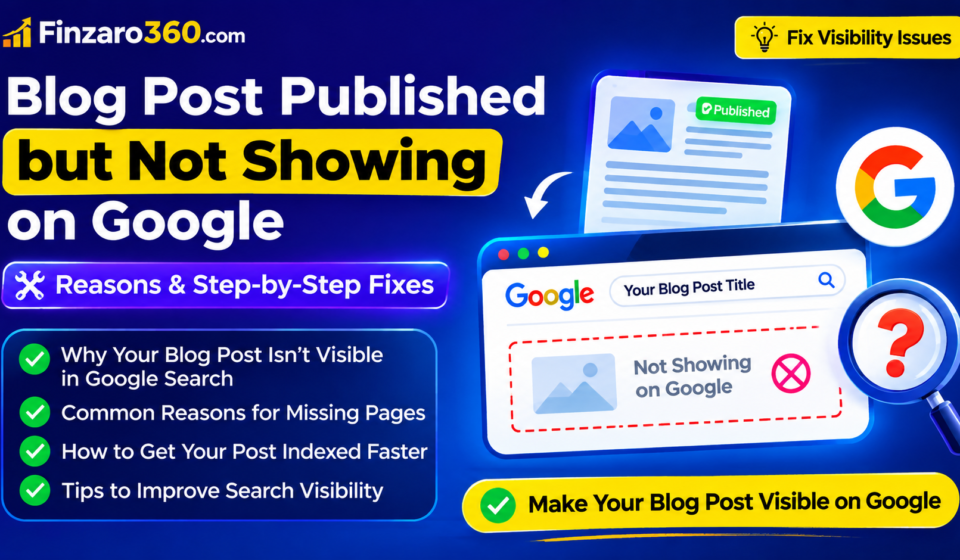

Blog Post Published but Not Showing on Google
You published a post days ago. You search your exact title on Google — nothing. You search your brand name plus the topic — still nothing. This is one of the most common panic moments for bloggers, especially beginners.
The good news is that “published but not showing on Google” almost always has a clear, fixable cause. In this guide, we’ll go through exactly how to diagnose the problem and what steps to take to get your post visible in search results.
1. Confirm the Post Is Actually Published (Not Just Saved)
Before assuming there’s a technical or SEO problem, rule out the simplest explanation first.
Check:
- Open the post’s live URL in an incognito/private browser window
- Make sure it’s not still showing as “Draft” or “Scheduled” in your dashboard
- Confirm it’s not password-protected or set to “Private” visibility
It sounds obvious, but many bloggers assume a post is live when it’s actually still in draft mode or scheduled for a future date. This is always the first thing to rule out.
If you’re not sure what steps to follow right after hitting publish, this guide on what to do immediately after publishing a blog post covers the full routine, including indexing requests, sitemap checks, and internal linking.
2. Check the Indexing Status in Google Search Console
This is the most reliable way to understand what’s actually happening. Search Console tells you exactly what Google knows about your URL.
Steps:
- Open Google Search Console.
- Paste your post’s exact URL into the URL Inspection tool.
- Press Enter and read the result.
You’ll typically see one of these:
- “URL is on Google” — it’s indexed; the issue might be ranking, not indexing
- “URL is not on Google” — it’s not indexed yet, and Search Console will usually explain why
- “Discovered – currently not indexed” — Google knows the URL exists but hasn’t crawled it yet
- “Crawled – currently not indexed” — Google crawled it but chose not to index it
For a complete walkthrough of this tool and how to interpret each result, this guide on how to check if your new blog post is properly indexed by Google covers it step by step.
3. Understand the Difference Between “Not Indexed” and “Not Ranking”
This distinction matters a lot. A post can be indexed but still not show up for the specific search you tried, simply because it’s not ranking well for that term yet.
Not indexed means the page isn’t in Google’s database at all — it can never appear in results.
Not ranking well means the page is indexed, but it’s buried on page 5 or beyond for your search term, which feels the same as “not showing” but is a completely different problem with different fixes.
If your post is indexed but ranking poorly, that’s usually a content quality, competition, or SEO optimization issue — not a technical indexing problem. If it’s genuinely not indexed, the reasons are usually more specific and often technical.
If you’ve confirmed the post is crawled but still not indexed, this guide on why Google crawls your blog post but doesn’t index it breaks down the most common reasons behind that exact status and how to fix each one.
4. Check If the Sitemap Includes the Post
If your sitemap doesn’t include the new post, Google may take much longer to discover it on its own.
What to check:
- Open your sitemap URL directly (usually
yourdomain.com/sitemap.xmlorsitemap_index.xml) - Confirm your new post’s URL appears there
- In Search Console, check the Sitemaps section for “Success” status with no errors
If your sitemap is outdated, broken, or wasn’t automatically updated, that alone can explain why a post isn’t showing up yet.
5. Look for a Noindex Tag or Robots.txt Block
This is one of the most common — and most frustrating — reasons a post never shows up on Google, because everything else about the post looks completely fine.
Check for:
- A “noindex” setting accidentally left on in your SEO plugin (RankMath, Yoast, etc.) for that specific post
- Your robots.txt file blocking the post’s URL or its entire directory
- A canonical tag mistakenly pointing to a different URL, telling Google to index that one instead
How to check quickly:
- Use the URL Inspection tool in Search Console — it directly flags noindex and canonical issues
- Right-click the live post, choose “View Page Source,” and search for “noindex” in the code
This single mistake, often left over from testing or a staging site, is responsible for a surprising number of “published but invisible” posts.
6. Check for Duplicate Content Issues
If your post is too similar to another page — either your own or someone else’s — Google may choose not to index it separately, since it doesn’t want multiple near-identical pages in search results.
This can happen when:
- You’ve written on a very similar topic before without a clear new angle
- The content closely resembles something already published elsewhere online
- AI-assisted content wasn’t edited enough and reads similarly to other AI-generated posts on the same topic
Fix:
- Add unique value — your own examples, opinions, or fresh data
- Clearly differentiate the post from similar content on your own site
- Review AI drafts carefully before publishing
If AI tools were part of your writing process, this guide on how to humanize AI generated content the SEO-safe way can help make your drafts more original and less likely to overlap with existing content.
7. Consider Your Site’s Overall Authority
For newer or smaller blogs, Google is often simply slower to crawl and index new content — this isn’t a punishment, it’s a natural part of how trust builds over time.
Signs this might be a factor:
- Your blog is relatively new (a few weeks to a few months old)
- You have very few backlinks from other sites
- Most of your existing posts also took a while to get indexed
What helps:
- Publish consistently — regular activity signals an active, maintained site
- Build a few quality backlinks over time, even from smaller relevant sites
- Be patient, but keep monitoring rather than assuming nothing can be done
This factor tends to improve naturally as your site matures, as long as you’re not making other mistakes on top of it.
8. Check Your Internal Linking
If your new post isn’t linked from anywhere else on your site, it may be harder for Google to discover and prioritize it — even if it’s technically in your sitemap.
What to check:
- Is the post linked from at least 2-3 older, already-indexed posts?
- Is it included in relevant category or tag pages?
- Is it reachable from your site’s main navigation or homepage?
Fix:
- Add internal links pointing to the new post from relevant older content
- Make sure it appears in the correct category archive
This is a simple fix that’s often overlooked, and it also helps with overall site structure and SEO. For a deeper explanation of how internal linking connects to visibility across your whole site, this guide on why your website is not getting organic traffic covers this in more detail.
9. Rule Out Publishing Mistakes
Sometimes the cause is simpler than a technical SEO issue — it’s a small mistake made during the publishing process itself.
Common mistakes:
- Changing the URL slug right after publishing (resets some indexing signals)
- Forgetting to set a category, leaving the post disconnected from site structure
- Publishing a duplicate draft while the original remains unpublished
- Missing featured image or broken formatting that affects how Google reads the page
This guide on common errors during and after publishing a blog post lists these mistakes in detail and is worth a quick review if this keeps happening across multiple posts. Building a habit around a proper pre-publishing checklist also helps a lot — this guide on 10 major steps to take before publishing an article covers everything to check before you hit publish in the first place.
10. Take Direct Action to Fix It
Once you’ve identified the likely cause, here’s what to do:
- Fix the root issue — remove noindex tags, fix canonical tags, improve thin content, or add internal links, depending on what you found.
- Update your sitemap if it wasn’t already including the post.
- Manually request indexing again through the URL Inspection tool in Search Console.
- Add internal links from a few older, well-indexed posts.
- Share the post on social media to generate fresh engagement signals.
- Wait a reasonable amount of time — a few days to a couple of weeks — before checking again, especially on newer sites.
If you want a complete step-by-step process to follow for every new post so this problem happens less often going forward, this guide on how to get a new blog indexed by Google fast walks through the full method.
Quick Diagnostic Checklist
Use this checklist whenever a post is published but not showing on Google:
- Confirm the post is actually live, not draft or scheduled
- Check indexing status in Search Console’s URL Inspection tool
- Understand if it’s a “not indexed” issue or a “not ranking” issue
- Verify the post is included in your sitemap
- Check for noindex tags or robots.txt blocks
- Rule out duplicate or too-similar content
- Consider your site’s overall age and authority
- Check internal linking to the post
- Rule out common publishing mistakes
- Fix the issue, request indexing again, and be patient
Final Thoughts
A published post that doesn’t show on Google is frustrating, but it’s rarely a mystery once you know where to look. Most of the time, it comes down to one of a handful of causes: a technical block, thin or duplicate content, weak internal linking, or simply a newer site still building trust with Google.
Work through the checklist methodically instead of guessing. Once you find and fix the actual cause, the post usually starts appearing within days — and you’ll know exactly what to check the next time this happens.