
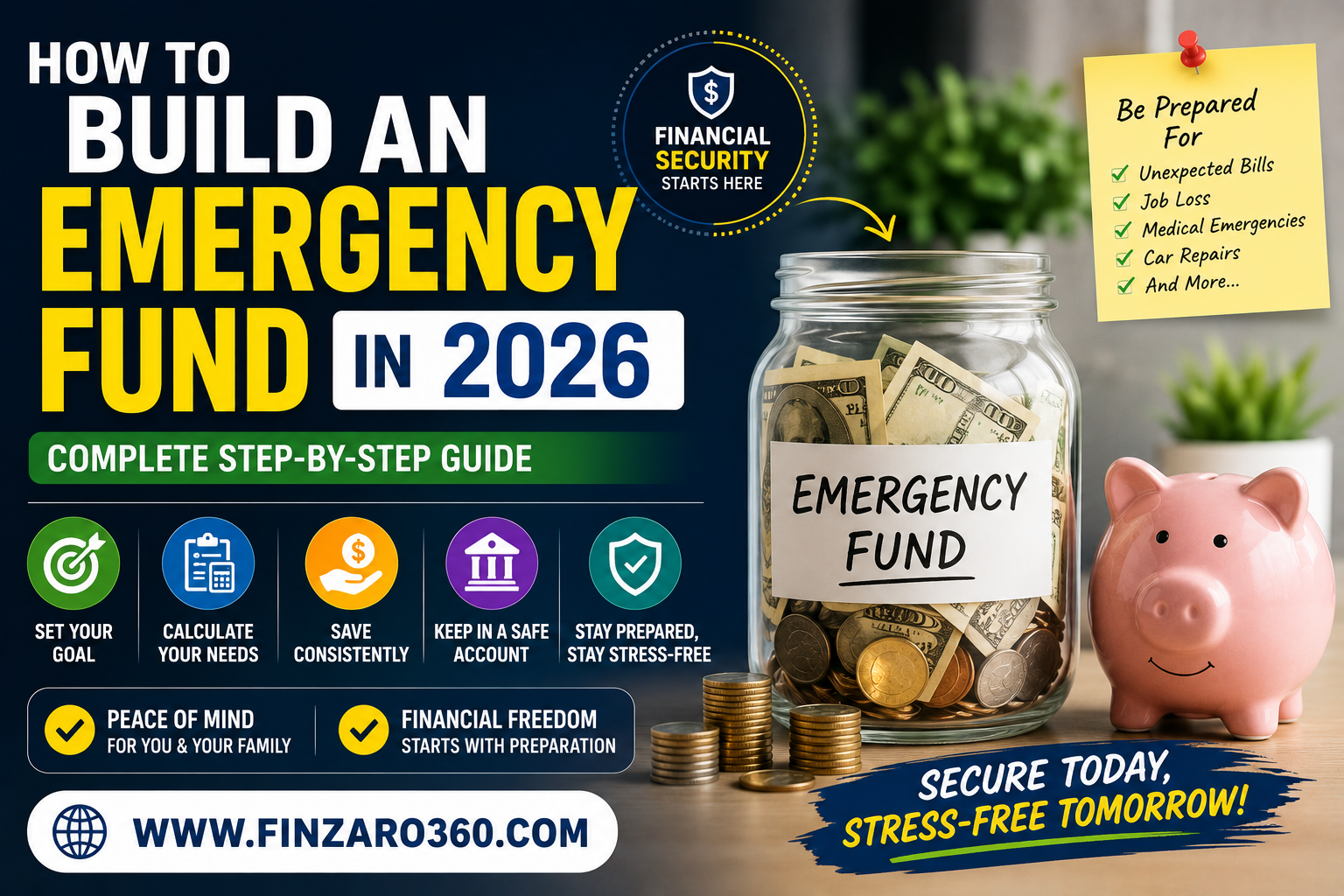

How to Build an Emergency Fund in 2026: Complete Step-by-Step Guide
One unexpected expense — a medical bill, a job loss, a car breakdown — separates people who stay financially stable from those who spiral into debt. The single most impactful financial move you can make in 2026 is also one of the simplest: build an emergency fund.
This guide explains exactly how much you need, where to keep it, and how to build it even if you’re living paycheck to paycheck right now — with a realistic step-by-step plan anyone can follow.
What is an Emergency Fund?
An emergency fund is a dedicated savings account holding enough cash to cover 3–6 months of essential living expenses. It exists for one purpose: to protect you from financial disaster when life goes wrong.
What it’s for:
- Job loss or unexpected reduced income
- Medical emergencies and unexpected health costs
- Major car repairs or breakdowns
- Emergency home repairs (boiler, roof, plumbing)
- Family emergencies requiring immediate travel
What it’s NOT for:
- Planned purchases (holiday, new phone, furniture)
- Investment opportunities
- Impulse buys or “it was on sale” purchases
How Much Do You Actually Need?
The standard recommendation is 3–6 months of essential living expenses. To calculate yours:
Step 1: Calculate Your Monthly Essentials
| Expense Category | Your Monthly Amount |
|---|---|
| Rent / Mortgage | $______ |
| Utilities (electric, gas, water, internet) | $______ |
| Groceries | $______ |
| Transportation (car payment, fuel, transit) | $______ |
| Insurance (health, car, home) | $______ |
| Minimum debt payments | $______ |
| Essential subscriptions (phone) | $______ |
| Total Monthly Essentials | $______ |
Step 2: Multiply for Your Target
- Stable job, no dependents: 3 months of essentials
- Self-employed / freelancer / irregular income: 6 months
- Single income household with dependents: 6 months
- High-risk industry or volatile income: 6–12 months
Example: Monthly essentials = $2,000 → Target emergency fund = $6,000–$12,000
Where to Keep Your Emergency Fund
Your emergency fund needs to be: safe, accessible, and separate from your regular spending account.
Best Options in 2026:
1. High-Yield Savings Account (HYSA) — Best Choice
High-yield savings accounts offered by online banks typically pay 4–5% APY in 2026 — compared to 0.01–0.5% at traditional banks. Your money is FDIC/FSCS insured, instantly accessible, and earns meaningful interest while you wait to (hopefully never) need it.
Top HYSAs in 2026: Marcus by Goldman Sachs, Ally Bank, Marcus, SoFi, Discover Bank
2. Money Market Account
Similar to HYSAs, money market accounts offer competitive interest rates with check-writing privileges. Slightly higher minimum balance requirements but good for larger emergency funds.
3. Separate Regular Savings Account
If you don’t have access to online banks, a separate savings account at any bank — as long as it’s completely separate from your checking — works fine. The separation prevents accidental spending more than the interest rate matters initially.
What to AVOID:
- Stocks or crypto — could be worth 50% less exactly when you need it most
- Long-term CDs or bonds — penalty for early withdrawal defeats the purpose
- Cash at home — loses value to inflation, can be lost/stolen
- Mixed with regular spending account — will be spent accidentally
How to Build Your Emergency Fund Fast: 7 Strategies
Strategy 1: Automate It (Most Important)
Set up an automatic transfer from your checking account to your emergency fund savings account on the same day you get paid — before you have a chance to spend it. Start with any amount: $25, $50, $100. Automation removes the willpower requirement and makes saving default behavior.
Strategy 2: Save Your “Windfall” Income
Any unexpected money — tax refund, work bonus, birthday money, freelance income, items sold online — goes directly into the emergency fund until it is fully funded. This is the fastest path to reaching your target.
Strategy 3: The 24-Hour Rule
For any non-essential purchase over a threshold (e.g., $50), wait 24 hours before buying. Most impulse purchases are abandoned after a day. Transfer the money you would have spent into your emergency fund instead.
Strategy 4: Cut One Expense, Save the Difference
Identify one monthly subscription or expense you rarely use. Cancel it. Set up an automatic transfer of that exact amount to your emergency fund. Common targets: unused gym memberships, streaming services, food delivery subscriptions, premium app subscriptions.
Strategy 5: Increase Income Temporarily
A focused 60–90 day income sprint can fund an entire emergency fund. Options include: overtime at your current job, selling unused items, weekend freelance work, or short-term gig economy work. Once the fund is built, return to your normal schedule.
For sustainable income-building ideas, read our guide on 17 passive income ideas in 2026 — many of which can be started as side efforts while building your emergency buffer.
Strategy 6: The “Round Up” Method
Many banking apps (Monzo, Chime, Revolut) offer automatic round-up savings — every purchase rounds up to the nearest dollar, and the difference goes to savings. Small individually, but adds up to $30–$60/month of effortless saving.
Strategy 7: The $1,000 Micro-Fund First
If 3–6 months of expenses feels overwhelming, start with just $1,000. This covers most common unexpected expenses (car repair, medical co-pay, appliance replacement) and prevents adding to debt for minor emergencies. Once you have $1,000 saved, set your next target to the full amount.
Emergency Fund + Debt: What to Do First?
This is one of the most common personal finance questions. Here is the recommended approach:
- First: Save a $1,000 micro-emergency fund
- Then: Attack high-interest debt aggressively (credit cards, personal loans above 10%)
- Then: Build emergency fund to 3–6 months while maintaining minimum debt payments
- Then: Pay off remaining lower-interest debt
- Then: Start investing
The $1,000 buffer is essential because without it, any emergency during debt payoff forces new debt — breaking the cycle. To understand debt payoff in detail, read our guide on how to get out of debt fast in 2026.
Emergency Fund for Freelancers and Self-Employed People
If your income is irregular — freelancing, content creation, online business — your emergency fund needs are larger and more urgent than for salaried employees.
- Target 6–12 months of expenses minimum (not 3)
- Include your estimated tax liability in your savings (set aside 25–30% of income for taxes)
- Consider maintaining a separate “income smoothing” fund for months when client work is slow
- Replenish the fund immediately after using it — don’t let it sit depleted
If you earn from blogging, YouTube, affiliate marketing, or freelancing, explore how to grow those income streams in our guide on how to make money with AI freelancing in 2026.
After Your Emergency Fund is Fully Funded — What’s Next?
Once your emergency fund reaches its target, do not stop there. The financial journey continues:
- Pay off all high-interest debt if not already done
- Start investing — index funds, ETFs, and retirement accounts. Check our guide to the best investment apps in 2026
- Build passive income streams — see our list of 17 passive income ideas in 2026
- Educate yourself further — the top 10 finance books of 2026 will transform your money mindset
Frequently Asked Questions (FAQ)
How much emergency fund is enough?
For most people with stable employment: 3 months of essential expenses. For freelancers, self-employed individuals, or single-income households with dependents: 6 months. High-risk situations: up to 12 months. Start with $1,000 if the full target feels too far away.
Should my emergency fund be invested in stocks?
No. Emergency funds must be liquid (instantly accessible) and stable in value. Stocks can drop 30–50% right when you need the money most. Keep your emergency fund in a high-yield savings account or money market account only.
What counts as a true financial emergency?
Job loss, unexpected medical expenses, essential car or home repairs that affect safety or livability, and genuine family crises. A sale at your favorite store, a vacation opportunity, or wanting a new phone do not qualify as emergencies.
Should I save for an emergency fund or pay off debt first?
Save $1,000 first — always. Then attack high-interest debt. Without the $1,000 buffer, any small emergency forces new debt and breaks your payoff momentum. Once high-interest debt is cleared, build your full 3–6 month emergency fund.
How do I rebuild my emergency fund after using it?
Make replenishing the emergency fund your #1 financial priority the month after using it. Return to aggressive saving until it is fully restored. Do not start investing or other financial goals until the fund is back to its target.
Is it okay to keep an emergency fund in a foreign currency or crypto?
No to crypto — too volatile. Foreign currency is generally not recommended as it introduces exchange rate risk. Your emergency fund should be in your local spending currency in a stable, insured savings account.
Can I keep my emergency fund with my regular savings?
Technically yes, but strongly not recommended. Having them in the same account makes it far too easy to accidentally spend emergency money. Open a separate account at a different bank if possible — making access slightly inconvenient protects the money.
⚠️ Disclaimer
This article is for educational and informational purposes only and does not constitute financial or professional advice. Interest rates, banking products, and financial recommendations change over time — always verify current rates and terms directly with financial institutions. Every person’s financial situation is unique; what works for most may not suit your specific circumstances. Consult a qualified financial advisor before making significant financial decisions. Finzaro360 is not a licensed financial institution and is not responsible for any financial outcomes from following this content. Read our full Disclaimer and Privacy Policy.
Published by Finzaro360 | Learn. Earn. Grow Online.