
Introduction
Domain authority in 2026 is still one of the most important SEO metrics for bloggers, website owners, and digital marketers who want to build long-term website authority. Whether you are trying to rank higher on Google, attract guest post clients, or improve your backlink profile, understanding Domain Authority can help you make smarter SEO decisions. In this complete guide, you will learn what Domain Authority is, how it works, why it matters in 2026, and the most effective ways to increase your DA score naturally.
If you have spent any time learning about SEO, you have almost certainly come across the term Domain Authority.
Some people treat it like the most important number in digital marketing. Others dismiss it entirely. The truth is somewhere in between — and understanding it properly can make a genuine difference to how you approach building your website’s long-term SEO strategy in 2026.
This guide covers everything you need to know: what Domain Authority actually is, how it is calculated, why it still matters, and — most importantly — ten proven strategies to increase it in a way that produces real, lasting results.
Whether you are a beginner blogger just starting your first website, a freelancer building your personal brand online, or an SEO professional managing multiple client websites, this guide is written to give you practical, honest, and actionable information.
Let us start from the beginning.
Table of Contents
- What is Domain Authority?
- Who Created Domain Authority and Why?
- How is DA Calculated?
- DA vs DR — What is the Difference?
- Does Google Use Domain Authority?
- Why Domain Authority Still Matters in 2026
- What is a Good DA Score?
- How to Check Your Domain Authority
- How to Increase Domain Authority — 10 Proven Strategies
- Common Mistakes That Hurt Your DA
- How Long Does It Take to Increase DA?
- Key Takeaways
- FAQ
- Internal Linking Suggestions
- Conclusion
- Disclaimer
What is Domain Authority?
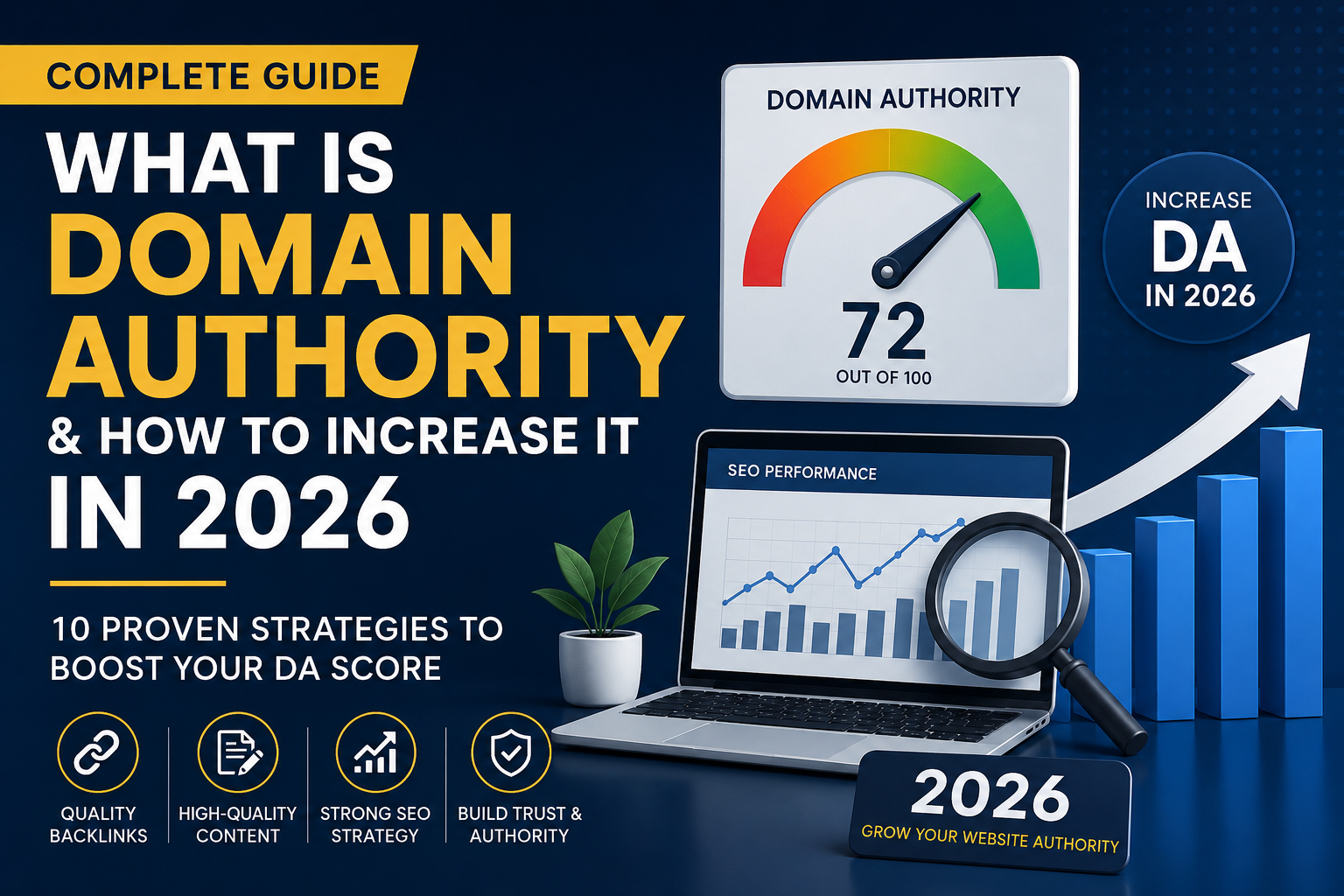
Domain Authority, commonly abbreviated as DA, is a score developed by the SEO software company Moz that predicts how likely a website is to rank in search engine results pages.
The score runs from 1 to 100. A higher score indicates a stronger, more authoritative domain that is more competitive in search results. A lower score indicates a newer or less established website that has not yet built significant link equity.
Here is a simple way to understand it:
Imagine two websites both publishing an article about how to invest money online. The first website has been active for three years, has earned backlinks from dozens of reputable websites, and holds a DA of 55. The second website launched two months ago, has very few backlinks, and holds a DA of 8. All other factors being equal, Google is significantly more likely to rank the first website for competitive search terms.
Domain Authority gives you a comparative benchmark to understand where your website stands relative to others in your niche.
One critical point to understand from the start: Domain Authority is a third-party metric created by Moz. It is not an official Google metric and is not used directly by Google to rank websites. We will cover this in more detail shortly, because it is one of the most commonly misunderstood facts in SEO.
Who Created Domain Authority and Why?
Domain Authority was created by Moz, one of the most established and respected SEO software companies in the world. Moz originally developed DA as a comparative benchmarking tool — a way for website owners and SEO professionals to understand how their domain stacks up against competitors, and to track progress over time.
The metric was never designed to be a perfect measure of SEO success. It was designed to be a useful reference point for making strategic decisions.
Over the years, Domain Authority became one of the most widely referenced metrics in the entire SEO industry. Other major SEO tools have since created their own equivalent metrics:
| Tool | Metric Name |
|---|---|
| Moz | Domain Authority (DA) |
| Ahrefs | Domain Rating (DR) |
| SEMrush | Authority Score |
| Majestic | Trust Flow / Citation Flow |
Each tool uses a different calculation methodology, which means scores will vary across platforms for the same website. This is completely normal. The important practice is to pick one tool and track your score consistently over time, rather than comparing scores across different platforms.
How is DA Calculated?
Moz calculates Domain Authority using a machine learning model that evaluates dozens of signals across your website’s link profile. The most significant factors include the following.
Linking Root Domains This refers to the number of unique websites that link to your domain. If one website links to you one hundred times, that still counts as a single linking root domain. Diversity of sources matters enormously.
Quality of Linking Domains A single backlink from a high-authority, trusted website — such as a major news publication, a government site, or a respected industry blog — carries far more weight than dozens of links from low-quality or unrelated websites.
MozRank and MozTrust These are internal Moz metrics that measure link equity and link trustworthiness respectively across your entire backlink profile.
Total Backlink Count The overall volume of inbound links matters, though quality always outweighs raw quantity.
Spam Score If your backlink profile contains links from spammy, low-quality, or penalized websites, your spam score increases — which can negatively affect your DA.
One important technical detail: DA uses a logarithmic scale. This means moving from DA 10 to DA 20 is considerably easier than moving from DA 50 to DA 60. As your score climbs higher, each incremental improvement requires significantly more effort and time.
DA vs DR — What is the Difference?
Many website owners confuse Domain Authority by Moz with Domain Rating by Ahrefs. Here is a straightforward comparison:
| Feature | DA (Moz) | DR (Ahrefs) |
|---|---|---|
| Created by | Moz | Ahrefs |
| Primary factor | Link profile + spam signals | Backlink profile strength |
| Scale | 1 to 100 | 0 to 100 |
| Best used for | Comparative benchmarking | Backlink profile analysis |
Both are useful metrics. Neither is used by Google directly. Most SEO professionals track both alongside actual Google rankings to build a complete picture of their website’s authority.
Does Google Use Domain Authority?
This is one of the most frequently asked questions in SEO — and the answer is clear.
No. Google does not use Domain Authority as a ranking factor.
Google has its own internal systems for evaluating website quality and authority. These include PageRank (which still exists internally but is no longer publicly visible), Core Web Vitals, content quality signals, E-E-A-T (Experience, Expertise, Authoritativeness, Trustworthiness), and many other proprietary factors.
However — and this is the critical point — the actions that improve your DA also tend to improve your Google rankings. Getting high-quality backlinks, publishing authoritative and comprehensive content, building topical depth, and maintaining a clean link profile all signal quality to both Moz’s algorithm and Google’s systems.
So while DA is not a Google metric, working to improve it pushes you toward better SEO practices that genuinely do help with rankings. The two goals are closely aligned in practice.
Why Domain Authority Still Matters in 2026
Despite being a third-party metric, DA remains highly relevant in 2026 for several practical reasons.
Guest Post and Link Building Outreach When you reach out to other websites for guest posts or backlink placements, the first thing they check is your DA. A site with DA 30 or above receives far more serious responses than a DA 5 site.
Attracting Advertisers and Sponsored Post Clients Brands and advertisers use DA as a quick filter when evaluating websites for sponsored content opportunities. A stronger DA score makes your site more commercially attractive.
SEO Agency Reporting Most SEO agencies include DA in their client reports as a standard benchmark metric to demonstrate progress over time.
Competitive Analysis DA gives you a fast, reliable way to compare your site against competitors and understand how much work is needed to compete in your niche.
Building Credibility and Trust A growing DA score signals to readers, business partners, and potential clients that your website is establishing genuine authority — not just publishing content without direction or strategy.
What is a Good DA Score?
There is no universal “good” DA score because it always depends on your niche and the competition within it. Here is a general benchmark to help you understand where scores typically sit:
| DA Score | Assessment |
|---|---|
| 1 to 10 | New website, just getting started |
| 11 to 20 | Early stage, building foundations |
| 21 to 40 | Growing authority, gaining real traction |
| 41 to 60 | Established site with strong niche presence |
| 61 to 80 | High authority, competitive across most niches |
| 81 to 100 | Major brands, global news sites, major platforms |
The most important thing is not your raw score in isolation — it is whether your DA is competitive relative to the websites ranking for your target keywords. A DA of 25 in a low-competition niche can outperform a DA of 45 site that is poorly optimized for its content.
Always benchmark against your direct competitors, not against major global domains.
How to Check Your Domain Authority
Checking your DA is straightforward and free. Here are the most reliable methods available at the time of writing:
Moz Link Explorer Visit moz.com/link-explorer and enter your domain. The free version provides a limited number of checks per month.
MozBar Chrome Extension Install the free MozBar browser extension and see DA scores directly as you browse any website.
Ahrefs Free Webmaster Tools Ahrefs offers a free tool for verified website owners at ahrefs.com/webmaster-tools that shows Domain Rating and backlink data for your own site.
SEMrush SEMrush displays an Authority Score for any domain. A limited free version is available at semrush.com.
Free Bulk DA Checkers Various free online tools allow bulk DA checking by pulling data from Moz’s API. These can be useful for quick comparisons, though they may not always reflect the most current data.
Note: Tool features, free tier limitations, and pricing may change over time. Always verify the latest details directly from official tool websites.
How to Increase Domain Authority — 10 Proven Strategies
Here are ten strategies that genuinely work in 2026, all based on legitimate and sustainable SEO practices.
Strategy 1: Build High-Quality Backlinks Consistently
This is the single biggest factor in your DA score. The more high-quality, relevant websites that link to yours, the stronger your domain becomes.
Focus on these proven backlink acquisition methods:
- Guest posting on established, relevant websites in your niche
- Link insertions in existing indexed articles on authority sites
- Creating linkable assets such as original tools, calculators, comprehensive guides, and research pieces that others naturally want to reference
- Broken link building — finding dead links on other websites and offering your content as a replacement
- Digital PR — earning mentions in news articles, industry roundups, and editorial publications
Quality always outweighs quantity. One backlink from a DA 50 website in your niche delivers more authority than fifty links from unrelated, low-quality directories.
Strategy 2: Publish Deep, Comprehensive Content Consistently
Google and Moz both favor websites that demonstrate genuine depth and expertise in their subject areas. Thin content — articles that barely scratch the surface of a topic — does not build authority and does not earn backlinks.
Aim for the following:
- Long-form pillar articles covering topics comprehensively
- A consistent publishing schedule that your audience and Google can rely on
- Content that genuinely answers user questions more thoroughly than existing results
- Regular updates to keep articles accurate and current
Treat content as a long-term investment in your website’s authority, not a short-term traffic hack.
Strategy 3: Build Topical Authority Through Content Clusters
One of the most powerful SEO strategies in 2026 is building topical authority — becoming the definitive resource for a specific subject rather than publishing random content across many unrelated topics.
A content cluster works as follows:
- Pillar page: A comprehensive guide on a broad topic (for example, a complete guide to personal finance in Pakistan)
- Cluster articles: In-depth articles covering specific subtopics within that broader subject
- Internal links: Every cluster article links back to the pillar page, and the pillar page links to all cluster articles
When Google sees that your website covers every angle of a topic in genuine depth, it recognizes your site as a topical authority — which improves both rankings and DA over time.
Strategy 4: Audit and Remove Toxic Backlinks
Not all backlinks help your DA. Links from spammy websites, link farms, completely irrelevant directories, or penalized domains can actively damage your score.
Regularly audit your backlink profile using Moz or Ahrefs and take the following steps:
- Identify toxic or suspicious links
- Reach out to webmasters to request removal where possible
- Use Google’s Disavow Tool in Google Search Console for links you cannot get removed
A clean backlink profile is as strategically important as a large one.
Strategy 5: Strengthen Your Internal Linking Structure
Internal links distribute authority between your own pages and help search engines understand the full structure and depth of your website.
A well-organized internal linking strategy accomplishes several things simultaneously:
- Distributes link equity from high-authority pages to newer, less-established ones
- Helps Google discover and index all your published content
- Keeps readers on your site longer, improving engagement signals
- Strengthens topical relevance across your content clusters
Every article you publish should include natural links to at least three to five other relevant articles on your site, using descriptive and contextual anchor text.
Strategy 6: Increase Your Linking Root Domain Diversity
Having one thousand backlinks from only ten websites is significantly weaker than having two hundred backlinks from one hundred and fifty different unique domains. DA rewards diversity in your backlink profile.
Strategies to build links from diverse, high-quality sources:
- Guest posting across multiple different websites in your niche
- Getting listed in legitimate, niche-relevant directories
- Earning mentions across podcasts, YouTube videos, and social media platforms
- Collaborating with other creators, bloggers, and journalists in your space
Strategy 7: Optimize On-Page SEO Across Your Entire Site
Strong on-page SEO signals contribute to how Moz’s algorithm evaluates your website’s overall quality. Ensure the following across your site:
- Every page has a unique, keyword-optimized title tag and meta description
- URLs are clean, descriptive, and free of unnecessary parameters
- Images have proper, descriptive alt text
- Heading structure (H1, H2, H3) is logical and consistent throughout
- Page speed is optimized — use Google PageSpeed Insights to identify issues
- Your site is fully mobile-responsive across all device types
A technically clean website makes it easier for both search engines and users to trust your content and your brand.
Strategy 8: Be Consistent — Domain Authority Takes Time
One of the most overlooked aspects of building Domain Authority is simply patience and consistency.
Many new bloggers publish a handful of articles, check their DA, see a score of 5, and give up. But DA growth follows a compounding curve — slow at first, then accelerating as your content earns more links and your backlink profile diversifies.
Set realistic expectations:
- New sites in the first six months: DA 1 to 10
- Growing sites at six to eighteen months with active link building: DA 15 to 30
- Established sites with two or more years of consistent effort: DA 30 and above
These are general ranges. Actual results vary significantly depending on niche competition, content quality, and link building consistency. No specific outcomes are guaranteed.
Strategy 9: Earn Editorial Links Through Original Research
One of the most powerful ways to attract natural, high-quality backlinks is to publish original research, data, or unique insights that other bloggers and journalists want to reference and cite.
Ideas for creating linkable, original content:
- Survey your audience and publish the results as a data piece
- Analyze publicly available industry data and present insights others have not compiled
- Create tools or calculators that are useful enough that others embed or reference them
- Compile statistics from multiple official sources into one comprehensive resource
When your content becomes a reference point for others in your niche, you earn backlinks passively and continuously over time.
Strategy 10: Build a Strong Brand and Social Presence
While most social media links are nofollow — meaning they do not directly pass link equity — a strong and recognizable brand presence signals credibility to both users and search algorithms.
A well-recognized brand benefits from:
- More branded searches, which Google notices as a trust signal
- More organic link opportunities as your reach expands
- Greater audience trust, turning one-time visitors into loyal return readers
- More partnership and collaboration opportunities with other authority sites in your niche
Maintain active profiles on LinkedIn, Twitter/X, and relevant platforms in your industry. Share your content consistently and engage genuinely with your community.
Common Mistakes That Hurt Your DA
Avoid these common mistakes that hold many websites back:
Buying cheap backlinks from link farms or PBNs These links appear unnatural to Moz’s algorithm and can trigger spam score increases that actively lower your DA — and potentially trigger Google penalties as well.
Prioritizing quantity over quality Ten links from trusted, niche-relevant sites deliver more authority than hundreds of links from low-quality directories with no editorial standards.
Ignoring toxic backlinks Old, spammy links from previous attempts at quick link building can quietly hold your DA back. Audit your backlink profile regularly.
Publishing thin or duplicate content Content that does not provide genuine value does not earn links and does not build authority with either Moz or Google.
Changing your domain without proper redirects If you switch domains without setting up correct 301 redirects, you lose all accumulated link equity instantly.
Comparing your DA to completely unrelated websites A niche blog should compare its DA to similar sites in the same niche, not to major national newspapers or global platforms.
How Long Does It Take to Increase DA?
There is no fixed timeline, and any service that promises rapid guaranteed DA increases is not being honest with you.
That said, here are realistic general expectations based on consistent, quality-focused work:
- From 0 to DA 10: A few weeks to a few months with any meaningful link building
- From DA 10 to DA 20: Six to twelve months of consistent content publishing and link acquisition
- From DA 20 to DA 30: Twelve to twenty-four months with targeted guest posting and authority content
- DA 30 and above: Generally two or more years of sustained, strategic effort
The most productive approach is to focus on the actions that build real authority — quality content, legitimate backlinks, technical excellence — rather than fixating on the score itself. The score follows the work, not the other way around.
Key Takeaways
- Domain Authority is a score from 1 to 100 created by Moz to predict ranking potential
- It is not a Google metric, but improving it aligns directly with better SEO practices
- Quality backlinks from relevant, trusted websites are the primary driver of DA growth
- Topical authority, content clusters, and internal linking all contribute meaningfully to DA
- Toxic backlinks can hurt your score — audit and clean your backlink profile regularly
- DA growth is slow initially and requires consistent long-term effort to see meaningful results
- Always compare your DA to direct competitors in your niche, not to major global websites
FAQ
Q: Is a DA of 30 good for a niche blog? For a niche blog that is one to two years old with consistent content and link building, DA 30 is a solid and competitive score. It is strong enough to attract guest post clients and rank well for low to medium competition keywords in most niches.
Q: How often does Moz update DA scores? Moz updates DA scores periodically as their web crawler revisits websites and recalculates scores. Changes in your backlink profile may take several weeks or months to be reflected in your updated score.
Q: Can DA drop suddenly? Yes. DA can drop if you lose significant backlinks, if Moz recalibrates its scoring algorithm, or if your spam score increases due to new low-quality links. Industry-wide algorithm recalibrations by Moz can also cause widespread DA fluctuations across many sites simultaneously.
Q: Does DA affect Google AdSense approval? Google does not use DA for AdSense approval decisions. AdSense evaluates content quality, policy compliance, and traffic legitimacy. However, a higher DA usually correlates with the type of quality content and site structure that satisfies AdSense requirements.
Q: Is Ahrefs DR more accurate than Moz DA? Neither is objectively more accurate — they measure slightly different aspects of link authority. Many SEO professionals track both alongside actual search rankings for a fuller picture. Ahrefs DR is generally more focused on raw backlink profile strength, while Moz DA incorporates additional quality and spam signals.
Q: Can I increase DA quickly? There is no reliable shortcut. Consistent high-quality guest posting on relevant websites combined with strong content production is the most reliable path. Be skeptical of any service promising rapid DA increases — these typically use low-quality links that can cause more harm than benefit.
Internal Linking Suggestions
| Suggested Article | Recommended Anchor Text | Why It Is Relevant |
|---|---|---|
| Free Backlinks Kaise Banayein 2026 | how to build free backlinks | Backlinks are the core driver of DA growth — direct strategic connection |
| Guest Posting in 2026: Benefits, Risks & Best Practices | guest posting strategy 2026 | Guest posting is the primary method for building linking root domains |
| On-Page SEO Complete Checklist 2026 | on-page SEO checklist | On-page SEO works alongside DA for complete website health |
| Keyword Research Kaise Karein — Free Tools Guide | keyword research for beginners | Keyword strategy supports content that earns natural backlinks |
| Topical Authority Kaise Build Karein — Content Cluster Strategy | topical authority and content clusters | Topical depth and DA growth are directly and strategically connected |
External Source Suggestions
- Moz Learn — Domain Authority: moz.com/learn/seo/domain-authority
- Ahrefs Blog — Domain Rating vs Domain Authority: ahrefs.com/blog/domain-rating
- Google Search Central Documentation: developers.google.com/search/docs
- Google Disavow Tool via Search Console: search.google.com/search-console/disavow-links
Conclusion
Domain Authority is not a perfect metric and it is not a direct Google ranking factor — but it is a genuinely useful benchmarking tool for understanding where your website stands and tracking your SEO progress over time.
The strategies that increase your DA — earning quality backlinks, publishing comprehensive content, building topical authority, maintaining a clean link profile — are the exact same strategies that improve your Google rankings. You are not gaming a metric. You are building a real website with real, defensible authority.
For any growing blog or digital publishing platform, the path forward is clear: publish consistently, build links through legitimate relationships and quality content, cover your niche in genuine depth, and give the process the time it needs to compound.
Authority is earned. Not bought, not rushed, and not shortcut.
If you found this guide useful, explore our related articles on backlink building, on-page SEO, guest posting strategy, and topical authority — all available on Finzaro360.
Disclaimer
This article is published for educational and informational purposes only. Domain Authority is a third-party metric developed by Moz and is not an official Google ranking factor. SEO results vary significantly based on niche competition, content quality, consistency of effort, and many other variables. No specific rankings, traffic levels, or business outcomes are guaranteed. Always verify tool features and pricing directly from official sources, as these may change over time.