
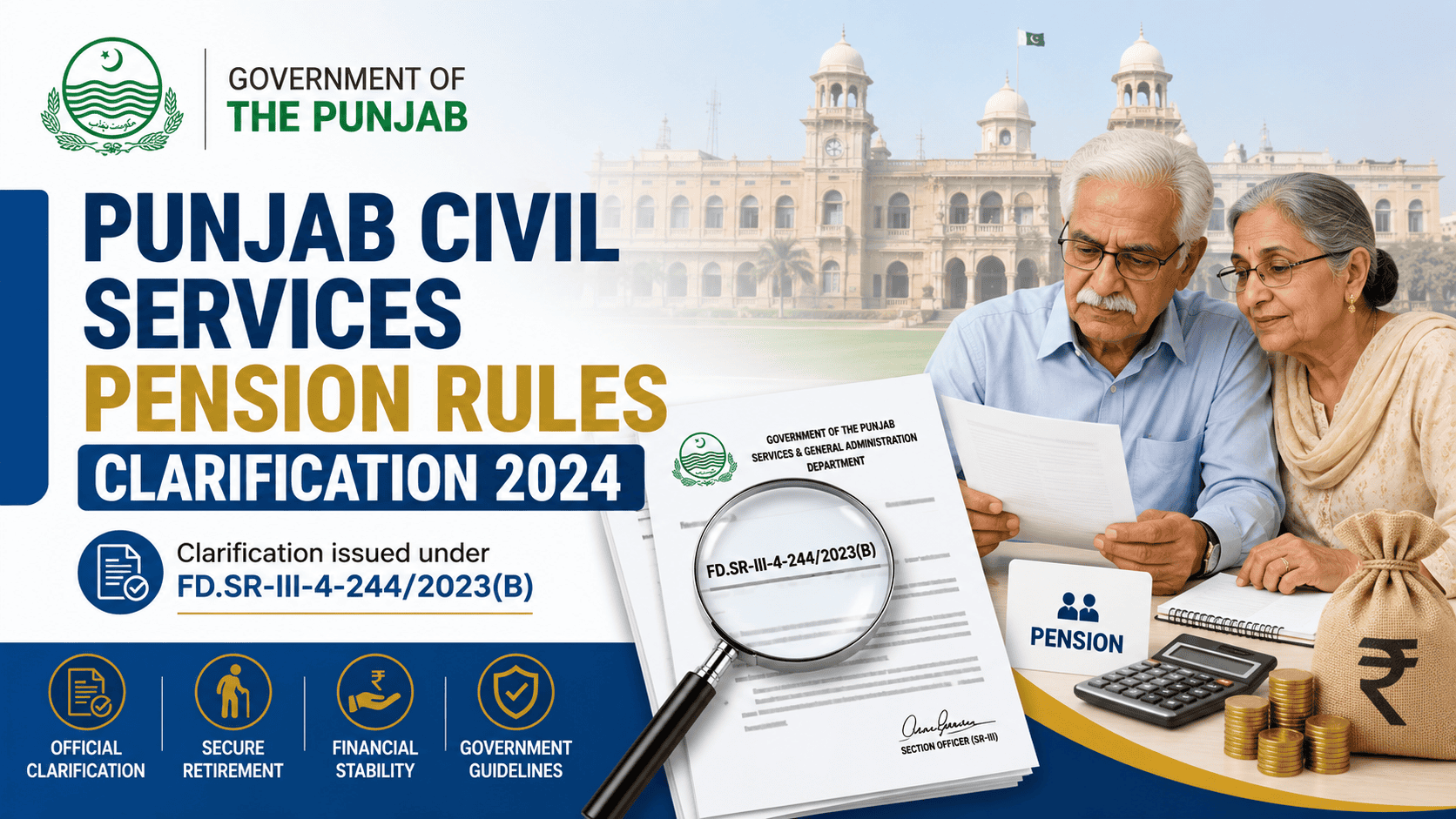
Punjab Pension Rules Clarification 2024-2025: Complete Guide to Notification No. FD.SR-III-4-244/2023(B) Explained in Simple Words

Punjab Civil Services Pension Rules clarification 2024
Article Information Table
| Detail | Information |
|---|---|
| Notification Clarified | No. FD.SR-III-4-244/2023(B), dated 02-12-2024 |
| Clarification Letter Issued By | Finance Department, Government of Punjab |
| Signed By | Amjad Hassan, Deputy Secretary (SR) |
| Clarification Letter Date | 30-05-2025 |
| Forwarded To | Accountant General Punjab, Lahore; All District Accounts Officers in Punjab; Treasury Officer, Lahore |
| Number of Queries Clarified | 10 |
| Applicable Law | Punjab Civil Services Pension Rules |
| Applies To | Punjab Government employees retiring/dying on or after 02-12-2024 |
| Last Updated | 28 July 2026 |
| Reviewed Date | 28 July 2026 |
| Reading Time | Approximately 28-30 minutes |
Important Disclaimer
This article is written for general awareness and educational purposes only. It is based strictly on the text of the Finance Department’s clarification letter regarding Notification No. FD.SR-III-4-244/2023(B), dated 02-12-2024, sent to us for review. This clarification letter answers ten specific queries about the original notification — it does not reproduce the complete original notification word-for-word. Wherever the clarification letter does not provide a detail (for example, the complete reduction factor table for every age, or the full original wording of the amended pension rules), this article clearly says so rather than guessing. This article is not a substitute for the official notification, and readers should always verify their individual pension case with the Accountant General Punjab, their District Accounts Officer, or the Finance Department, Government of Punjab, before taking any financial decision. Finzaro360 does not accept responsibility for decisions taken solely on the basis of this article.
Table of Contents
- Introduction
- What Is This Clarification Notification?
- Why Was This Clarification Issued?
- Who Will Be Affected?
- Employees Covered
- Employees Not Covered
- Notification Timeline
- Clarification No. 1 — Date of Effectiveness
- Clarification No. 2 — Impact on Existing Family Pensioners
- Clarification No. 3 — Date of Grant of Pension
- Clarification No. 4 — The 10-Year Family Pension Period
- Clarification No. 5 — Family Pensioners Who Already Completed 10 Years
- Clarification No. 6 — Average Emoluments Formula
- Clarification No. 7 — Notional Increment and Special Allowances
- Clarification No. 8 — Adhoc Relief Allowance and Pension Increase
- Clarification No. 9 — Voluntary Retirement, LPR and Notice Period Cases
- Clarification No. 10 — Reduction Factor Rounding Rule
- Real Case Study 1
- Real Case Study 2
- Real Case Study 3
- Comparison Tables
- Common Misunderstandings
- Common Mistakes to Avoid
- Frequently Asked Questions (20+)
- Key Takeaways
- Summary
- Final Conclusion
Introduction
If you are a Punjab Government employee, a retired pensioner, a family pension claimant, or a dealing hand in a District Accounts Office or Treasury, you have probably heard confusing versions of what changed in the Punjab Civil Services Pension Rules after the Finance Department’s notification of 02-12-2024. Because the original notification raised so many practical questions, the Finance Department itself issued a follow-up clarification letter on 30-05-2025, signed by the Deputy Secretary (SR), answering ten of the most common queries raised by administrative secretaries, treasury officers, and the Accountant General’s office.
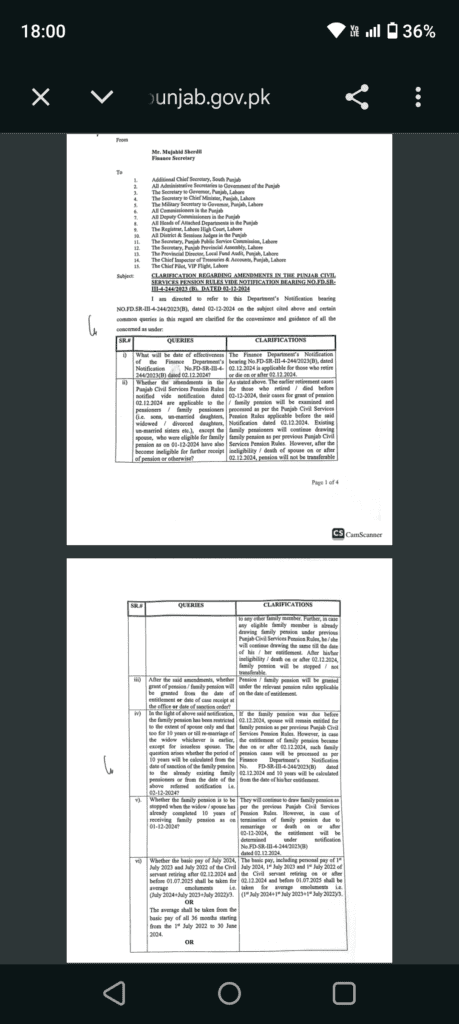
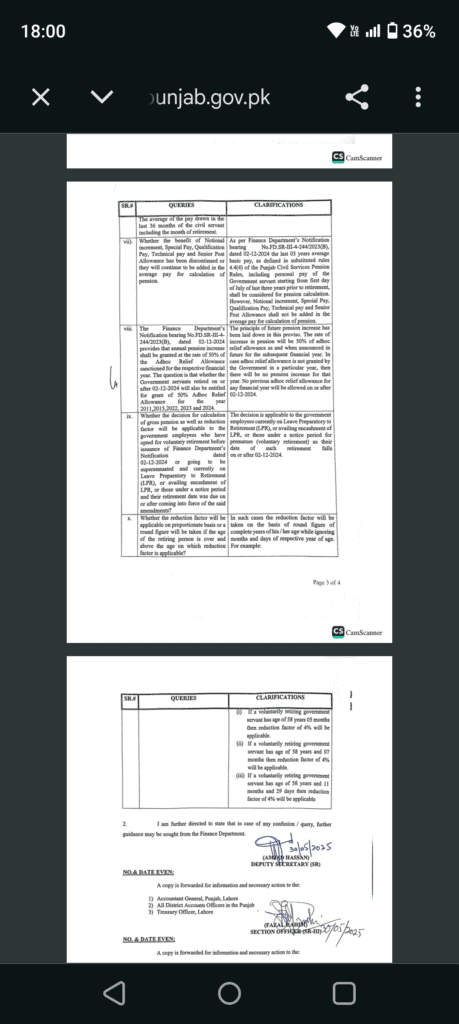
This article walks through that clarification letter point by point, in plain English, without legal jargon. Every clarification is explained with its official meaning, a simple explanation, a practical example, an important note, and who is and is not affected. Wherever the source document does not give a specific figure or detail, this article says so honestly instead of guessing — because when it comes to your pension, guesswork is not acceptable.
1. Introduction
Pension is not just a retirement benefit — for most Punjab Government employees, it is the single largest financial resource they will rely on for the rest of their lives, and for their spouse after them. So when a rule changes, even a small wording difference can change a pensioner’s monthly income by thousands of rupees.
On 02-12-2024, the Finance Department, Government of Punjab, issued Notification No. FD.SR-III-4-244/2023(B) amending the Punjab Civil Services Pension Rules. As is common with any major rule change, field offices — District Accounts Officers, Treasury Officers, and even the Accountant General Punjab — began sending queries to the Finance Department asking how exactly the new rules should be applied in real cases. In response, the Finance Department issued a clarification letter dated 30-05-2025 addressing ten such queries.
This article is a complete explanation of that clarification letter.
2. What Is This Clarification Notification?
The document this article is based on is officially titled:
“Clarification Regarding Amendments in the Punjab Civil Services Pension Rules Vide Notification Bearing No. FD.SR-III-4-244/2023(B), Dated 02-12-2024.”
<cite index=”0-0″>I am directed to refer to this Department’s Notification bearing NO.FD.SR-III-4-244/2023(B), dated 02-12-2024 on the subject cited above and certain common queries in this regard are clarified for the convenience and guidance of all the concerned as under.</cite>
In simple words: this is not a new rule. It is an official explanation of an existing rule. It does not create new pension entitlements; it explains how the Finance Department wants field offices to interpret and apply the notification already issued on 02-12-2024.
It was sent to a wide list of recipients including the Additional Chief Secretary South Punjab, all Administrative Secretaries, the Secretary to Governor Punjab, the Secretary to Chief Minister Punjab, all Commissioners, all Deputy Commissioners, the Registrar Lahore High Court, all District and Sessions Judges, the Punjab Public Service Commission, the Punjab Provincial Assembly, the Provincial Director Local Fund Audit, the Chief Inspector of Treasuries and Accounts, and the Chief Pilot VIP Flight — showing that this clarification is meant to apply uniformly across all provincial departments, courts, and institutions.
3. Why Was This Clarification Issued?
Whenever a pension rule changes the way average emoluments, family pension duration, or reduction factor are calculated, dealing hands at the district and treasury level face real cases that do not fit neatly into the words of a short notification. Common practical confusions typically include:
- Does the new rule apply to people who already retired before the notification?
- What happens to a widow or family member already receiving family pension?
- From which date should the 10-year family pension period be counted?
- Which three years’ pay should be averaged, and does it include allowances?
- Does the changed reduction factor apply to someone already on notice period or LPR?
The Finance Department’s clarification letter exists specifically to remove this confusion at the field level, so that every District Accounts Office and Treasury Office in Punjab follows the same interpretation.
4. Who Will Be Affected?
Based strictly on the clarification letter, the notification and its interpretation affect:
- Government servants of the Punjab Government who retire or die in service on or after 02-12-2024.
- Spouses of such employees who become entitled to family pension on or after 02-12-2024.
- Family pensioners (sons, unmarried daughters, widowed/divorced daughters, unmarried sisters, etc.) whose entitlement to family pension arises after an existing spouse pensioner’s death or ineligibility on or after 02-12-2024.
- Employees currently on Leave Preparatory to Retirement (LPR), availing encashment of LPR, or serving a notice period for premature/voluntary retirement, if their actual date of retirement falls on or after 02-12-2024.
- Employees opting for voluntary retirement whose retirement date falls on or after 02-12-2024.
5. Employees Covered
The clarification letter confirms the following categories are covered by the new notification:
- Employees who retire (superannuation, voluntary retirement, or premature retirement) on or after 02-12-2024.
- Employees who die in service on or after 02-12-2024, for purposes of family pension.
- Spouses becoming newly entitled to family pension on or after 02-12-2024.
- Employees on LPR, encashment of LPR, or under notice period, provided their actual retirement date is on or after 02-12-2024.
6. Employees Not Covered
The clarification letter is equally clear about who continues under the old (previous) Punjab Civil Services Pension Rules:
- <cite index=”0-3″>Employees who retired or died before 02-12-2024 — their cases for grant of pension or family pension will be examined and processed as per the Punjab Civil Services Pension Rules applicable before the notification dated 02-12-2024.</cite>
- Existing family pensioners who were already drawing family pension under the previous rules — they continue drawing it under those old rules until their entitlement ends.
- Widows/spouses whose family pension became due before 02-12-2024 — they remain entitled as per the old rules, even though the new notification has since come into force.
7. Notification Timeline
| Date | Event |
|---|---|
| 02-12-2024 | Finance Department issues Notification No. FD.SR-III-4-244/2023(B) amending the Punjab Civil Services Pension Rules |
| 01-12-2024 | Reference date used in the clarification letter to identify pensioners/family pensioners already eligible before the change |
| 02-12-2024 onward | New notification becomes applicable for retirement, death-in-service, and new family pension entitlement |
| 30-05-2025 | Finance Department issues the clarification letter answering 10 field-level queries |
| 30-05-2025 | Clarification letter forwarded to Accountant General Punjab, all District Accounts Officers, and Treasury Officer Lahore |
8. Clarification No. 1 — Date of Effectiveness of the Notification
Official Query: <cite index=”0-1″>What will be date of effectiveness of the Finance Department’s Notification No.FD.SR-III-4-244/2023(B) dated 02.12.2024?</cite>
Official Clarification: <cite index=”0-2″>The Finance Department’s Notification bearing No.FD-SR-III-4-244/2023(B), dated 02.12.2024 is applicable for those who retire or die on or after 02.12.2024.</cite>
Simple Explanation: The new pension rule is not backdated and not applied to everyone at once. It only applies going forward — to employees whose retirement date or date of death falls on 02-12-2024 or any date after that.
Practical Example: Suppose an employee retired on 30-11-2024. This is before 02-12-2024, so their pension will be calculated under the old pension rules, not the new notification. But if another employee retires on 05-12-2024, their pension will be calculated entirely under the new rules introduced by this notification.
Important Note: The trigger date is the date of retirement or date of death, not the date the pension case is processed, not the date of sanction, and not the date an employee applies for pension.
Who Is Affected: Employees retiring/dying on or after 02-12-2024.
Who Is Not Affected: Employees who retired or died before 02-12-2024 — their pension continues to follow the old rules.
9. Clarification No. 2 — Impact on Existing Family Pensioners (Sons, Unmarried Daughters, Sisters, etc.)
Official Query: <cite index=”0-4″>Whether the amendments in the Punjab Civil Services Pension Rules notified vide notification dated 02.12.2024 are applicable to the pensioners/family pensioners (i.e. sons, un-married daughters, widowed/divorced daughters, un-married sisters etc.), except the spouse, who were eligible for family pension as on 01-12-2024 have also become ineligible for further receipt of pension or otherwise?</cite>
Official Clarification: <cite index=”0-3,0-5,0-6,0-7″>The earlier retirement cases for those who retired/died before 02-12-2024, their cases for grant of pension/family pension will be examined and processed as per the Punjab Civil Services Pension Rules applicable before the said Notification dated 02.12.2024. Existing family pensioners will continue drawing family pension as per previous Punjab Civil Services Pension Rules. However, after the ineligibility/death of spouse on or after 02-12-2024, pension will not be transferable to any other family member. Further, in case any eligible family member is already drawing family pension under previous Punjab Civil Services Pension Rules, he/she will continue drawing the same till the date of his/her entitlement. After his/her ineligibility/death on or after 02.12.2024, family pension will be stopped/not transferable.</cite>
Simple Explanation: This clarification protects people who were already receiving family pension before the rule changed (for example, an unmarried daughter or dependent sister drawing family pension under the old rules). They will keep receiving it exactly as before. But going forward, once that particular family pensioner becomes ineligible (say, a daughter gets married, or a sister passes away) on or after 02-12-2024, the pension will stop completely — it will not pass on to any other family member such as another sibling.
Practical Example: Suppose an unmarried daughter has been drawing family pension since 2020 after her father’s death, under the old rules. She continues to receive it without disruption. If she gets married in 2026 (after 02-12-2024), her family pension stops on marriage — and it will not transfer to her unmarried sister or any other family member, because that “chain transfer” facility available under the old rules is no longer applicable after 02-12-2024.
Important Note: This is one of the most significant changes introduced by the original notification — it effectively ends the practice of pension passing down a chain of eligible family members one after another.
Who Is Affected: Family pensioners other than the spouse (sons, unmarried daughters, widowed/divorced daughters, unmarried sisters) who become ineligible on or after 02-12-2024.
Who Is Not Affected: Family pensioners who were already drawing pension before 02-12-2024 continue to draw it without interruption until their own eligibility ends.
10. Clarification No. 3 — Which Date Decides the Applicable Rule for Grant of Pension
Official Query: <cite index=”0-8″>After the said amendments, whether grant of pension/family pension will be granted from the date of entitlement or date of case receipt at the office or date of sanction order?</cite>
Official Clarification: <cite index=”0-9″>Pension/family pension will be granted under the relevant pension rules applicable on the date of entitlement.</cite>
Simple Explanation: Sometimes a pension case takes months to process at the District Accounts Office due to paperwork delays. This clarification confirms that delay does not matter — what matters is the date the person actually became entitled (i.e., date of retirement, or date of death for family pension), not the date the file physically reached the office, and not the date the sanction order was finally signed.
Practical Example: An employee retires on 25-11-2024 but due to administrative delay, the case papers reach the District Accounts Office only in March 2025, and the sanction order is issued in June 2025. Even though the paperwork was processed under the “new rules era,” the pension will still be calculated as per the old rules, because the date of entitlement (25-11-2024) falls before 02-12-2024.
Important Note: Dealing hands and treasury officials must always check the date of retirement/death, not the file movement date, when deciding which rule set to apply.
Who Is Affected: All pension and family pension cases, regardless of processing delay.
Who Is Not Affected: No exceptions mentioned in the clarification.
11. Clarification No. 4 — How the 10-Year Family Pension Period Is Counted
Official Query: <cite index=”0-10″>In the light of above said notification, the family pension has been restricted to the extent of spouse only and that too for 10 years or till re-marriage of the widow whichever is earlier, except issueless spouse. The question arises whether the period of 10 years will be calculated from the date of sanction of the family pension to the already existing family pensioners or from the date of the above referred notification i.e. 02-12-2024?</cite>
Official Clarification: <cite index=”0-11″>If the family pension was due before 02-12-2024, spouse will remain entitled for family pension as per previous Punjab Civil Services Pension Rules. However, in case the entitlement of family pension became due on or after 02-12-2024, such family pension cases will be processed as per Finance Department’s Notification No. FD-SR-III-4-244/2023(B) dated 02.12.2024 and 10 years will be calculated from the date of his/her entitlement.</cite>
Simple Explanation: This is one of the biggest changes in the original notification — under the new rules, a surviving spouse (other than an issueless spouse, i.e., one whose late partner had no children) is entitled to family pension only for 10 years, or until remarriage, whichever comes first. This clarification confirms that the 10-year clock starts from the date the spouse actually became entitled (i.e., the date of the employee’s death), not from the date the notification was issued, and not from the date the pension was sanctioned on paper.
Practical Example: If a Government servant dies in service on 10-01-2025 (after 02-12-2024), the widow’s 10-year family pension period is counted from 10-01-2025, and it will end on 10-01-2035, or earlier if she remarries before that date. If, however, the death occurred on 15-11-2024 (before 02-12-2024), the widow continues under the old rules, which — as per the previous Punjab Civil Services Pension Rules — did not impose this 10-year cap on the spouse.
Important Note: An “issueless spouse” (a widow or widower without children from the marriage) is stated in the query as an exception to this 10-year restriction. The clarification letter does not go into further detail on the exact treatment of issueless spouse cases beyond repeating the term used in the query — so specific procedural rules for issueless spouse cases should be verified from the original notification text or the Finance Department directly.
Who Is Affected: Spouses whose family pension entitlement arises on or after 02-12-2024.
Who Is Not Affected: Spouses whose family pension was already due before 02-12-2024 — they continue under the old rules without the 10-year cap.
12. Clarification No. 5 — Family Pensioners Who Had Already Completed 10 Years as of 01-12-2024
Official Query: <cite index=”0-12″>Whether the family pension is to be stopped when the widow/spouse has already completed 10 years of receiving family pension as on 01-12-2024?</cite>
Official Clarification: <cite index=”0-13″>They will continue to draw family pension as per the previous Punjab Civil Services Pension Rules. However, in case of termination of family pension due to remarriage or death on or after 02-12-2024, the entitlement will be determined under notification No.FD-SR-III-4-244/2023(B) dated 02.12.2024.</cite>
Simple Explanation: If a widow/spouse was already receiving family pension for 10 years or more as of 01-12-2024 (i.e., before the new rule came into force), her pension is not automatically stopped just because the new 10-year cap exists. She continues drawing it under the old rules. The new rule only comes into play if her entitlement is terminated (through remarriage or her own death) on or after 02-12-2024 — in that case, whatever comes next (if anything) will be decided as per the new notification.
Practical Example: A widow has been receiving family pension continuously since 2012 (13 years by 2025). Because her entitlement started before 02-12-2024, she is not cut off just because 10 years have technically passed. She keeps receiving her pension under the old rules unless she remarries or passes away.
Important Note: This clarification protects long-standing family pensioners from a retroactive cutoff — the new 10-year rule is not applied backward to pensions that started before the notification.
Who Is Affected: Widows/spouses whose family pension is terminated (remarriage or death) on or after 02-12-2024 — their further entitlement, if any, will be assessed under the new rules.
Who Is Not Affected: Widows/spouses who were drawing family pension before 02-12-2024, even beyond 10 years — they are not stopped due to the new cap.
13. Clarification No. 6 — Average Emoluments Formula for Pension Calculation
Official Query: <cite index=”0-14,0-15,0-16″>Whether the basic pay of July 2024, July 2023 and July 2022 of the Civil servant retiring after 02.12.2024 and before 01.07.2025 shall be taken for average emoluments i.e. (July 2024+July 2023+July 2022)/3 OR the average shall be taken from the basic pay of all 36 months starting from the 1st July 2022 to 30 June 2024 OR the average of the pay drawn in the last 36 months of the civil servant including the month of retirement.</cite>
Official Clarification: <cite index=”0-17″>The basic pay, including personal pay of 1st July 2024, 1st July 2023 and 1st July 2022 of the Civil servant retiring on or after 02.12.2024 and before 01.07.2025 shall be taken for average emoluments i.e. (1st July 2024+1st July 2023+1st July 2022)/3.</cite>
Simple Explanation: This is the single most important clarification for pension calculation. For an employee retiring between 02-12-2024 and 30-06-2025, the pension is not based on the last drawn monthly pay, and not based on a full 36-month running average. Instead, it is based on just three fixed reference points: the basic pay (including personal pay, if any) as it stood on 1st July 2022, 1st July 2023, and 1st July 2024. Add these three figures and divide by 3.
Worked Example:
Suppose a civil servant’s basic pay (including personal pay, if applicable) on the three reference dates was:
| Reference Date | Basic Pay (Rs.) |
|---|---|
| 1st July 2022 | 65,000 |
| 1st July 2023 | 72,000 |
| 1st July 2024 | 80,000 |
| Total | 217,000 |
| Average Emoluments (Total ÷ 3) | 72,333 |
This figure of Rs. 72,333 becomes the “average emoluments” used as the base for pension calculation (before applying the pension formula and reduction factor, where applicable).
Important Note: This formula specifically applies to employees retiring on or after 02-12-2024 and before 01-07-2025. The clarification letter does not state what formula applies to employees retiring on or after 01-07-2025 — logically, once a new financial year’s 1st July basic pay becomes available, the three reference points would likely shift forward (for example, 1st July 2023, 1st July 2024, and 1st July 2025). However, since the clarification letter does not explicitly confirm this for post-01-07-2025 retirements, this article does not assume it — employees retiring after 01-07-2025 should confirm the applicable reference dates with their District Accounts Office or the Finance Department.
Who Is Affected: Employees retiring on or after 02-12-2024 and before 01-07-2025.
Who Is Not Affected: Employees who retired before 02-12-2024 (old average emoluments rule applies to them).
14. Clarification No. 7 — Notional Increment, Special Pay, Qualification Pay, Technical Pay, Senior Post Allowance
Official Query: <cite index=”0-18″>Whether the benefit of Notional increment, Special Pay, Qualification Pay, Technical pay and Senior Post Allowance has been discontinued or they will continue to be added in the average pay for calculation of pension.</cite>
Official Clarification: <cite index=”0-19,0-20″>As per Finance Department’s Notification bearing No.FD.SR-III-4-244/2023(B), dated 02-12-2024 the last 03 years average basic pay, as defined in substituted rules 4.4(4) of the Punjab Civil Services Pension Rules, including personal pay of the Government servant starting from first day of July of last three years prior to retirement, shall be considered for pension calculation. However, Notional increment, Special Pay, Qualification Pay, Technical pay and Senior Post Allowance shall not be added in the average pay for calculation of pension.</cite>
Simple Explanation: Only basic pay plus personal pay (if any) counts toward the average emoluments used for pension. Extra components like a Notional Increment, Special Pay, Qualification Pay, Technical Pay, and Senior Post Allowance are excluded — they will not increase your average emoluments figure, even if you were actually drawing them at the time of retirement.
Practical Example: Suppose an employee’s salary slip for 1st July 2024 shows Basic Pay Rs. 80,000 + Qualification Pay Rs. 5,000 + Senior Post Allowance Rs. 3,000. For pension calculation purposes, only the Rs. 80,000 basic pay (plus personal pay, if drawn) is used. The Qualification Pay and Senior Post Allowance are simply ignored in the average emoluments calculation.
Important Note: This clarification confirms rule 4.4(4) of the Punjab Civil Services Pension Rules was substituted (replaced) by the 02-12-2024 notification. The clarification letter does not reproduce the full old or new text of rule 4.4(4) — it only confirms which allowances are excluded. Employees who previously counted on these allowances being included in their pension calculation should be aware this is no longer the case for retirements on or after 02-12-2024.
Who Is Affected: All employees retiring on or after 02-12-2024 who draw any of these allowances.
Who Is Not Affected: Employees who retired before 02-12-2024 — their pension was calculated under the pre-amendment rules, whose exact treatment of these allowances is not detailed in this clarification letter.
15. Clarification No. 8 — Adhoc Relief Allowance and Future Pension Increase
Official Query: <cite index=”0-21″>The Finance Department’s Notification bearing No.FD.SR-III-4-244/2023(B), dated 02-12-2024 provides that annual pension increase shall be granted at the rate of 50% of the Adhoc Relief Allowance sanctioned for the respective financial year. The question is that whether the Government servants retired on or after 02-12-2024 will also be entitled for grant of 50% Adhoc Relief Allowance for the year 2011, 2015, 2022, 2023 and 2024.</cite>
Official Clarification: <cite index=”0-22″>The principle of future pension increase has been laid down in this proviso. The rate of increase in pension will be 50% of adhoc relief allowance as and when announced in future for the subsequent financial year. In case adhoc relief allowance is not granted by the Government in a particular year, then there will be no pension increase for that year. No previous adhoc relief allowance for any financial year will be allowed on or after 02-12-2024.</cite>
Simple Explanation: From 02-12-2024 onward, a pensioner’s future annual pension increase will equal 50% of whatever Adhoc Relief Allowance the Government announces for that year — but only going forward. Past Adhoc Relief Allowances announced in earlier years (like 2011, 2015, 2022, 2023, or 2024) are not retroactively given to new pensioners just because they retired after the notification. And if, in some future year, the Government does not announce any Adhoc Relief Allowance at all, then there is simply no pension increase that year.
Practical Example: Suppose in the financial year 2026-27, the Government announces a 15% Adhoc Relief Allowance for serving employees. A pensioner who retired after 02-12-2024 will get a pension increase equal to 50% of 15%, i.e., 7.5%, applied to their pension for that year. But this pensioner cannot separately claim 50% of the Adhoc Relief Allowance amounts that were announced back in 2011 or 2022, since those are past years, not “future” years from the date of the notification.
Important Note: This clarification only fixes the formula/principle for future pension increases (50% of Adhoc Relief Allowance, when announced). It does not guarantee an increase every year — it is entirely dependent on the Government announcing Adhoc Relief Allowance for that year.
Who Is Affected: All pensioners retiring on or after 02-12-2024, for their future annual pension increases.
Who Is Not Affected: No claim can be made for adhoc relief allowances of years before the notification (2011, 2015, 2022, 2023, 2024) as a separate benefit.
16. Clarification No. 9 — Voluntary Retirement, LPR, and Notice Period Cases
Official Query: <cite index=”0-23″>Whether the decision for calculation of gross pension as well as reduction factor will be applicable to the government employees who have opted for voluntary retirement before issuance of Finance Department’s Notification dated 02-12-2024 or going to be superannuated and currently on Leave Preparatory to Retirement (LPR), or availing encashment of LPR, or those under a notice period and their retirement date was due on or after coming into force of the said amendments?</cite>
Official Clarification: <cite index=”0-24″>The decision is applicable to the government employees currently on Leave Preparatory to Retirement (LPR), or availing encashment of LPR, or those under a notice period for premature (voluntary retirement) as their date of such retirement falls on or after 02-12-2024.</cite>
Simple Explanation: What actually matters is the final date of retirement, not the date the employee applied for voluntary retirement, went on LPR, or started their notice period. Even if an employee submitted their voluntary retirement request, or went on LPR, or began their notice period before 02-12-2024, if their actual retirement date falls on or after 02-12-2024, the new rules (gross pension calculation and reduction factor) will apply to them.
Practical Example: An employee applies for voluntary retirement in October 2024 and goes on LPR from 01-11-2024, with actual retirement effective from 15-12-2024. Even though the application and LPR started before 02-12-2024, because the actual retirement date (15-12-2024) is after 02-12-2024, the new pension rules — including the reduction factor for voluntary retirement — will apply to this employee.
Important Note: Employees currently on LPR or notice period should check their exact retirement date, not the date they applied, to know which pension rule will govern their case.
Who Is Affected: Employees on LPR, LPR encashment, or notice period whose actual retirement date is on or after 02-12-2024.
Who Is Not Affected: Employees whose actual retirement date fell before 02-12-2024, even if their LPR/notice period continued into the new period — their pension follows the old rules based on their retirement date.
17. Clarification No. 10 — How the Reduction Factor Is Rounded for Age
Official Query: <cite index=”0-25″>Whether the reduction factor will be applicable on proportionate basis or a round figure will be taken if the age of the retiring person is over and above the age on which reduction factor is applicable?</cite>
Official Clarification: <cite index=”0-26″>In such cases the reduction factor will be taken on the basis of round figure of complete years of his/her age while ignoring months and days of respective year of age.</cite>
The clarification letter gives three worked illustrations:
<cite index=”0-27,0-28,0-29″>(i) If a voluntarily retiring government servant has age of 58 years 05 months then reduction factor of 4% will be applicable. (ii) If a voluntarily retiring government servant has age of 58 years and 07 months then reduction factor of 4% will be applicable. (iii) If a voluntarily retiring government servant has age of 58 years and 11 months and 29 days then reduction factor of 4% will be applicable.</cite>
Simple Explanation: For employees taking voluntary retirement, the pension amount is reduced by a certain percentage (called the “reduction factor”) depending on how far the employee’s age is from the normal retirement age. This clarification confirms that the reduction factor is decided by complete years of age only — extra months and days beyond a completed year are simply ignored, they do not improve the reduction factor on a proportionate/pro-rata basis.
Worked Example (Based on the Notification’s Own Illustrations):
| Employee’s Exact Age at Voluntary Retirement | Completed Years Counted | Reduction Factor Applied |
|---|---|---|
| 58 years, 5 months | 58 years | 4% |
| 58 years, 7 months | 58 years | 4% |
| 58 years, 11 months, 29 days | 58 years | 4% |
| 59 years, 0 months, 1 day (hypothetical, for comparison only) | 59 years | Not stated in this clarification letter |
Important Note: The clarification letter gives examples only for the age slab of 58 completed years, where the reduction factor is 4%. It does not provide the complete reduction factor table for other ages (such as 50, 55, 56, 57, or 59 years). This article does not invent those figures — readers must refer to the original notification dated 02-12-2024 or the Punjab Civil Services Pension Rules for the complete age-wise reduction factor table.
Who Is Affected: Employees opting for voluntary retirement whose age falls just above a completed year threshold (e.g., 58 years and some extra months/days).
Who Is Not Affected: Superannuation (normal) retirement is not linked to a reduction factor in the same way; the reduction factor specifically concerns voluntary/premature retirement cases, as indicated by the clarification’s own wording (“voluntarily retiring government servant”).
18. Real Case Study 1 — Normal Retirement Just After the Cut-Off Date
Employee Profile: A Section Officer working in a Punjab Government department.
Appointment Date: 01-08-1990 (illustrative, for calculation purposes only)
Retirement Date: 10-12-2024 (on superannuation, after attaining the age of 60 years)
Applicable Rule: New rule under Notification No. FD.SR-III-4-244/2023(B), since retirement date is on or after 02-12-2024
Applicable Notification: FD.SR-III-4-244/2023(B), dated 02-12-2024, as explained by the clarification letter dated 30-05-2025
Average Emoluments: Calculated as (Basic pay on 1st July 2022 + Basic pay on 1st July 2023 + Basic pay on 1st July 2024) ÷ 3
Illustrative figures: Rs. 68,000 (2022) + Rs. 75,000 (2023) + Rs. 82,000 (2024) = Rs. 225,000 ÷ 3 = Rs. 75,000 average emoluments
Qualifying Service: 34 years, 4 months (illustrative)
Pension Calculation — Old Rule (if retirement had been before 02-12-2024): The clarification letter does not state the pre-amendment average emoluments formula in detail, so an old-rule pension figure cannot be responsibly calculated here without guessing. This case study therefore focuses only on the confirmed new-rule method.
Pension Calculation — New Rule: Average emoluments of Rs. 75,000 (per the fixed three-reference-date formula) is used as the base pay for pension calculation under the Punjab Civil Services Pension Rules formula for full qualifying service. (The exact pension percentage/formula from qualifying service to gross pension is governed by the wider Pension Rules and is not restated in this clarification letter — only the average emoluments component and the exclusion of certain allowances are clarified here.)
Difference: The key practical difference for this employee compared to someone retiring before 02-12-2024 is that Notional Increment, Special Pay, Qualification Pay, Technical Pay, and Senior Post Allowance — even if drawn — are excluded from the average emoluments calculation, and the average is based strictly on three fixed 1st-July reference dates rather than a full 36-month rolling average.
Final Conclusion: Because this employee’s retirement date (10-12-2024) falls after 02-12-2024, their pension is governed entirely by the new notification, using the fixed 1-July-2022/2023/2024 average emoluments formula and excluding the allowances mentioned in Clarification No. 7.
19. Real Case Study 2 — Widow’s Family Pension Starting After the Notification
Employee Profile: A Junior Clerk in a District Accounts Office.
Date of Death (in service): 20-01-2025 (after 02-12-2024)
Applicable Rule: New family pension rule — 10 years or till remarriage, whichever is earlier (unless issueless spouse)
Applicable Notification: FD.SR-III-4-244/2023(B), dated 02-12-2024, as clarified on 30-05-2025
Family Pension Entitlement Start Date: 20-01-2025 (date of death = date of entitlement)
10-Year Period Calculated From: 20-01-2025, ending 20-01-2035, unless remarriage occurs earlier
Old Rule (hypothetical comparison, if death had occurred before 02-12-2024): Family pension would have continued under the previous Punjab Civil Services Pension Rules without the 10-year cap referenced in this clarification (subject to the actual old rule’s own conditions, which are not restated in this clarification letter).
New Rule (actual, since death occurred after 02-12-2024): Widow is entitled to family pension for a maximum of 10 years from 20-01-2025, or until remarriage, whichever happens first — unless she qualifies as an “issueless spouse,” a term used in the clarification but not elaborated further in this document.
Difference: Under the new rule, this widow’s family pension has a defined end date (20-01-2035) unless she remarries earlier, whereas under the old rule (as referenced, though not detailed, in the clarification), no such 10-year cap applied to the spouse.
Final Conclusion: Because the date of death (20-01-2025) is after 02-12-2024, the widow’s family pension is governed by the new notification, and the 10-year period is counted strictly from her date of entitlement (date of death), not from any later sanction date.
20. Real Case Study 3 — Voluntary Retirement Straddling the Cut-Off Date
Employee Profile: An Assistant working in a provincial department who applied for voluntary retirement.
Application for Voluntary Retirement Submitted: 15-10-2024 (before the notification)
LPR/Notice Period Start: 01-11-2024
Actual Retirement Date: 20-12-2024 (after 02-12-2024)
Age at Retirement: 58 years, 7 months
Applicable Rule: New rule, because the actual retirement date (20-12-2024) is on or after 02-12-2024, per Clarification No. 9
Applicable Notification: FD.SR-III-4-244/2023(B), dated 02-12-2024
Average Emoluments: Based on basic pay on 1st July 2022, 2023, and 2024 (as per Clarification No. 6)
Reduction Factor: Since the employee’s age is 58 years and 7 months, only the completed years (58) are counted per Clarification No. 10; the reduction factor of 4% (as per the notification’s own illustration for 58 completed years) applies — the extra 7 months do not change or reduce this factor.
Old Rule (if retirement had fallen before 02-12-2024): The application and LPR start date being before 02-12-2024 would not have mattered under the old regime either — the retirement date is always what counts. But since actual retirement is after 02-12-2024, the old rule does not apply here at all.
Difference: The employee might have assumed that because they applied for voluntary retirement in October 2024 (before the new notification), the old rules would apply to them. Clarification No. 9 corrects this assumption — the actual retirement date governs, not the application date.
Final Conclusion: This employee’s pension, including the reduction factor for voluntary retirement, is governed entirely by the new notification, because their actual date of retirement (20-12-2024) falls on or after 02-12-2024 — regardless of when they applied or started LPR.
21. Comparison Tables
Old Rules vs New Rules (Summary)
| Aspect | Before 02-12-2024 (Old Rule) | On/After 02-12-2024 (New Rule) |
|---|---|---|
| Applicability | Governed by pre-amendment Punjab Civil Services Pension Rules | Governed by Notification No. FD.SR-III-4-244/2023(B) |
| Family pension chain transfer (to other eligible family members after spouse) | Continued as per previous rules until specific case ends (per clarification, “as stated above”) | Not transferable to any other family member once the entitled person becomes ineligible on/after 02-12-2024 |
| Family pension duration for spouse | No 10-year cap referenced in this clarification | Limited to 10 years or till remarriage, whichever is earlier (except issueless spouse) |
| Average emoluments basis | Not detailed in this clarification letter | Basic pay (incl. personal pay) on 1st July 2022, 2023, 2024, averaged — for retirements between 02-12-2024 and 30-06-2025 |
| Allowances in average pay | Not detailed in this clarification letter | Notional Increment, Special Pay, Qualification Pay, Technical Pay, Senior Post Allowance excluded |
| Pension increase basis | Not detailed in this clarification letter | 50% of Adhoc Relief Allowance announced in future years; no increase if none announced |
Before 2 December 2024 vs After 2 December 2024
| Situation | Before 02-12-2024 | On/After 02-12-2024 |
|---|---|---|
| Retirement/death cases | Old Pension Rules apply | New notification applies |
| Existing family pensioners | Continue as before | Continue as before, until their own ineligibility |
| New family pension entitlement | N/A (old rule governs) | 10-year cap / until remarriage; no chain transfer |
Old Family Pension vs New Family Pension
| Feature | Old Family Pension Rule (as referenced) | New Family Pension Rule (per clarification) |
|---|---|---|
| Who can receive it | Spouse, and after spouse — other eligible family members in sequence | Restricted to spouse only (with limited exception for issueless spouse) |
| Duration for spouse | Not capped, per this clarification’s framing | 10 years or till remarriage, whichever is earlier |
| Transfer to next eligible family member | Allowed under old rules for those already in the chain | Not transferable to any other family member once ineligibility/death occurs on/after 02-12-2024 |
Average Emoluments Comparison
| Retirement Period | Average Emoluments Formula (as confirmed by clarification) |
|---|---|
| Before 02-12-2024 | Not detailed in this clarification letter |
| 02-12-2024 to 30-06-2025 | (Basic pay on 1-7-2022 + Basic pay on 1-7-2023 + Basic pay on 1-7-2024) ÷ 3 |
| After 01-07-2025 | Not explicitly stated in this clarification letter |
Voluntary Retirement Comparison
| Scenario | Rule Applied |
|---|---|
| Application filed before 02-12-2024, actual retirement before 02-12-2024 | Old rule |
| Application filed before 02-12-2024, actual retirement on/after 02-12-2024 | New rule (per Clarification No. 9) |
| On LPR/notice period, actual retirement on/after 02-12-2024 | New rule |
Reduction Factor Comparison
| Age at Voluntary Retirement | Reduction Factor (as per notification’s own example) |
|---|---|
| 58 years, 5 months | 4% |
| 58 years, 7 months | 4% |
| 58 years, 11 months, 29 days | 4% |
| Other ages (below/above 58) | Not stated in this clarification letter — refer to the original notification’s full reduction factor table |
22. Common Misunderstandings
- “My pension case was delayed, so I will get the old rule.” — Incorrect. Clarification No. 3 confirms the applicable rule depends on the date of entitlement (retirement/death), not the date the case was received or sanctioned.
- “I applied for voluntary retirement before the notification, so old rules apply to me.” — Incorrect. Clarification No. 9 confirms the actual retirement date decides which rule applies, not the application or LPR start date.
- “The 10-year family pension period starts from the date the pension gets sanctioned.” — Incorrect. Clarification No. 4 confirms it starts from the date of entitlement (i.e., date of death), not the sanction date.
- “If my mother has already received family pension for over 10 years, it will now be stopped.” — Incorrect. Clarification No. 5 confirms pre-existing family pensioners are not cut off retroactively.
- “Qualification Pay and Senior Post Allowance will still count toward my average emoluments.” — Incorrect. Clarification No. 7 excludes these specifically.
- “I will get the pending Adhoc Relief Allowance benefits of 2011, 2015, 2022, 2023, 2024 added to my pension since I retired after the new rule.” — Incorrect. Clarification No. 8 confirms only future Adhoc Relief Allowance (post-notification) counts toward pension increase, not past years.
- “Since I am 58 years and almost 59, my reduction factor should be slightly better than someone who is exactly 58.” — Incorrect. Clarification No. 10 confirms only completed years count; months and days are ignored.
23. Common Mistakes to Avoid
- Do not assume the applicable pension rule based on when the retirement/pension application was submitted — always check the actual date of retirement or death.
- Do not calculate average emoluments using a rolling 36-month average — for retirements between 02-12-2024 and 30-06-2025, only the fixed 1st July 2022/2023/2024 figures apply.
- Do not include Notional Increment, Special Pay, Qualification Pay, Technical Pay, or Senior Post Allowance while computing average emoluments for pension.
- Do not assume family pension can pass on to another family member (e.g., unmarried sister) after the primary family pensioner becomes ineligible on or after 02-12-2024 — it cannot.
- Do not assume a fixed annual pension increase — it depends entirely on whether the Government announces Adhoc Relief Allowance that year.
- Do not try to prorate the reduction factor for extra months/days beyond a completed year of age — it is always rounded down to completed years.
- Do not confuse this clarification letter with the full original notification — some details (like the complete reduction factor table and the exact pre-amendment rule text) are not part of this clarification and must be checked in the original notification.
24. Frequently Asked Questions (FAQs)
Q1. What is Notification No. FD.SR-III-4-244/2023(B)? It is a Finance Department notification dated 02-12-2024 that amended the Punjab Civil Services Pension Rules. The document explained in this article is a later clarification letter (dated 30-05-2025) answering common questions about that notification.
Q2. From which date does the new pension rule apply? It applies to employees who retire or die on or after 02-12-2024, as confirmed in Clarification No. 1.
Q3. Will my pension change if I retired before 02-12-2024? No. Your pension case will be processed under the Punjab Civil Services Pension Rules applicable before this notification.
Q4. Can family pension now pass from one family member to another indefinitely? No. Per Clarification No. 2, once a family pensioner (other than spouse) becomes ineligible on or after 02-12-2024, the pension stops and is not transferable to another family member.
Q5. My father died in November 2024. Which rule applies to my mother’s family pension? Since the death occurred before 02-12-2024, the old Punjab Civil Services Pension Rules apply, as per Clarification No. 1 and No. 4.
Q6. Is there now a time limit on how long a widow can receive family pension? Yes, if her entitlement arose on or after 02-12-2024 — 10 years or until remarriage, whichever is earlier, except for an issueless spouse (a term used in the notification without further elaboration in this clarification).
Q7. From which date is the 10-year family pension period counted? From the date of entitlement (i.e., date of the employee’s death), not from the date of sanction — per Clarification No. 4.
Q8. My mother has already been receiving family pension for 12 years. Will it stop now? No. Per Clarification No. 5, pre-existing family pensioners continue under the old rules.
Q9. Which basic pay figures are used to calculate average emoluments now? Basic pay (including personal pay) on 1st July 2022, 1st July 2023, and 1st July 2024, for those retiring between 02-12-2024 and 30-06-2025 — per Clarification No. 6.
Q10. Is the average emoluments a rolling 36-month average? No. It is specifically the average of three fixed reference dates (1st July of each of the last three years), not a 36-month rolling average — per Clarification No. 6.
Q11. What happens for employees retiring after 01-07-2025 — which reference dates apply? This clarification letter does not explicitly state the formula for retirements after 01-07-2025. This article does not guess; please confirm with the Finance Department or District Accounts Office.
Q12. Does Qualification Pay count toward my pension calculation? No. Per Clarification No. 7, Qualification Pay is specifically excluded from average emoluments for pension purposes.
Q13. Does Senior Post Allowance count toward pension calculation? No, it is excluded, per Clarification No. 7.
Q14. Will Notional Increment be added to my average pay for pension? No, Notional Increment is excluded, per Clarification No. 7.
Q15. Will my pension increase every year automatically? Only if the Government announces an Adhoc Relief Allowance for that year — the pension increase will be 50% of that allowance. If none is announced, there is no increase that year — per Clarification No. 8.
Q16. Can I claim 50% of the Adhoc Relief Allowances given in 2011, 2015, 2022, 2023, or 2024, since I retired after the new notification? No. Per Clarification No. 8, only future Adhoc Relief Allowances (announced after the notification) count toward pension increase.
Q17. I applied for voluntary retirement in October 2024, but my actual retirement date is in December 2024. Which rule applies? The new rule applies, because your actual retirement date is on or after 02-12-2024, regardless of when you applied — per Clarification No. 9.
Q18. I am currently on LPR. Will the new rule apply to me? Yes, if your actual date of retirement falls on or after 02-12-2024 — per Clarification No. 9.
Q19. How is the reduction factor decided for voluntary retirement? Based on your completed years of age only; extra months and days in the current year of age are ignored — per Clarification No. 10.
Q20. If I am 58 years and 11 months and 29 days old at voluntary retirement, will I get a better reduction factor than someone who is exactly 58? No. Per Clarification No. 10’s own example, both cases get the same 4% reduction factor, because only completed years are counted.
Q21. Does this clarification letter give the complete reduction factor table for all ages? No. It only illustrates the rule using the 58-year age slab (4%). The complete table is not part of this clarification letter.
Q22. Who should I contact if my specific pension case does not match any of these clarifications? Per the clarification letter itself, further guidance may be sought from the Finance Department, Government of Punjab, or your Accountant General/District Accounts Office/Treasury Officer.
25. Key Takeaways
- The applicable pension rule depends on the actual date of retirement or death, not the application date, LPR start date, sanction date, or file receipt date.
- Employees/pensioners before 02-12-2024 continue under the old Punjab Civil Services Pension Rules; those on/after 02-12-2024 follow the new notification.
- Family pension for a spouse is now capped at 10 years or till remarriage (except issueless spouse), counted from the date of entitlement.
- Family pension for other members (sons, unmarried daughters, sisters, etc.) is no longer transferable once the current pensioner becomes ineligible on/after 02-12-2024.
- Average emoluments for retirements between 02-12-2024 and 30-06-2025 are based strictly on basic pay (plus personal pay) on 1st July 2022, 2023, and 2024 — averaged.
- Notional Increment, Special Pay, Qualification Pay, Technical Pay, and Senior Post Allowance are excluded from average emoluments.
- Future annual pension increase equals 50% of Adhoc Relief Allowance, only when announced — no retroactive benefit for past years.
- Reduction factor for voluntary retirement is based on completed years of age only — months/days are ignored, not prorated.
26. Summary
The Finance Department’s clarification letter dated 30-05-2025 answers ten field-level questions about the pension rule changes brought in by Notification No. FD.SR-III-4-244/2023(B) dated 02-12-2024. Across all ten clarifications, one consistent principle stands out: the date of retirement or death is what determines which set of rules applies — not the date of application, LPR, notice period, file processing, or sanction order. The notification tightens family pension rules (10-year cap for spouse, no chain transfer to other family members), changes the average emoluments formula to three fixed reference dates, excludes several allowances from pension calculation, ties future pension increases to Adhoc Relief Allowance, and confirms that the reduction factor for voluntary retirement is based on completed years of age only.
27. Final Conclusion
This clarification letter is a practical field guide for treasury officials, District Accounts Officers, and pensioners trying to understand exactly how the 02-12-2024 pension amendment applies to real cases. While it resolves ten important questions clearly, it does not replace the full original notification — several details, such as the complete reduction factor table for all ages, the exact pre-amendment rule wording, and the average emoluments formula for retirements after 01-07-2025, are not covered in this document. Employees and pensioners with cases that don’t fit neatly into these ten clarifications should approach the Finance Department, Accountant General Punjab, or their District Accounts Office directly, as the clarification letter itself advises.
- [Punjab Government Pension Calculator 2026] — (placeholder link)
- [Family Pension Rules 2026 — Complete Guide] — (placeholder link)
- [Qualifying Service Rules for Punjab Government Employees] — (placeholder link)
- [Punjab Pay Scale 2026] — (placeholder link)
- [Commutation of Pension Rules Explained] — (placeholder link)
- [GP Fund Rules for Punjab Government Employees] — (placeholder link)
External References
- Finance Department, Government of Punjab
- Punjab Civil Services Pension Rules
- Office of the Accountant General, Punjab
- Inspectorate of Treasuries and Accounts, Punjab
This article was last updated and reviewed on 28 July 2026. It is based on the Finance Department, Government of Punjab’s clarification letter regarding Notification No. FD.SR-III-4-244/2023(B), dated 02-12-2024, signed by Amjad Hassan, Deputy Secretary (SR), dated 30-05-2025. For case-specific guidance, please contact the Finance Department, Government of Punjab, or your concerned District Accounts Office / Treasury Office.