
On-Page vs Off-Page SEO
If you have spent any time reading about SEO, you have definitely come across the terms “on-page SEO” and “off-page SEO.” Most articles throw these terms around assuming you already understand them, which leaves a lot of beginners nodding along without actually knowing the difference — or worse, focusing entirely on one while completely ignoring the other.
This is a real problem, because on-page and off-page SEO are not competing strategies. They work together, like two legs walking in the same direction. A blog with perfect on-page SEO but zero off-page authority will struggle to rank for competitive keywords. A site with strong off-page authority but poorly optimized pages will also underperform, because Google still needs to understand what each individual page is actually about.
This guide breaks both concepts down in plain language, with real examples, so you understand exactly what to focus on and when.
If you are still choosing what to write about before applying any of this, our guide on How to Choose a Profitable Blog Niche in 2026 is worth reading first, since SEO strategy works best once your content direction is clear.
The Simple Way to Understand the Difference
Here is the easiest way to remember it:
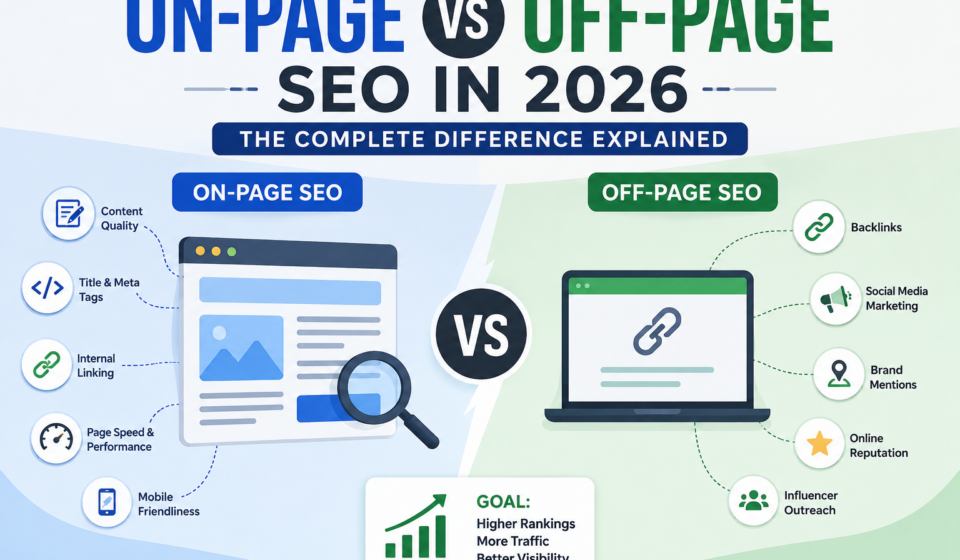
- On-page SEO is everything you control directly on your own website — your content, your titles, your images, your internal links, your page speed.
- Off-page SEO is everything that happens outside your website that still affects how Google ranks you — backlinks from other sites, brand mentions, social signals, and your site’s overall reputation across the internet.
A simple analogy: Think of on-page SEO as how well you present yourself in a job interview — your resume, your answers, your body language. Think of off-page SEO as your reputation before you even walk into the room — recommendations from previous employers, your professional network, and what people say about you when you’re not in the room. Both matter enormously, but they work in completely different ways.
Part 1: What Is On-Page SEO?
On-page SEO refers to all the optimization work you do directly within your website and individual pages to help both search engines and readers understand your content clearly. This includes several key elements.
Keyword Placement and Content Quality
Your target keyword should appear naturally in your title, your first paragraph, a few subheadings, and throughout the body content — without forcing it in awkwardly. Google’s algorithms in 2026 are sophisticated enough to understand context and related terms, so keyword stuffing (repeating a keyword unnaturally many times) actually hurts rankings rather than helping them.
Example of poor keyword usage: “If you want to know how to make money on Upwork, this Upwork guide will show you how to make money on Upwork because Upwork is a great way to make money on Upwork.”
Example of natural keyword usage: “Upwork is one of the most reliable platforms for building a freelancing career in 2026. This guide walks through exactly how to get started, from creating your profile to landing your first client.”
If you are still working on the keyword research stage of your content strategy, our guide on Keyword Research Kaise Karein? Free Tools Se Complete SEO Guide 2026 covers exactly how to find keywords worth targeting before you even start writing.
Title Tags and Meta Descriptions
Your title tag (the clickable blue headline in Google search results) and meta description (the short summary text below it) directly influence whether someone clicks on your result. A clear, benefit-focused title tends to outperform a vague or overly clever one.
Example of a weak title: “Freelancing Tips”
Example of a strong title: “How to Make Money on Upwork in 2026: Complete Beginner’s Guide”
The second title tells searchers exactly what they’ll get and includes the specific keyword they likely searched for.
Header Structure (H1, H2, H3)
Using a clear, logical heading structure helps both readers scan your content and helps Google understand how your article is organized. Your H1 should be your main title, and H2s should break your content into clear sections, similar to how this article is structured.
Internal Linking
This is one of the most underrated on-page SEO factors. Linking to other relevant articles on your own site helps Google understand your site’s overall topic structure, keeps readers engaged longer, and passes authority between your pages. Our guide on Why Your Website Is Not Getting Organic Traffic in 2026 explains how weak internal linking is one of the most common, overlooked reasons blogs struggle to rank even with decent content.
Example: If you write an article about data entry jobs, linking to your related articles about freelancing platforms, payment methods, and budgeting tools (assuming they genuinely add value for the reader) strengthens your site’s internal structure significantly more than leaving each article as an isolated island with no connections.
Page Speed and Mobile-Friendliness
Google has confirmed for years that page speed and mobile usability directly affect rankings, and in 2026, with the vast majority of searches happening on mobile devices, this matters more than ever. A beautifully written article that takes eight seconds to load will lose a significant percentage of visitors before they even read a single sentence.
Image Optimization
Images should be compressed for fast loading and include descriptive alt text (a short description of the image for accessibility and SEO purposes). This also gives your content a chance to rank in Google Image search, which can be a meaningful additional traffic source for visual niches.
Part 2: What Is Off-Page SEO?
Off-page SEO covers everything that builds your website’s authority and reputation from outside your own domain. Google treats external validation as a strong trust signal — essentially asking, “do other credible sources on the internet vouch for this site?”
Backlinks
A backlink is simply a link from another website pointing to yours. Backlinks remain one of the strongest ranking factors in 2026, but quality matters far more than quantity. One link from a well-established, relevant site is worth significantly more than fifty links from low-quality, irrelevant websites.
Example: If a well-known personal finance website links to your article about freelance rate calculators, that single backlink likely carries more SEO weight than twenty backlinks from unrelated, low-authority blogs, because Google factors in both the linking site’s authority and its topical relevance to your content.
If you are just starting to build backlinks, our step-by-step guide on How to Get Your First 100 Backlinks for Free in 2026 walks through practical, beginner-friendly methods that don’t require an existing network or budget.
Domain Authority and Domain Rating
These are third-party metrics (created by SEO tools, not Google itself) that estimate how authoritative and trustworthy your site appears based largely on its backlink profile. While not an official Google ranking factor, these scores correlate closely enough with real ranking ability that most SEO professionals treat them as a useful benchmark. Our guide on How to Increase Your DA/DR Fast in 2026 covers practical, realistic strategies for building this kind of authority over time.
Brand Mentions and Online Reputation
Even mentions of your brand or website without a direct clickable link (called “unlinked mentions”) can contribute to how search engines perceive your site’s authority and relevance, especially as AI-powered search results become more common. This is part of why building a recognizable brand name, not just optimized pages, increasingly matters for long-term SEO success.
Social Signals
While social media shares and engagement are not direct Google ranking factors in the traditional sense, they indirectly support SEO by increasing your content’s visibility, which often leads to more organic backlinks and brand mentions as more people discover and reference your work.
Guest Posting and Digital PR
Writing guest articles for other reputable websites in your niche, in exchange for a backlink to your site, remains one of the most effective and controllable off-page SEO strategies in 2026, since you have direct influence over the outreach process rather than waiting passively for links to appear.
How On-Page and Off-Page SEO Work Together
Here is a practical example that shows why you need both working together, not one instead of the other.
Scenario: Two bloggers both write an article about “how to file taxes as a freelancer in Pakistan.”
- Blogger A writes a well-structured, genuinely helpful, keyword-optimized article (strong on-page SEO) but never actively promotes it or builds any backlinks to it.
- Blogger B writes a decent but not exceptional article, but actively reaches out to five relevant finance and freelancing blogs, earning three quality backlinks (strong off-page SEO).
In most competitive niches, Blogger B’s article will likely outrank Blogger A’s over time, simply because Google trusts the increased external validation, even though the on-page content quality was slightly lower. However, if Blogger A also builds backlinks to their already well-optimized article, they would likely outperform both — this is exactly why the strongest SEO strategies combine both elements deliberately, rather than treating them as separate, competing approaches.
Which Should You Focus On First as a New Blog?
For brand-new websites, on-page SEO should almost always come first, for a simple reason: it makes no sense to actively promote or build backlinks to poorly structured, thin, or unoptimized content. Get your foundational on-page elements right first — clear structure, genuine keyword research, strong internal linking, and fast-loading pages.
Once you have a solid base of well-optimized articles (even just 15–20 strong pieces), shifting more attention toward off-page strategies like backlink building and guest posting tends to produce much better returns, because you now have genuinely link-worthy content to promote.
Before you start actively building backlinks, it also helps to make sure Google has actually indexed and can properly access your content in the first place. Our guide on How to Get a New Blog Indexed by Google Fast in 2026 covers this often-overlooked technical step that many beginners skip entirely.
A Simple On-Page SEO Checklist
Use this quick checklist before publishing any new article:
- Does your target keyword appear naturally in the title, first paragraph, and at least one subheading?
- Is your title clear, specific, and under roughly 60 characters?
- Does your meta description clearly summarize the article’s value in under 160 characters?
- Have you used a logical H1/H2/H3 structure throughout the article?
- Have you linked to at least two to three genuinely relevant internal articles?
- Are your images compressed and given descriptive alt text?
- Does your page load quickly on both desktop and mobile?
A Simple Off-Page SEO Checklist
- Have you identified at least five to ten relevant, reputable websites in your niche for potential backlink outreach?
- Are you sharing new content across relevant social platforms to increase early visibility?
- Have you considered guest posting opportunities on established blogs in your niche?
- Are you monitoring your backlink profile regularly to spot both new opportunities and potentially harmful low-quality links?
- Are you building genuine relationships within your niche community, rather than only reaching out when you need something?
Common Mistakes Beginners Make
- Focusing entirely on backlinks while ignoring content quality. Backlinks to weak, thin content rarely produce lasting ranking improvements, since Google still evaluates the actual page quality independently.
- Obsessing over on-page perfection while never promoting content at all. Even perfectly optimized articles can sit on page five of Google indefinitely without any off-page authority signals.
- Buying low-quality backlinks from irrelevant, spammy websites. This can actively harm your site’s reputation with Google rather than helping it, especially with modern spam-detection algorithms.
- Keyword stuffing in an attempt to “help” on-page SEO. As covered earlier, this reads unnaturally to both readers and modern search algorithms, and can hurt rather than help rankings.
- Ignoring internal linking entirely. Many bloggers focus so much on external backlinks that they forget internal links are a free, fully controllable on-page SEO tool sitting right in front of them.
Looking Ahead: SEO in an AI Search World
As AI-powered search tools and AI-generated answers become a bigger part of how people find information in 2026, both on-page and off-page SEO principles are evolving rather than disappearing. Clear, well-structured, genuinely helpful content (strong on-page fundamentals) combined with genuine external authority and citations (strong off-page fundamentals) increasingly determines whether AI systems reference and cite your content, not just whether you rank in traditional blue-link search results.
Our guide on Generative Engine Optimization (GEO): The Only 2026 Guide You Need to Get Cited by AI explores this emerging area in detail, and how the same core on-page and off-page principles covered in this article extend into optimizing for AI-driven search experiences.
Frequently Asked Questions
Which is more important, on-page or off-page SEO? Neither works well without the other for competitive keywords. On-page SEO should generally be prioritized first on a new site, since it makes off-page efforts (like backlink building) far more effective once your content is genuinely well-optimized.
How long does it take to see results from on-page SEO changes? Google often re-crawls and reflects on-page changes within days to a few weeks, though ranking improvements, especially for competitive keywords, can take longer to fully materialize.
How long does it take to see results from off-page SEO efforts like backlinks? Backlink-driven ranking improvements typically take longer, often two to six months, since Google needs time to discover, evaluate, and factor in new links, especially for newer websites with less established trust.
Can a blog rank well with only on-page SEO and no backlinks at all? For low-competition, very specific long-tail keywords, yes, this is sometimes possible. For competitive, high-search-volume keywords, off-page authority becomes increasingly necessary to compete with established sites.
Is buying backlinks a good shortcut for off-page SEO? Generally, no. Low-quality purchased backlinks from irrelevant or spammy sites can violate Google’s guidelines and risk penalties. Earning genuine backlinks through quality content, outreach, and guest posting is a safer, more sustainable long-term strategy.
Final Thoughts
On-page and off-page SEO are not two separate strategies competing for your attention — they are two halves of the same overall approach to ranking well on Google in 2026. On-page SEO ensures your content is genuinely clear, well-structured, and valuable, while off-page SEO builds the external trust and authority that convinces Google (and increasingly, AI search systems) that your site deserves to be recommended.
Start by getting your on-page fundamentals right on every new piece of content, then gradually shift energy toward building genuine off-page authority as your content library grows. Used together consistently, these two approaches compound over time, turning a new blog into a genuinely authoritative, well-ranking website.
Disclaimer: This article is for informational and educational purposes only. SEO results vary based on niche, competition, and consistency, and are not guaranteed.