
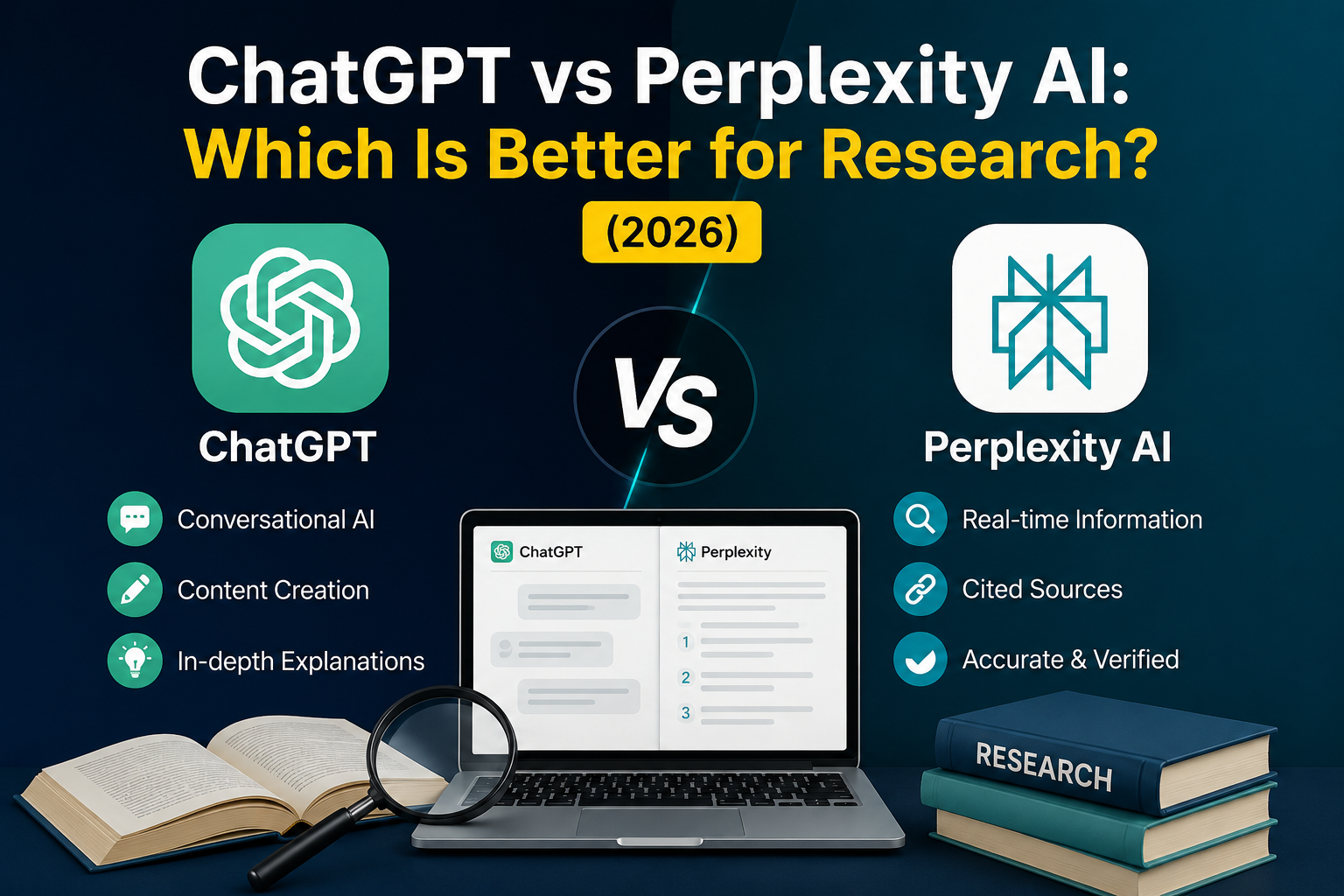

ChatGPT vs Perplexity AI: Which Is Better for Research? (2026) | Finzaro360
📋 Table of Contents
- The Core Difference
- Side-by-Side Comparison
- Key Takeaways
- Research Use Cases
- Accuracy Comparison
- Speed vs Depth
- Which to Use for Content Research?
- Final Verdict
- Author Experience & Methodology
- Frequently Asked Questions
- Conclusion
Both ChatGPT and Perplexity AI are impressive tools — but they were built for very different things. If you’re trying to decide between them for research, this comparison will save you a lot of trial and error.
In this head-to-head breakdown of ChatGPT vs Perplexity AI, I’ll look at research use cases, accuracy, speed, source quality, and which one makes more sense depending on how you work.
✅ Key Takeaways
- Perplexity AI is faster and always cites sources — ideal for quick, current, verifiable research.
- ChatGPT goes deeper — best for analysis, synthesis, and writing based on research findings.
- Perplexity’s Academic focus mode is exceptional for finding peer-reviewed papers and journal articles.
- ChatGPT can hallucinate specific facts — always verify statistics and claims with primary sources.
- The best research workflow uses both: Perplexity for facts and sources, ChatGPT for writing.
- Both tools offer free plans; Perplexity Pro and ChatGPT Plus are both $20/month.
The Core Difference (Before We Get Into Details)
Think of it this way: ChatGPT is a knowledgeable colleague who has read almost everything — but their information stops at a certain date. Perplexity AI is a research assistant that goes online right now and brings you back current sources.
That’s the fundamental difference, and it shapes everything else in this comparison.
Side-by-Side Comparison
| Feature | ChatGPT (GPT-4o) | Perplexity AI |
|---|---|---|
| Real-time web access | Yes (with browsing mode) | Yes (default) |
| Source citations | Limited in browsing mode | Always cites sources |
| Research depth | Very deep (synthesis + analysis) | Good (aggregation focus) |
| Accuracy | High (but can hallucinate) | High (source-grounded) |
| Speed | Fast | Very fast |
| Free plan | Yes | Yes |
| Paid plan | $20/mo | $20/mo |
| Best for | Deep analysis, writing, synthesis | Quick fact-checking, current events |
Research Use Cases: Where Each Tool Shines
ChatGPT: Best for Deep Synthesis and Analysis
If your research task involves taking a large body of information and making sense of it — analyzing trends, comparing arguments, synthesizing multiple perspectives — ChatGPT wins hands down. It can hold long, complex conversations, remember earlier context in the session, and produce sophisticated written analysis.
Ideal research use cases for ChatGPT:
- Academic research and essay writing
- Competitive analysis and market research
- Understanding complex topics (science, law, finance)
- Drafting research reports and white papers
- Brainstorming research angles and interview questions
Perplexity AI: Best for Current, Source-Cited Research
Perplexity was built specifically as a search engine replacement. Every answer includes cited sources, and it pulls information in real time — making it ideal for anything that happened recently. The “Focus” modes (Academic, YouTube, Reddit, etc.) make it even more powerful for targeted research.
Ideal research use cases for Perplexity:
- News and current events research
- Fact-checking and source verification
- Finding recent statistics and data
- Academic paper discovery (with Academic focus mode)
- Quick answer retrieval with immediate source links
Accuracy Comparison
This is where things get nuanced. Both tools are highly accurate — but they fail in different ways:
- ChatGPT can “hallucinate” — confidently stating things that are plausible but incorrect, especially for niche or obscure topics. Always verify statistics and claims from ChatGPT.
- Perplexity is more accurate for current facts because it cites sources. However, it sometimes pulls from low-quality or biased web sources, so the quality of its output depends on the quality of the pages it finds.
Verdict: For time-sensitive, factual research — Perplexity. For conceptual, synthesized research — ChatGPT with verification.
Speed vs Depth
Speed: Perplexity is faster for getting a quick answer with a source link. If you need to check a fact in 30 seconds, it wins.
Depth: ChatGPT goes deeper. You can have a multi-message back-and-forth that builds a comprehensive research picture over time. Perplexity answers are usually self-contained and don’t go as deep in conversation.
For journalists or content creators doing quick research at the start of a project, Perplexity is the starting tool. For deeper dives, switch to ChatGPT.
Which Should You Use for Content Research?
For bloggers and content writers, the best approach is actually to use both:
- Start with Perplexity to gather current facts, statistics, and recent developments with source links
- Switch to ChatGPT to synthesize those facts into structured, nuanced written content
- Verify all specific claims and statistics with the original sources Perplexity cites
See how these tools compare in our full AI Tools Guide 2026 for more platform breakdowns.
Author Experience & Methodology
🔍 How We Evaluated These Tools
We ran parallel research tests using identical research queries across both tools, measuring response accuracy, source quality, speed, and depth of analysis. Research tasks included news research, academic topic exploration, SEO competitive analysis, and fact verification — covering the most common use cases for content creators and researchers in 2026.
Editorial note: Neither OpenAI nor Perplexity AI sponsored or influenced this comparison. Our assessment reflects genuine testing experience.
Frequently Asked Questions
Is Perplexity AI more accurate than ChatGPT?
For current, factual, source-backed information — yes. Perplexity cites its sources and retrieves real-time data, reducing the hallucination risk. However, the quality of the sources matters. ChatGPT can be more accurate for analytical or conceptual questions drawing on its training data.
Can I use Perplexity AI for free?
Yes, Perplexity has a free plan with unlimited basic searches. The Pro plan ($20/month) unlocks more searches using advanced models like GPT-4 and Claude, plus focus modes and image uploads.
Which is better for academic research — ChatGPT or Perplexity?
Perplexity’s Academic focus mode, which searches academic papers and journals directly, is outstanding for academic research. For writing the research paper itself, ChatGPT is better suited.
Does ChatGPT have real-time information in 2026?
Yes, ChatGPT Plus includes a browsing feature that can access current web content. However, Perplexity is faster and more reliable for real-time research because it’s built around web search from the ground up.
Which tool is better for SEO research?
For keyword research and SERP analysis, neither replaces dedicated SEO tools. But for understanding topics, finding angles, and researching competitors’ content, ChatGPT is more versatile. Perplexity helps with finding recent industry stats to cite in your articles.
Final Verdict
For pure research speed and source accuracy: Perplexity AI wins. It retrieves real-time, cited information faster than any other tool available in 2026.
For depth of analysis, synthesis, and turning research into written content: ChatGPT wins. Its conversational depth and contextual memory within a session are unmatched.
Our recommendation: Use Perplexity first to gather facts and source links, then switch to ChatGPT to synthesize, analyze, and write. This two-tool stack outperforms either tool alone for serious content research.
Conclusion
The ChatGPT vs Perplexity AI debate doesn’t have a clear winner — it has a clear answer: use both, strategically. Perplexity for fast, sourced, real-time research. ChatGPT for depth, analysis, and synthesis. Together, they form a research stack that’s faster, more accurate, and more comprehensive than either tool alone.
📚 Related Articles on Finzaro360
- AI Tools Guide 2026 (Pillar)
- AI writing tools comparison guide
- writing SEO blog posts with AI
- common AI content writing mistakes
- can Google detect AI content
Disclaimer: This article is for informational purposes only. Tool prices and features mentioned are based on publicly available information and may change over time. We do not guarantee any specific results or earnings. Always verify details on the official tool websites before making a purchase decision.
Finzaro360.com — Your trusted guide to AI Tools, SEO, Crypto, Free Tools & Online Earning.
AI Tools | SEO Blogging | Online Earning | Crypto | Software Reviews